
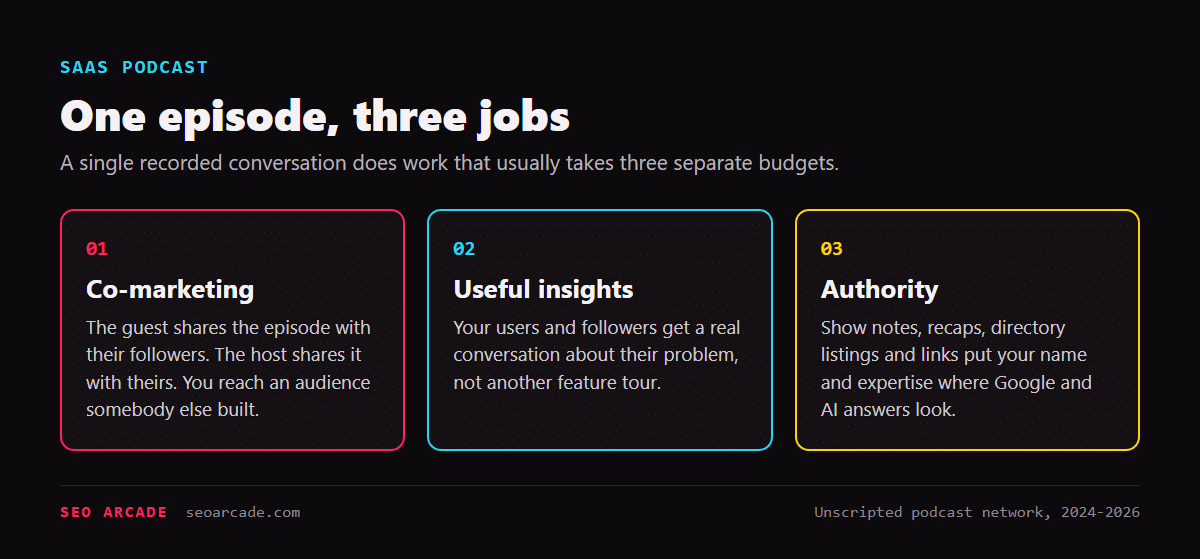
Why would a SaaS company spend an hour on a podcast when it could buy another round of LinkedIn ads? Well, the truth is that a SaaS podcast, whether you host one or guest on other shows, does three jobs an ad can’t. It puts you in front of an audience somebody else already built. It gives your users and followers something useful to listen to. And it builds the kind of authority that Google and AI answers can actually find. Co-marketing, customer education and authority, from one recorded conversation.
We’ve recorded hundreds of interviews across the Unscripted SEO, Unscripted SaaS and Unscripted Small Business shows, and the software founders on those shows keep running into the same wall: the channel that grew their product is getting crowded. Here’s what they said on tape, and how you turn one episode into all three jobs.
Why SaaS founders are looking past organic search
Christopher Gimmer has run Snappa since 2015 and now builds GoodMetrics, a cookieless alternative to Google Analytics. When I asked what problem he was still working through, he went straight to distribution:
“organic was always a channel that was kind of tried and true to bootstrap software founders.”
— Christopher Gimmer, Snappa and GoodMetrics, on the Unscripted SEO podcast
His next line is the part you probably already feel: it’s “definitely getting more challenging.” AI Overviews answer the question before the click, and paid listings push even a number-one organic result further down the page.
Tom Girgash, who is building Taproot, said the same thing from the other end of the founder timeline, a few weeks after launch:
“distribution and marketing is going to be, that’s going to be the most important aspect to building a business, software business, name any business really.”
— Tom Girgash, Taproot, on Unscripted SaaS
Nick Eubanks, global CMO at Digistore24, put it more sharply — “distribution is the only remaining moat when execution becomes infinite” — and then argued with himself: “Cause I think expertise does still allow for some layer of defensibility, at least for now.” (listen to Nick’s episode). Keep both halves in mind. A podcast is one of the few channels that gets you distribution and puts your expertise on the record in the same hour.
Every guest brings an audience: how podcast co-marketing works
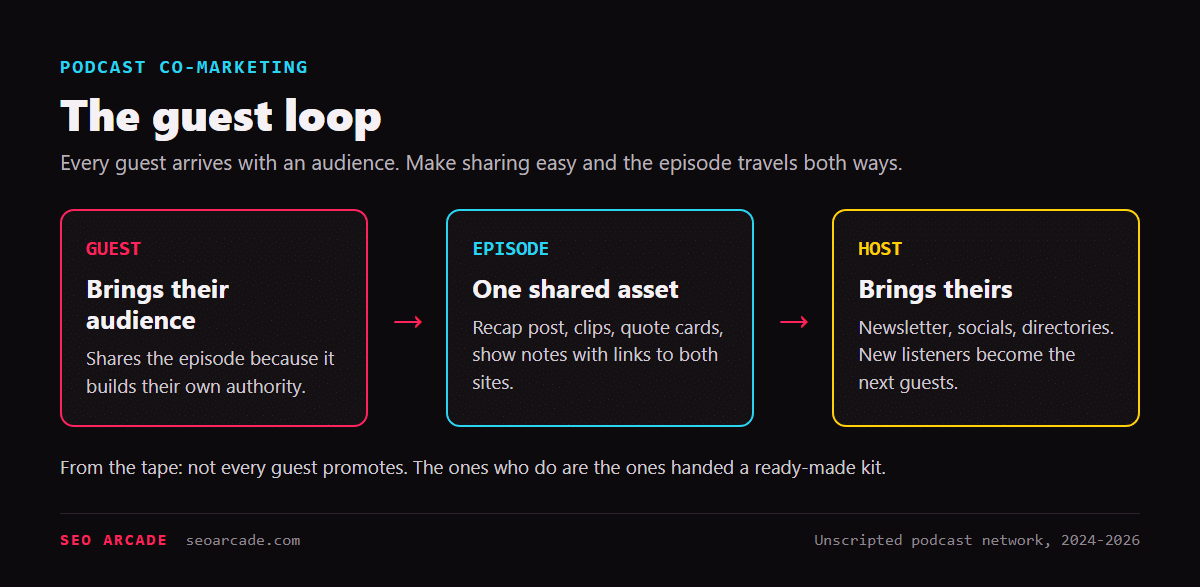
Co-marketing usually means two companies trading something: a joint webinar, a newsletter swap, a shared ebook. A podcast episode is a co-marketing asset with the trade built in. The host brings an audience, the guest brings an audience, and you both have a reason to share the same link.
Cahill Camden founded Novacast AI (formerly Echo Jockey), a tool that books founders onto podcasts. He explained why hosts invite guests in the first place:
“If you want to grow your show, the fastest way to do it is to have guests. That’s the fastest way. Why? Well, because the guest is going to promote your show as well because they’re on the show.”
— Cahill Camden, Novacast AI, on the Unscripted SEO podcast
And why the guest goes along with it: “the guest wants to build their brand authority and their influence as well. So it’s in their best interest for them to promote their expertise from your podcast.”
When you’re the guest, you borrow the host’s audience
Pick the show by who listens, not by download count. A show for 2,000 RevOps leads beats a general business show with ten times the audience if RevOps is who buys your product. Our podcast guesting strategy from 8 guests who do it covers how to find and pitch those shows.
When you’re the host, your guest list is the marketing plan
Your guests carry each episode to their followers, so invite people whose audience overlaps yours but who don’t compete with you. Integration partners, adjacent tools and your own power users all qualify. Podcast lead generation starts with who you invite goes deeper on choosing them.
Make sharing easy, because not every guest will
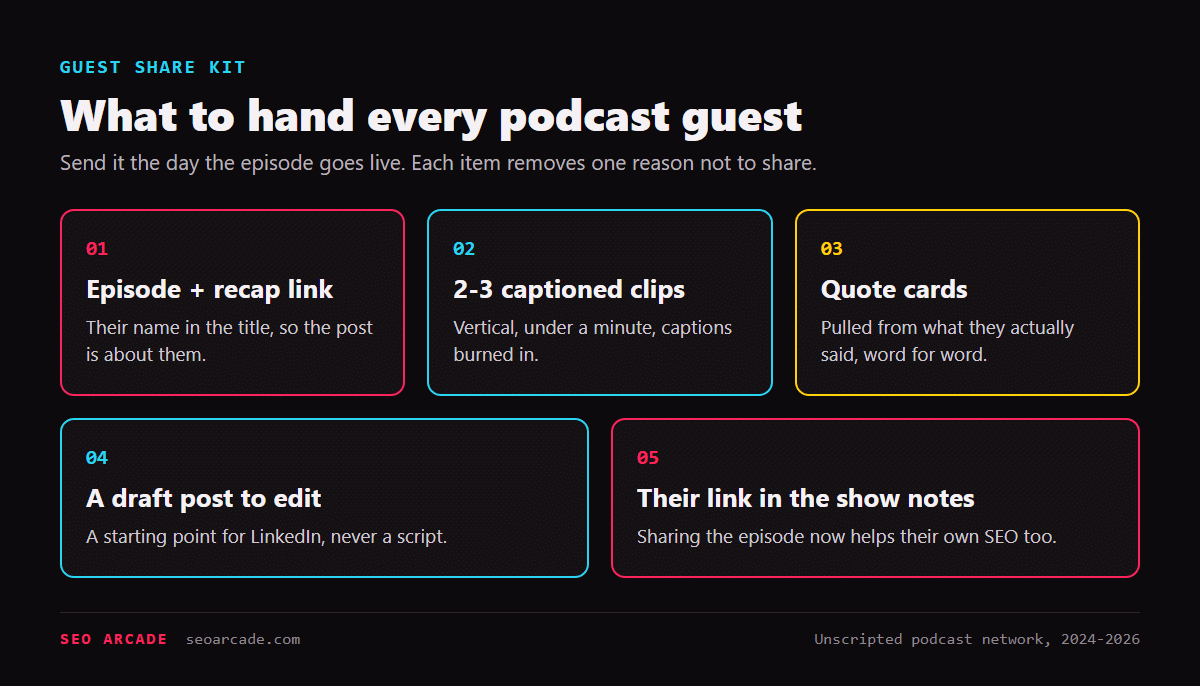
Cahill was honest about the catch: “not every guest that you have is going to actually promote.” The ones who do are usually the ones you made it easy for. Send every guest a kit the day the episode goes live:
- the episode link and a written recap with their name in the title
- two or three short clips with captions already burned in
- a quote card or two, pulled word for word from what they said
- a draft LinkedIn post they can edit, never a script
- a link to their own site in the show notes, so sharing the episode also helps their SEO
Your users want the conversation, not another feature tour
The second job is the one most SaaS teams skip. Your blog is probably full of release notes and “how to use feature X.” A podcast gives your users and followers something they’ll actually listen to: other operators explaining how they solve the problem your product sits next to.
Greg Digneo saw this at Time Doctor before he started Content Guppy. Outbound sales got easier because prospects already knew who Time Doctor was. Some of them knew it
“because they had heard us on a podcast. So all those like kind of SEO plays that we did really sort of helped out that sales as well.”
— Greg Digneo, Content Guppy, on the Unscripted SEO podcast
He also told me where that attention should end up: “build a hundred thousand person newsletter, a 10,000 listenership podcast, build a 10,000 subscriber, a hundred thousand subscriber YouTube channel with that traffic. Do those things that you can then own that distribution.” Search traffic is rented. A subscriber is yours.
Episodes that are useful to a SaaS audience tend to look like this:
- a customer walking through the workflow they built around your tool
- an adjacent expert answering the questions your support team hears every week
- a founder-to-founder conversation about pricing, churn or hiring
- a teardown of the problem your category solves, with no pitch until the last minute
Authority that search engines and AI answers can find
The third job is authority. When you guest on a show, your name, your company and your topics land on a show-notes page, a recap article and dozens of podcast directories, usually with a link back to your site. That’s a brand mention plus a relevant link from a page about your topic, which is the kind of link that still earns citations and rankings.
AI answers raise the stakes. Malith Gamage, co-founder of the client reporting SaaS Zapdigits, tested what AI tools say about his brand and found the answers wander: “if you ask the same question five times you get five different answers” (Malith on Unscripted SaaS). Those tools pull from wherever your name shows up. The more places a clear, consistent description of you exists, the better your odds of being the answer, and a podcast appearance is one of the easiest of those places to earn.
A transcript is also your expertise on the record. Cahill again: “I do think podcasts is one of those forms of content creation that generates a huge amount of trust. People get to understand who you are.” An AI tool can rewrite your feature page. It can’t fake your founder explaining why you built the product.
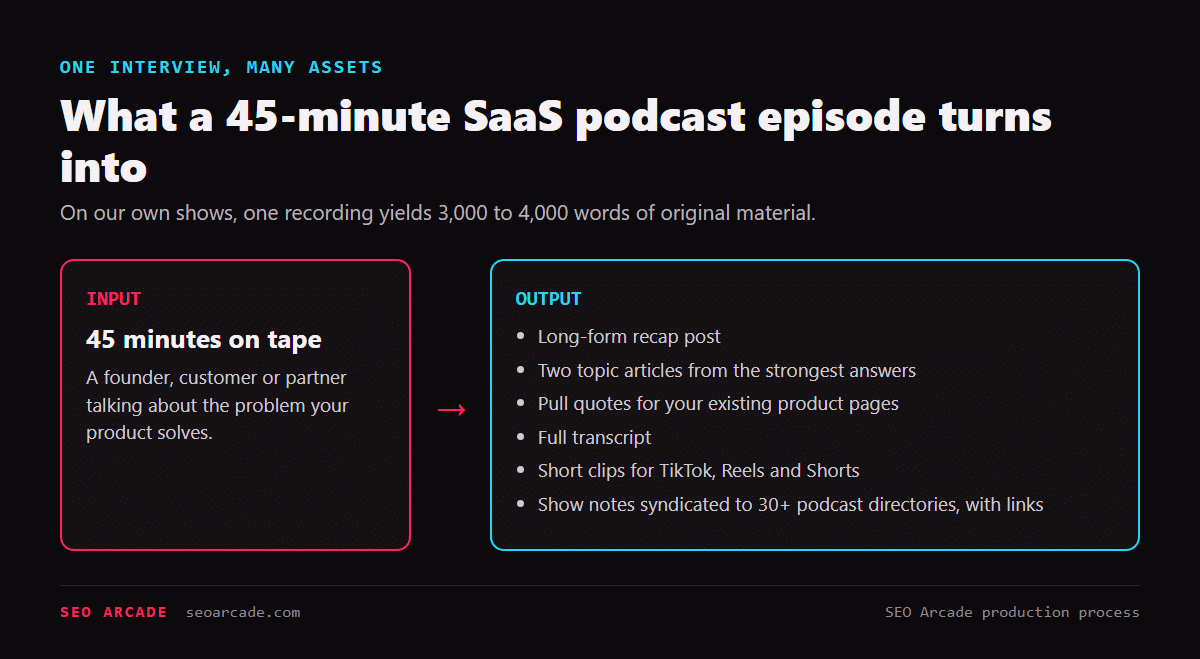
On our own shows, a 45-minute recording yields 3,000 to 4,000 words of original material. You can turn that into a long-form recap, two topic articles, pull quotes for your existing pages, a transcript and a stack of short clips. That’s the podcast-to-content repurposing play in practice.
What a podcast won’t fix for a SaaS company
Here’s where I’d push back on the podcast hype, because you’ll hear plenty of it:
- It won’t fix positioning. If you can’t say who the product is for, an hour of talking makes that obvious faster.
- It’s slow. One episode rarely shows up as a signup spike. The return builds over 10 or 20 episodes.
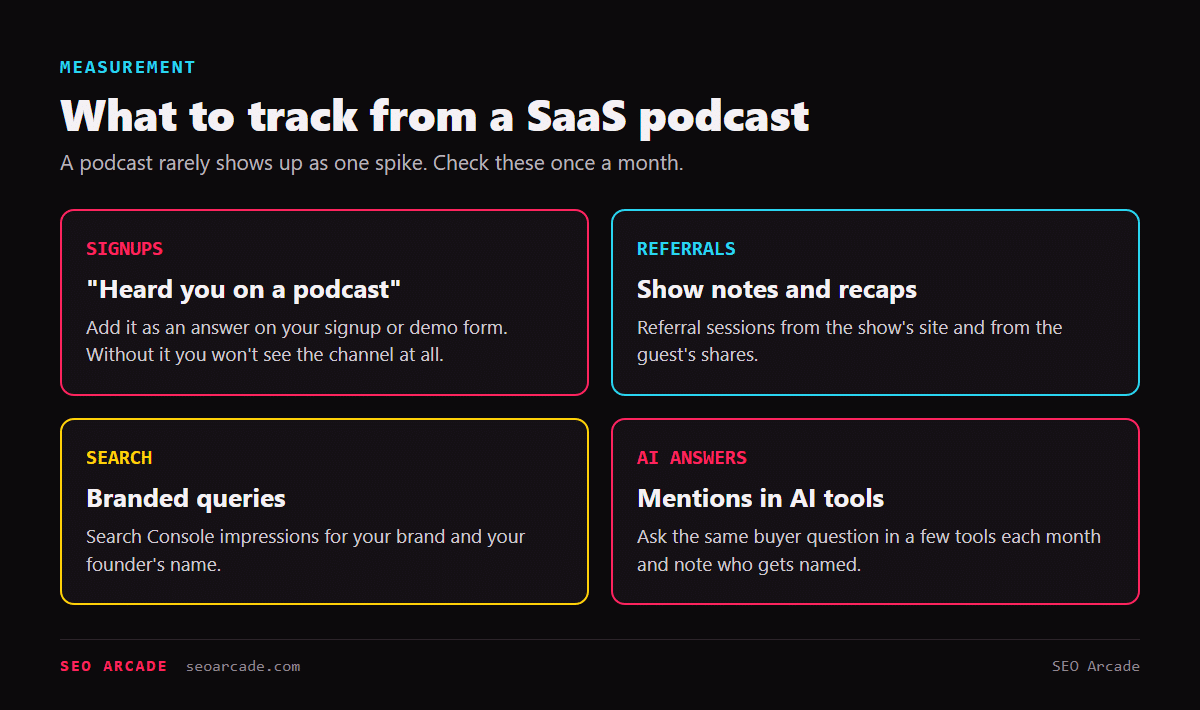
- Attribution is messy. Add “heard you on a podcast” as an option on your signup or demo form, or you’ll never see the channel at all.
- Not every guest shares and not every host promotes. Plan the program so it still works if half of them don’t.
If you’re still deciding whether the channel is worth it at all, Is starting a podcast worth it for a B2B company? walks through that question on its own.
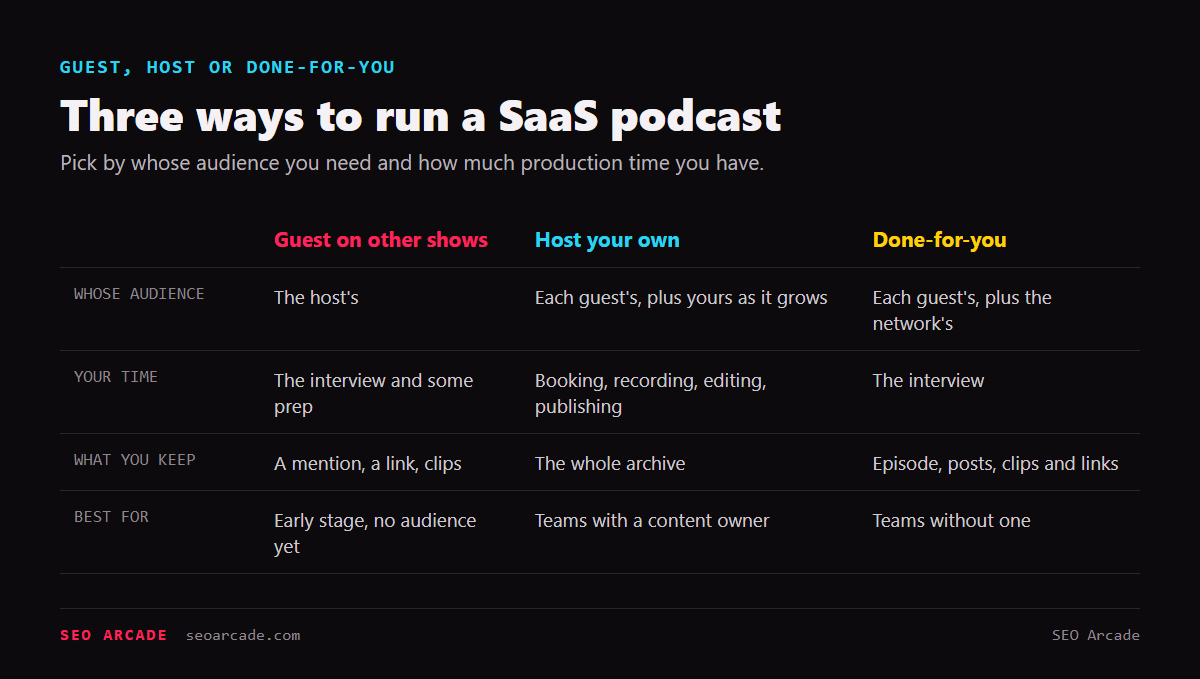
SaaS podcast guesting vs hosting vs done-for-you
You have three ways in, and the right one depends on whose audience you need and how much production time you have.
Which should you pick?
You’re pre-launch or still small: guest. Borrow other people’s audiences before you try to build one.
You have a content marketer and customers worth interviewing: host, and fill the calendar with customers and integration partners.
You want the output without running a production team: hand it off. Our Podcasting As An SEO Service books, records, edits and publishes the interview, then writes the posts, cuts the clips and links it all back to you.
How to run a SaaS podcast as a co-marketing program
Treat it as a monthly program, not a one-off appearance. Four steps, repeated:
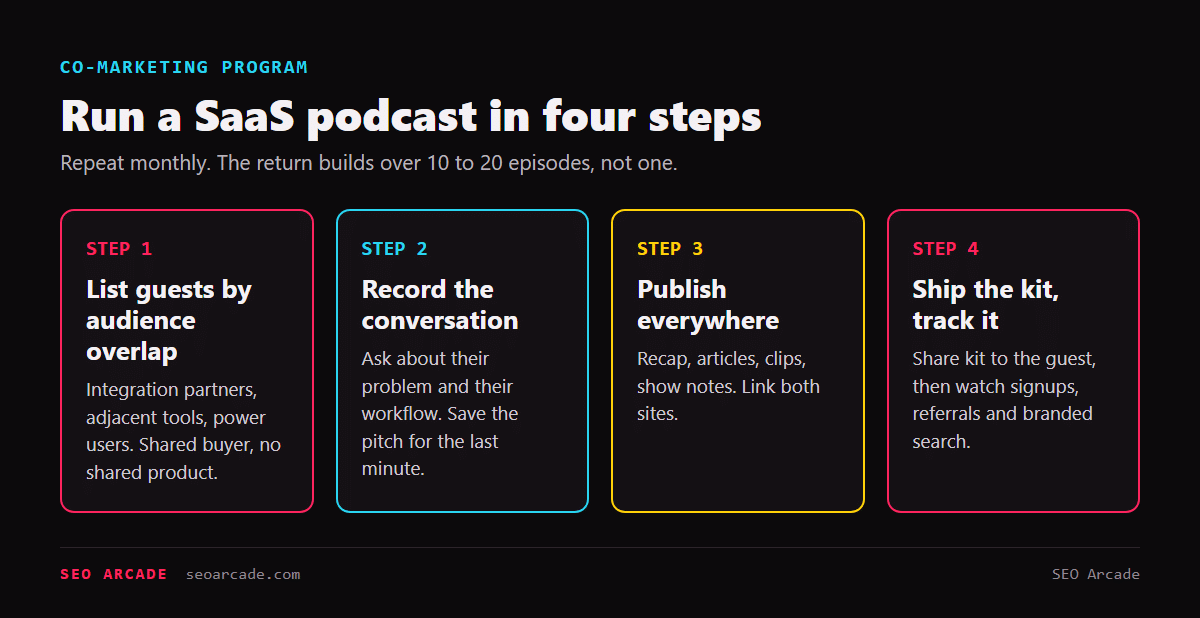
1. List guests by audience overlap
Write down every company that sells to your buyer without competing with you. Integration partners go first, because a shared customer gives both of you a reason to promote the episode.
2. Record the conversation, save the pitch
Ask about the guest’s problem and how they work. Your product can come up where it fits, and once in the last minute. Listeners can tell when an episode is an ad.
3. Publish everywhere the episode can live
Recap post, topic articles, clips and show notes, with links to both sites. The 8-step podcast content process is the checklist we run on our own shows.
4. Ship the kit, then track what comes back
Send the share kit, then check these once a month:
SaaS podcast co-marketing starts with the guest list
If you take one piece of advice from this, take this one: choose every show and every guest by audience overlap, then make sharing so easy that saying no takes more effort than saying yes. That’s the whole co-marketing engine. The useful insights and the authority follow from having the right people in the conversation. If you want the playbook we run on our own shows, grab the free Podcasting for Business Toolkit.