
White label content writing is content a third party writes that your agency delivers under its own brand. For most agencies that means a pool of offshore or freelance generalists, a keyword, an outline and a word count. You’ve probably been told that’s the only way the margins work. Well, the truth is that the margin was never the writer’s rate. It’s what the page can earn once it’s live, and a page written by someone who has never done the work can’t earn much anymore.
There’s a better source for white label content, and it’s sitting in an hour of conversation: an expert interview, recorded as a podcast episode, then written up under your client’s brand. You get content from the person who actually knows the subject, a guest with a reason to link to it, and named mentions on pages your client doesn’t own. Here’s how that model works, what the agency owners on Unscripted SEO said about it on tape, and where it falls short.

What white label content writing usually buys you
Search the way your agency would search for a content partner and look at what comes back. We ran the cluster on “content writing for agencies” and “white label content writing” (page-level SERP overlap, DataForSEO, US desktop, November 13, 2026). Every top term is about buying writers: white label content writing services, content writing firm, content writer companies. The market sells hours of writing. Nobody in that cluster is selling expertise.

That’s the gap. A generalist writer working from a brief does desk research, which means reading the ten pages that already rank and writing an eleventh. The writer isn’t lazy. The writer just has no other input. Mike Montague, who runs the agency Avenue9, described what AI does to that same job on his Unscripted SEO episode:
“I can instantly get a C plus grade in any subject.”
Mike Montague, Avenue9, on Unscripted SEO
A C-plus is exactly what a generalist brief produces too. Once a model can match it in a minute, you’re paying a person for something your client can get for free.
Why the offshore writer model stops paying off for agencies
Three things changed at once, and each one lands on the generalist brief.
Google asks who wrote it and what they actually know
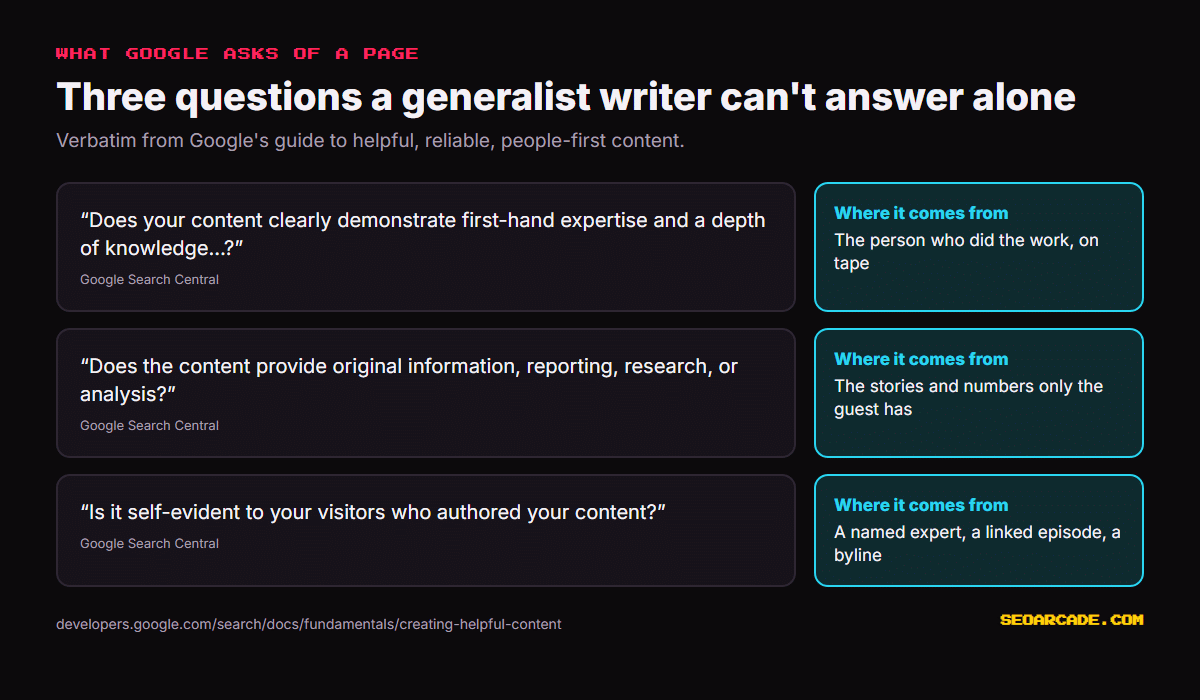
Google’s own guidance on helpful, reliable, people-first content asks: “Does your content clearly demonstrate first-hand expertise and a depth of knowledge (for example, expertise that comes from having actually used a product or service, or visiting a place)?” It also asks: “Does the content provide original information, reporting, research, or analysis?” And under the “Who” section: “Is it self-evident to your visitors who authored your content?”
Read those three questions with an offshore brief in your hand. The writer can’t supply first-hand expertise they don’t have, and the original information isn’t in the top ten results they were told to read. The byline is usually a name your client has never met.
AI already writes the version nobody needs to cite
Montague has a blunt way of explaining this to clients who want to publish at volume:
“Why would it cite your version if it can already write one that doesn’t need to be cited? It already has this domain knowledge. So what could we do that could add to AI, tell it something that it doesn’t know?”
Mike Montague, Avenue9, on Unscripted SEO
Robert Spinrad, Associate SEO Director at the agency SEO Interactive, put the same problem from the other side on his episode: “Anyone can be an expert nowadays.” When anyone can publish the generic version, the only content worth paying for is the version with something in it the model hasn’t seen.
Scaled content is a named spam policy
Google’s spam policies define scaled content abuse as “when many pages are generated for the primary purpose of manipulating search rankings and not helping users,” and add that it’s “typically focused on creating large amounts of unoriginal content that provides little to no value to users, no matter how it’s created.” Note the last four words. The policy doesn’t care whether a person in another time zone or a model wrote the page. It cares whether the page is unoriginal.
How podcast-sourced content replaces the writer brief
The fix isn’t a better writer. It’s a better input. Instead of handing a writer a keyword, you hand them a transcript of the person who does the work talking for 30 to 45 minutes. Montague does this at his own company:
“…interview the founder, the top salesperson, best client or whatever, and then turn that into the marketing material so that I already have their context and expertise built in”
Mike Montague, Avenue9, on Unscripted SEO
Erika Braeger, Director of Strategy at the B2B SaaS content agency Ten Speed, described the same principle inside a content brief on her first episode: “SME is built into our briefs.” And whether a human or an AI-assisted process writes the draft, she said, “we still need that expertise review, expert review layer.”
Joshua Altman, Managing Director of Beltway Media, explained why the split works on his episode: “we’re the expert at communicating your expertise. You’re the expert in home remodeling.” That’s the whole division of labor. Your client brings the knowledge, your agency brings the format, the distribution and the SEO. Nobody has to fake anything.
The podcast part matters more than it looks. You could just interview the client on a call. Recording it as a real episode means the conversation also exists as a published page, a video and an audio file, each with the expert’s name on it. That’s the difference between an interview-led content process and a phone call someone took notes on. If you want the full inventory, here’s how much content one podcast episode actually holds.

Three jobs one expert interview does for white label content
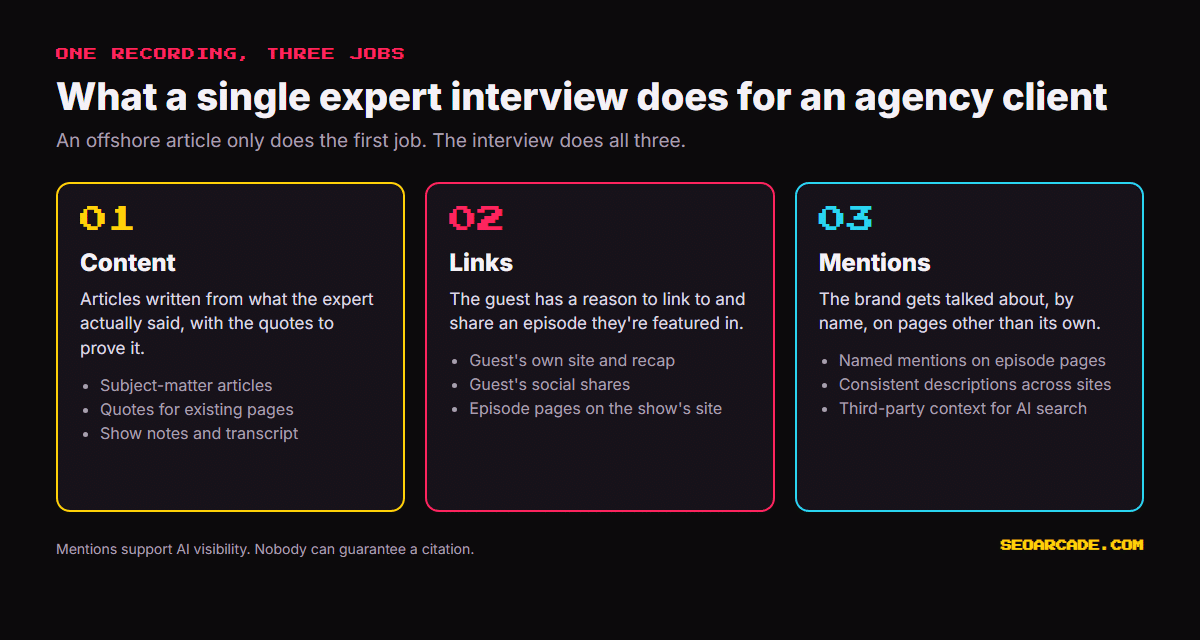
An offshore article does one job: it fills a slot in the content calendar. A recorded expert interview does three, and the second and third are the ones your clients actually struggle to buy.
Content from the person who actually knows
The articles come straight from the transcript, so they carry the stories, numbers and opinions only that guest has. That’s what Google’s guidance calls original information, and it’s what Montague means by telling AI “something that it doesn’t know.” Quote the expert word for word and link the episode, and the “who wrote this” question answers itself.
Links that come with the guest
A writer you pay per word has no reason to link to anything. A guest featured on a show does. They share the episode, they link it from their own site, and the show’s recap post links back to the client’s content. Bradley Benner, who runs the white-label link building service Semantic Links, said on his episode that he built his own service after years on the buying side: “I always used to use outsource white label fulfillment providers for my own agency.” He wanted better, more effective links for his clients. A link from a show in your client’s niche, earned by an actual conversation, is about as relevant as a link gets. We cover the mechanics in the podcast guest appearance tactic.
Spinrad’s agency holds the line on the quality of what goes out under a client’s name. When his PR team lands an opportunity for a mention or a link, he said, “you give a quote from the owner, no AI response accepted.”
Mentions the AI answer engines can find
This is the part to be careful about, because nobody can promise a client an AI citation. What the practitioners describe is a pattern, not a guarantee. Benner on what moves AI visibility for his local clients:
“press releases, branded assets, brand mentions on blog posts, things like that, those all can act as unstructured citations. And that’s what influences LLM or AI search visibility right now, more than anything.”
Bradley Benner, Semantic Mastery and Semantic Links, on Unscripted SEO
Braeger made the consistency point on her second episode: “LLMs are looking for that confirmation that you’re spoken about in the same way outside of your site…” An episode page, a guest recap and a transcript all describe your client in the client’s own words, on sites the client doesn’t control. That’s the raw material those answer engines read. Treat it as one input you can actually produce, then measure it rather than promising it.
How to run expert-sourced white label content for your clients
Here’s the workflow, with the one check that gates each step. You can run it in-house or hand the production to a white-label podcast service and keep the client relationship.

- Pick the expert. The client’s founder, their top salesperson, or a practitioner guest in their niche. Check that they do the work, not just sell it.
- Map questions to keywords. Turn your target keywords into questions only this person can answer. If a question doesn’t need a story or a number to answer, cut it.
- Record it as a real episode. 30 to 45 minutes, video on, published on a show. Send the guest the topic list first so nobody gets ambushed.
- Keep the raw transcript. Quote from the raw file, never from a cleaned-up summary. Cleaned transcripts and “best quotes” lists drift from what people said. Trim quotes; never rewrite them.
- Write and attribute. Publish the articles under the client’s brand with the expert named, the quotes verbatim and the episode linked. Have the expert check facts before it ships.
- Publish and hand it back. Send the guest the episode and the article. That’s when the shares and the links happen, so don’t skip it.
If you want to see this end to end, our 8-step podcast content process is the same idea written up as a production checklist.
What podcast-sourced content doesn’t fix
Tell your clients about the limits before you sell this, because they’ll find them anyway:
- It needs a person who will talk. Some clients have no founder who wants to be on a mic. A practitioner guest from their niche can stand in, but the content is then that guest’s expertise, not the client’s.
- It’s slower per page. One interview turns into a handful of strong pieces, not fifty. If the contract is priced on article count, you’ll need to reprice it around what each piece earns.
- Transcripts are messy. Speech-to-text gets words wrong. You can trim around a bad word; you can’t fix it and still call it a quote.
- It doesn’t guarantee AI visibility. Mentions and links are inputs. Track what happens rather than promising a citation.
- It doesn’t replace link building. Guest links are a bonus on top of the content. Clients who need volume still need a white-label link building program or a podcast-powered link building service.
Offshore writers vs expert interviews: what changes
| Offshore or generalist writer | Expert podcast interview | |
|---|---|---|
| Where the knowledge comes from | The pages that already rank | The person who does the work |
| Quotes | Borrowed from other articles, if any | Verbatim, named, linked to the episode |
| Who the reader sees as the author | Often a name the client never met | The client’s own expert |
| Links | None built in | Guest shares, guest links, recap post |
| Off-site mentions | None | Episode page, recap, transcript |
| Volume per month | High | Lower, a handful of pieces per interview |
| What the client has to give | A keyword list | About an hour of an expert’s time |
If your clients are already asking whether AI makes their content budget pointless, Jon Gillham’s words vs data test for agencies is a useful companion read. For everything else on the format, the podcasting as content and SEO strategy resource guide collects it in one place.
White label content writing for agencies: where to start
Pick one client whose content isn’t moving and whose founder likes to talk. Book one interview. Write two articles from the transcript, quote the founder word for word, link the episode, and send it all back to them. Then compare what that one interview produced against the last month of briefs you sent offshore.
If I had to leave you with one piece of advice, it’s this: stop buying writing and start buying the expert’s knowledge. The writing was always the easy part. When you’d rather not build the studio side yourself, our white-label podcast service runs the recording and the content under your agency’s brand.