
Every small business owner gets the same advice: post more content. Start a blog, film some Reels, write on LinkedIn every day, become a thought leader. You’re probably wondering when you’re supposed to do that between payroll and the customer who just called about an invoice. Well, the truth is that the benefits of podcasting for small business come down to one trade. You talk for 30 to 60 minutes about the work you already know inside out, and that one conversation becomes thought leadership, content in your own voice, backlinks, social posts and leads you can actually follow up on.
I’ve sat in both chairs. I host the Unscripted podcast network, which has published more than 650 episodes across its shows, including Unscripted Small Business, and in one year I recorded 142 interviews. Below you’ll find what those benefits look like, in the words of small business guests from the show (every quote checked against the recording), plus how to start without becoming a full-time producer.
What are the benefits of podcasting for small business?
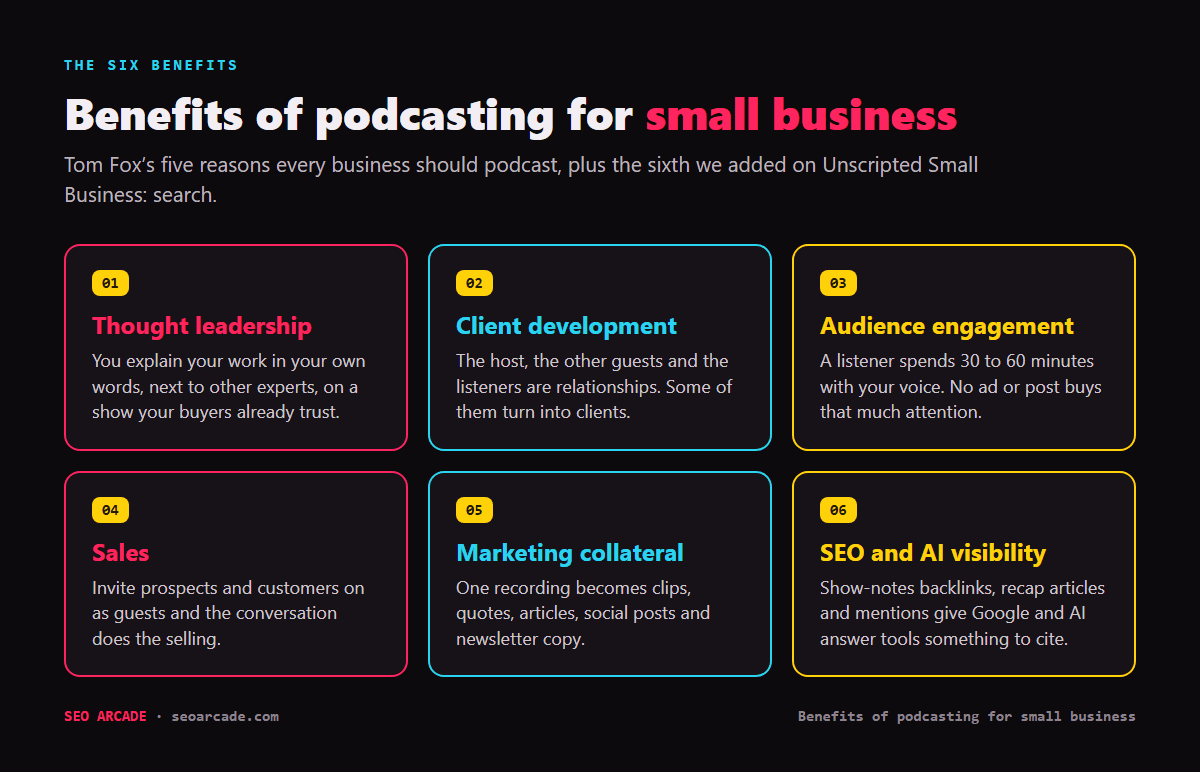
There are six: thought leadership, client development, audience engagement, sales, marketing collateral and search. The first five come from a guest who has built two podcast networks.
Tom Fox is a lawyer who started blogging for his solo compliance practice in 2010, moved into podcasting, and went on to found the Compliance Podcast Network. When I asked for his elevator pitch, he gave it in one breath:
There are five reasons for every business to have a podcast, thought leadership, client development, audience engagement, sales, and social media marketing or marketing, collateral creation. And you can get all five of those with a podcast
Tom Fox, founder of the Compliance Podcast Network, on Unscripted Small Business
I added a sixth on the spot: search. Here’s what each one means when you run a small business:
- Thought leadership. You explain how you work, in your own words, on a show your buyers already trust.
- Client development. Hosts, fellow guests and listeners are relationships, and some of them become clients.
- Audience engagement. A listener gives you half an hour of attention. No ad buys that.
- Sales. Tom’s favorite example is a woman running a software company who interviewed one of her own clients. Mid-episode he wished the tool did one more thing, and she told him it was rolling out next week. He got upsold in the middle of an interview.
- Marketing collateral. One recording becomes clips, quote cards, articles, social posts and a newsletter section.
- SEO and AI visibility. Show-notes backlinks, recap articles and mentions give Google and AI answer tools something to cite.
Tom also explained why audio works when so much else gets ignored. People at conferences told him he was in their head every morning, because they listened to his daily news show on the way to work. His take on the science is that hearing a voice builds trust in a way other formats don’t: “if you hear someone’s voice, it gives you greater credibility and they will trust you more.” That’s the whole thought leadership game for a small business. You don’t need to be famous. You need the people who might hire you to feel like they already know you.
Why being a podcast guest is the fastest way to start
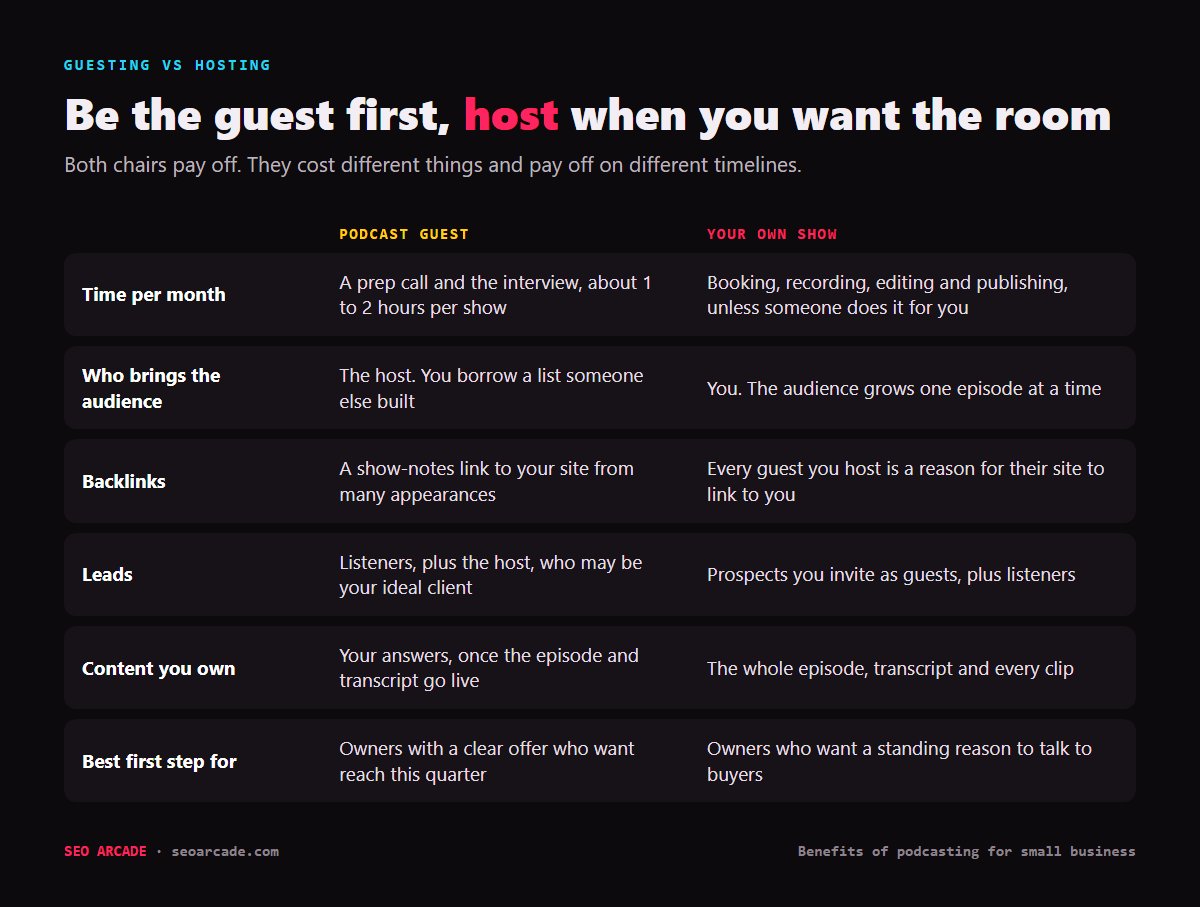
You don’t need your own show to get most of these benefits. Victoria Bennion has run The Best Podcast Guest Booking Agency since 2019, and when I asked why anyone should want to be on podcasts badly enough to hire her, she didn’t start with the audience.
The host might be your next client
it’s a great networking opportunity, and sometimes our clients find that the host is their ideal client and they end up working together, or if not, it’s they might collaborate in some way, or the host introduces them to other podcasts looking for guests.
Victoria Bennion, founder of The Best Podcast Guest Booking Agency, on Unscripted Small Business
Think about what an interview actually is: 30 minutes of a business owner’s undivided attention, spent asking about your work. Most sales calls don’t get that far.
A niche show beats a famous one
People who are new to guesting tend to aim for the biggest show they can name. Victoria’s clients usually get more from the small ones:
where podcasts can be so niche, you don’t need to be on Oprah or Joe Rogan or whatever to see benefits from a podcast interview strategy. You can really really hone in your marketing and talk to the people that need to hear from you.
Victoria Bennion, on Unscripted Small Business
That’s good news if you sell to one town, one trade or one kind of customer. A show with 400 listeners who all match your buyer is worth more to you than a show with 400,000 who don’t.
The show notes hand you a backlink
It can also be great for your SEO because a lot of hosts will give you a backlink to your website in the show notes.
Victoria Bennion, on Unscripted Small Business
This is the part I care about most as an SEO. A link from an episode page is an editorial link, earned in a conversation, on a page about you. Stack a dozen of those and you have a link profile most local competitors can’t match. We wrote up the mechanics in the podcast guest appearance tactic, and the pitching side in our podcast guesting strategy guide.
One conversation becomes a month of content in your own voice
Here’s the problem every small business runs into with content — nobody else knows your business well enough to write it, and you don’t have time to write it yourself. Jorge Chavez, president and co-founder of Topaz Sales Consulting, hit exactly that wall when his team hired a marketing firm. The challenge, he said, “was they don’t know our business to the degree we do.” His fix:
Regular conversations, have those sales insight into the sales conversations, and then try to create content from first person narrative to the best of your ability.
Jorge Chavez, Topaz Sales Consulting, on Unscripted Small Business
A podcast interview is that first-person narrative, already recorded. You answer questions out loud the way you answer customers, and the transcript keeps your phrasing, your stories and your opinions. Nobody has to guess what you’d say. That matters more every month, because the alternative most owners reach for is AI-written content that sounds like everybody else. Richard Gearhart, the patent attorney behind Gearhart Law, uses AI all over his firm but draws the line at his own writing:
I personally don’t use AI to write emails because I like people hearing me … I don’t want to lose my voice.
Richard Gearhart, Gearhart Law, on Unscripted Small Business
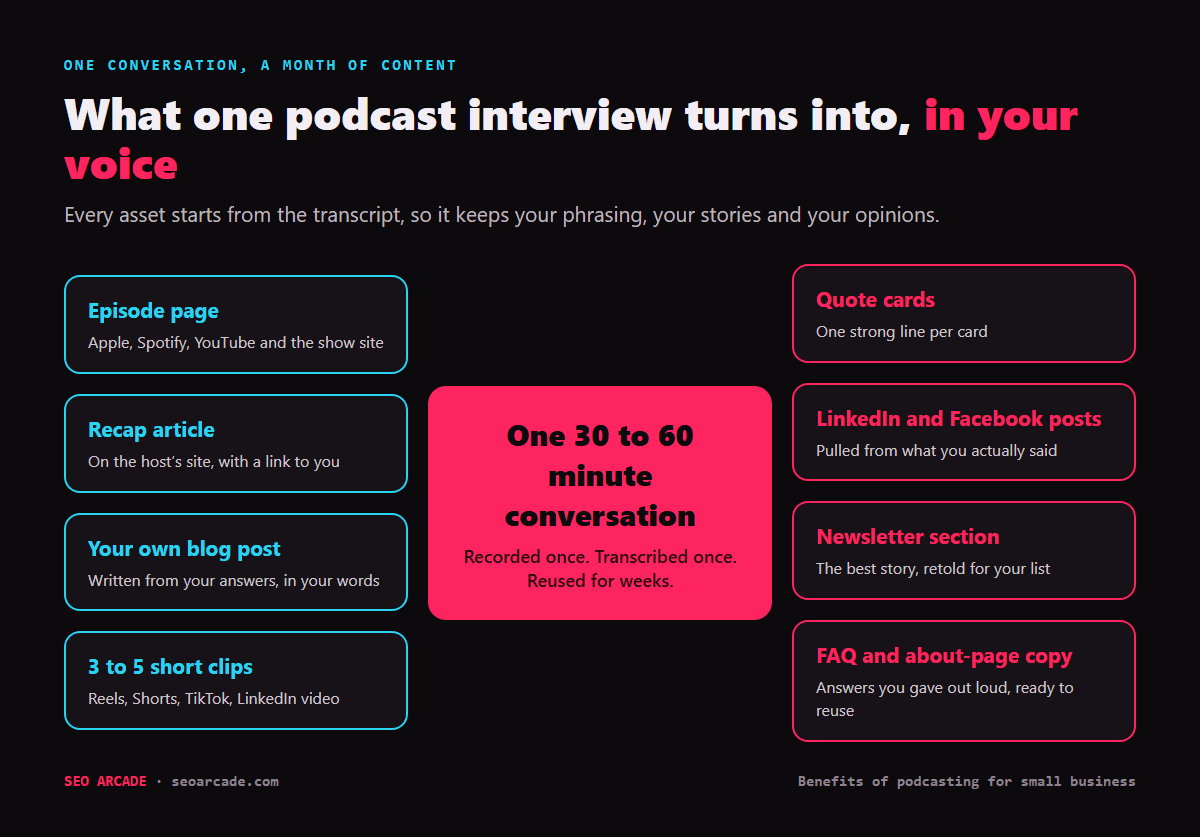
Here’s what a single interview actually turns into when someone does the work afterward:
- The episode itself, on Apple, Spotify, YouTube and the show’s site
- A recap article on the host’s site, linking to you
- A blog post on your own site, written from your answers
- Three to five short video clips for Reels, Shorts, TikTok and LinkedIn
- Quote cards and a week or two of social posts
- A newsletter section and FAQ answers you can reuse on your about and service pages
Tom Fox’s point is that none of this replaces what you already do:
But it’s the collateral that you create that then you can use for other types of media. And it doesn’t take away from anything that you’re doing. It just supplements.
Tom Fox, on Unscripted Small Business
If you want the step-by-step version, the one episode into twelve link assets SOP is the exact checklist we run, and the podcast-to-content repurposing tactic covers the why.
How podcasting fuels social media and fills your marketing pipeline
Most marketing channels feed one stage of your pipeline. Ads bring strangers. A newsletter warms up people who already know you. Sales calls close. A podcast interview actually touches every stage from the same recording, which is why it’s such a good fit for an owner who can’t run five separate channels.
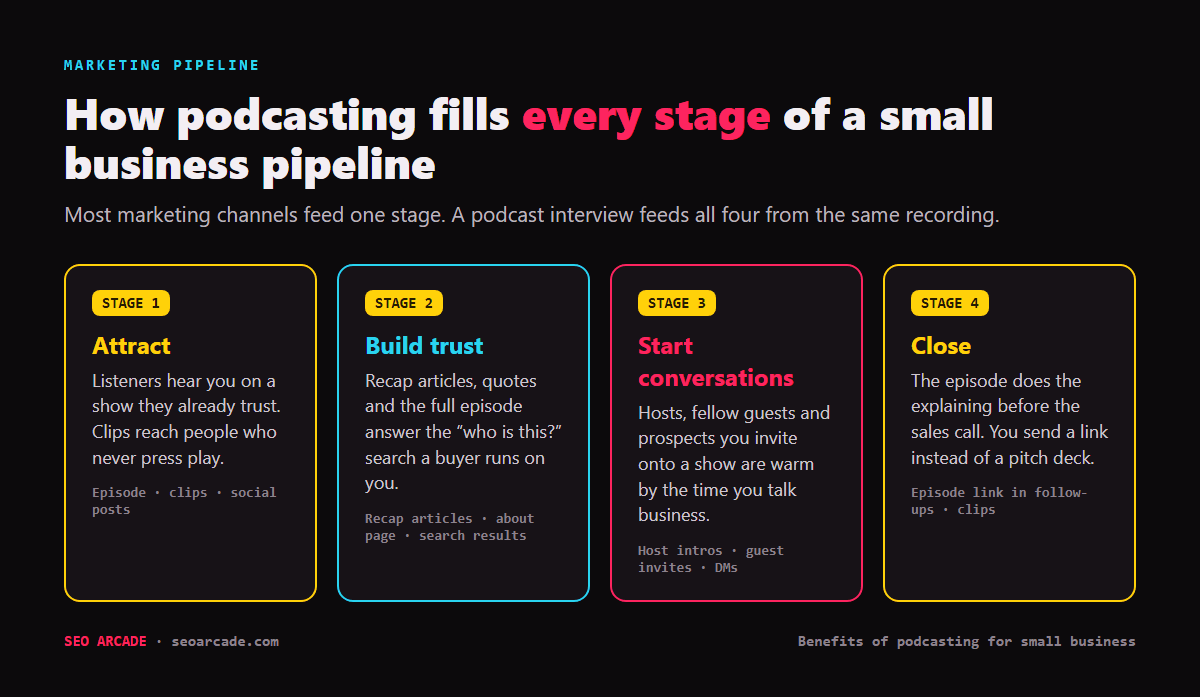
Social media stops being a blank page. The hardest part of posting is deciding what to say. After an interview, you already said it. Clip the best two minutes, put a quote on a card, turn one story into a LinkedIn post, and you’ve got weeks of posts that sound like you because they are you.
Prospects say yes to an interview when they won’t say yes to a call. If you host, even occasionally, Tom Fox has the best line I’ve heard on it. Email a prospect asking for a sales call and they may or may not answer. Invite them on your show instead:
I’d like you to come on my podcast and talk about yourself. You get a hundred percent response. Everybody wants to come on and talk about themselves.
Tom Fox, on Unscripted Small Business
That’s the idea behind podcast lead generation that starts with who you invite. The guest chair is the warmest seat in your pipeline.
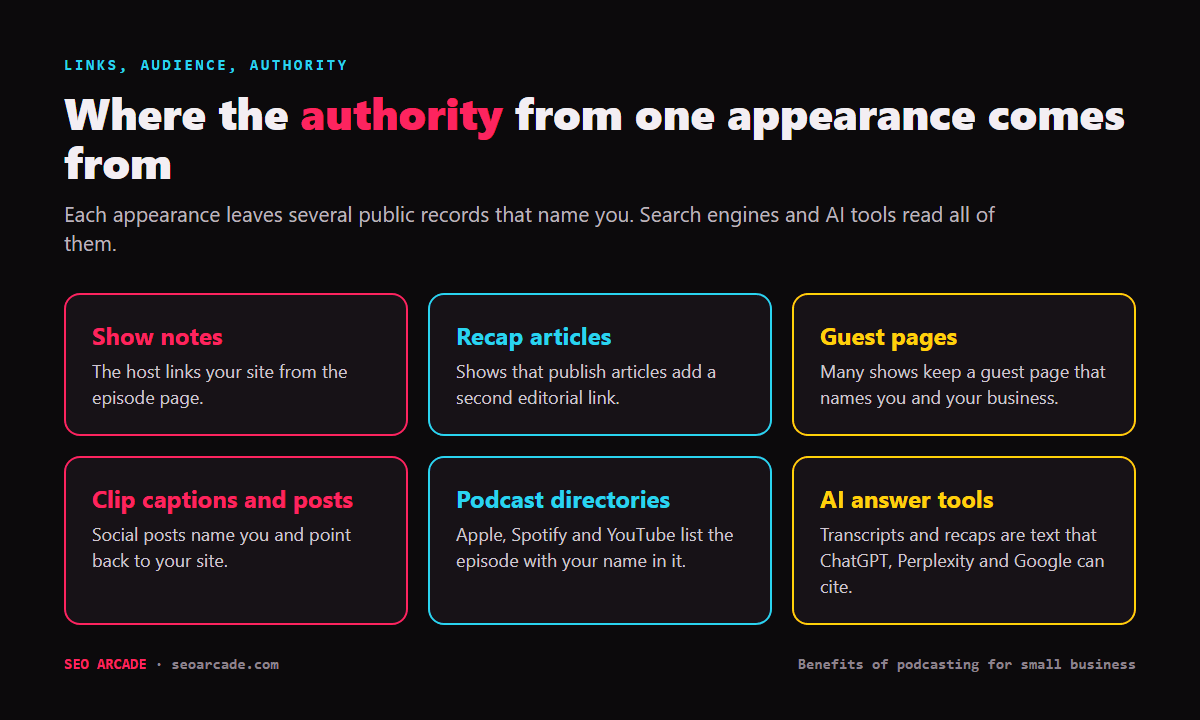
Links, audience and authority stack up. Every appearance leaves public records that name you: the episode page, the recap, the guest page, the clips. Search engines read those records, and so do AI answer tools. When someone asks ChatGPT or Perplexity who to hire for what you do, transcripts and recaps are text it can find and cite. The longer version is in from guest seat to authority and does podcasting actually help SEO?
How to start podcasting as a small business owner
Start small, start as a guest, and plan the reuse before you record. Here are the five steps in order.
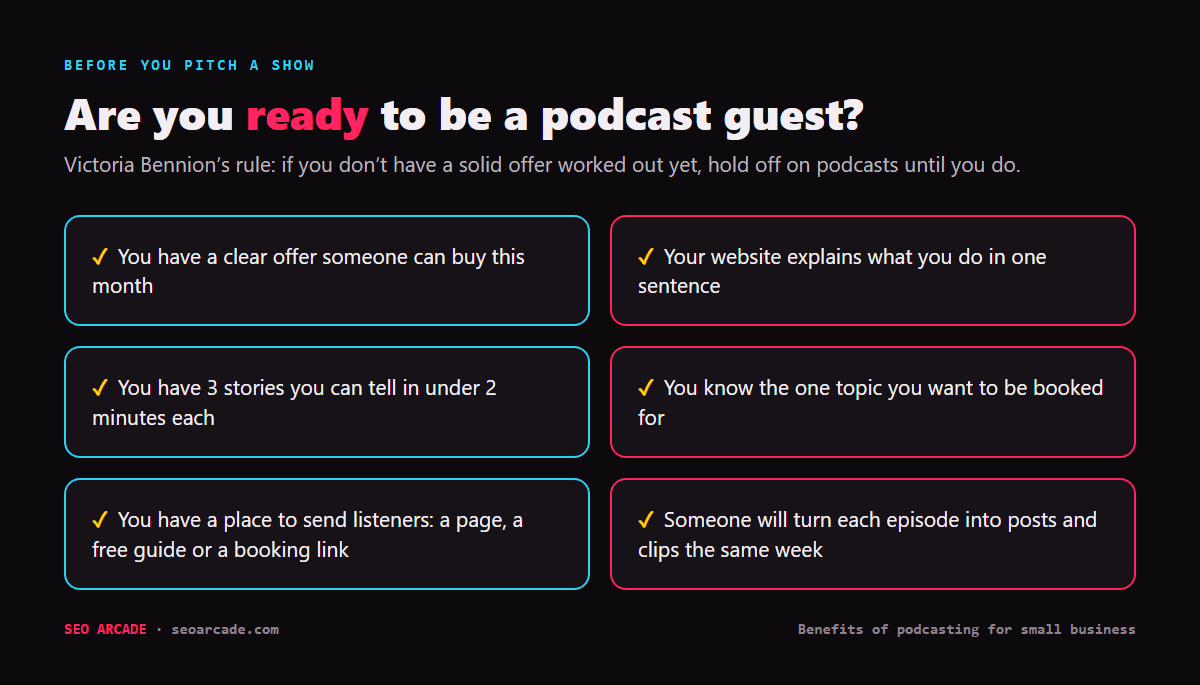
1. Get your offer solid before you pitch anyone
When I asked Victoria who shouldn’t hire her, she didn’t hedge:
So if maybe you’re not selling anything yet or you don’t have a solid offer worked out yet, then hold off. Hold off on the podcasts till you do.
Victoria Bennion, on Unscripted Small Business
Listeners who like you need somewhere to go. If your website can’t tell them what you sell in one sentence, fix that first.
2. Start as a guest, then decide whether to host
Guesting costs you an hour or two per show and borrows an audience someone else built. Hosting costs more time but puts your prospects in the guest chair. Most owners should guest first, get comfortable, and add a show once they see which conversations turn into business.
3. Commit to a cadence you can keep
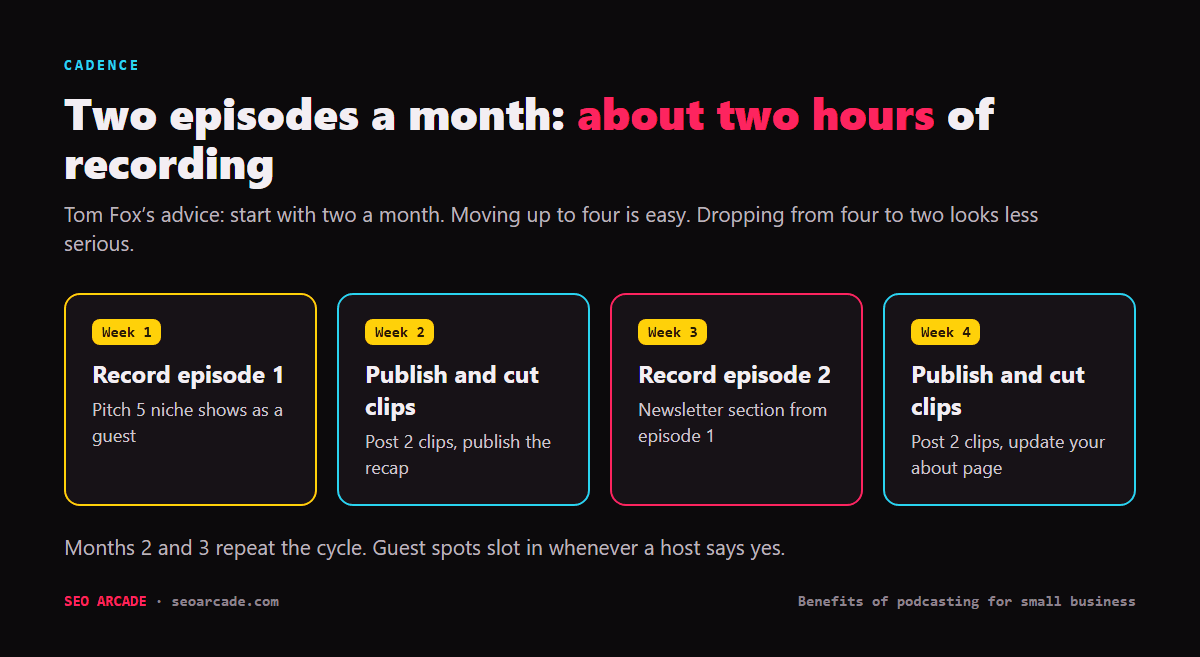
If you do host, Tom’s advice is to set a pace your audience can count on and never miss it:
I tell most business owners start with two, you can easily move to four. It’s much more difficult to move from four to two because you are seen as less serious. But if you start with two, that’s two hours a month. Everybody has two hours a month.
Tom Fox, on Unscripted Small Business
4. Show up as yourself, with stories
You don’t need a studio or a script. Victoria told me a decent external microphone, a webcam and headphones are plenty, and the clients who struggle are the ones who show up over-rehearsed. Her speech coach’s advice to every guest is to bring stories, because listeners remember stories long after they forget facts. Bring two or three that show how you work.
5. Turn every episode into assets the same week
This is where most owners leave the value on the table. The interview goes live, they share it once, and the transcript never gets used. Block time the week it publishes, or hand it to someone, and work through the list above while the conversation is fresh.
One honest note: podcasting won’t fix a weak offer, a website that doesn’t convert, or a business that never follows up with the people who reach out. It compounds slowly, over months, not days. If you need leads by Friday, run ads. If you want a business people already trust when they call, this is the channel.
Which should you pick?
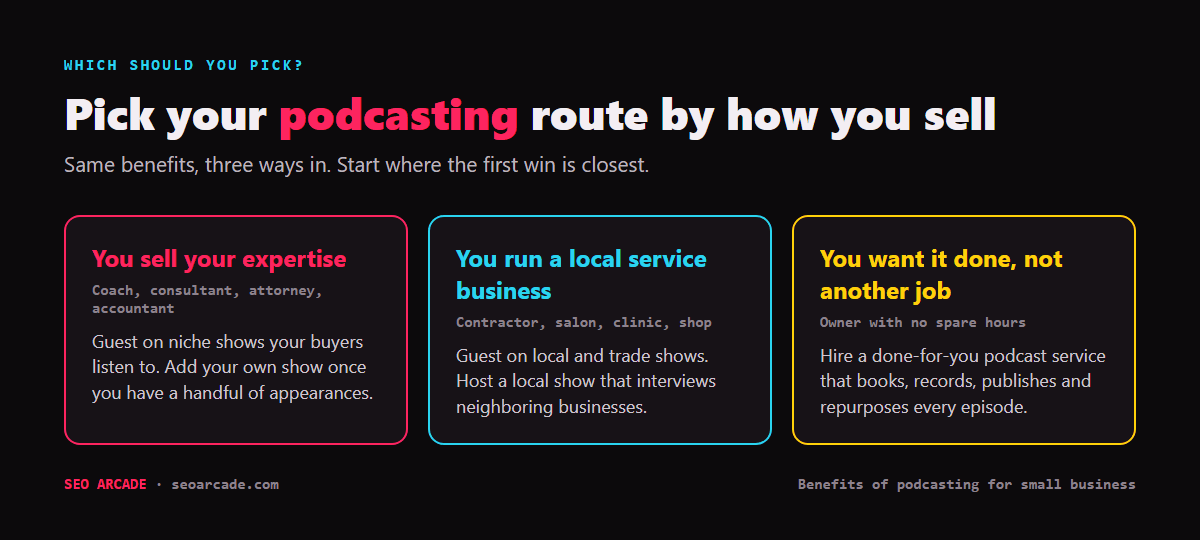
Pick by how you sell, because the first win comes from a different place for each kind of business.
- You sell your expertise (coach, consultant, attorney, accountant): guest on niche shows your buyers listen to, and add your own show once you have a handful of appearances.
- You run a local service business (contractor, salon, clinic, shop): guest on local and trade shows, then consider hosting a local show that interviews neighboring businesses. Tom built a whole rural podcast network on that idea, so the car dealership, the barbershop and the plumbers in a small town could talk to their customers where those customers already were.
- You want the benefits without another job: hand it off. SEO Arcade’s podcast SEO work runs on the same process we use on our own shows. One Podcasting As An SEO Service episode covers booking, recording, editing and publishing the interview, backlinks from the show notes and articles, blog posts written from the transcript, social posts and short clips, for $700 an episode with no retainer.
Benefits of podcasting for small business: start with one conversation
So ask yourself a few questions. Who are the five shows your best customers already listen to? What are the three stories you tell every new client? What would it be worth if one host turned out to be your next client, or one transcript became your best-ranking page? You already have the expertise and the stories. What’s missing is the microphone, and a plan for what happens after you hang up.
Book one conversation this month. If you want the checklists, the pitch tracker and the episode SOP we use, grab the free Podcasting for Business Toolkit.