
Tom Fox runs two podcast networks, and the best podcast lead generation advice he’s given me fits in two emails. Email a prospect asking for a sales call and “they may or may not respond.” Email them asking to come on your podcast and talk about themselves, and “you get a hundred percent response. Everybody wants to come on and talk about themselves.”
That’s the case for running your own show. It gives the people you most want to sell to a reason to spend 40 minutes talking with you, on the record, and then share the result. Below is what eight business owners who host their own shows told me on Unscripted about how that works, what it produces and where it breaks.
The podcast invite is outreach that doesn’t get ignored
Tom is a lawyer by training and the founder of the Compliance Podcast Network. When he came on Unscripted Small Business, he put “client development” at the center of why he thinks every business should have a show (my full write-up of his episode covers the rest). He set the two emails side by side:
The first email asks for a call about your consulting business, and maybe it gets an answer. Then the second one:
if you email them and say, my name is Jeremy Rivera, I have a podcast. I’d like you to come on my podcast and talk about yourself. You get a hundred percent response.
Tom Fox, Compliance Podcast Network, on Unscripted Small Business
He was using me as the hypothetical sender. Put your own name in.
He also told me about a software company in his space whose host was interviewing a client. Mid-episode, the client said he wished the tool did one more thing. “Without missing a beat, she goes, we have developed that. We’ll be rolling that out next week. You’ll be the first to get it. And I just went, that was the smoothest sales I have ever seen. He just got upsold on his own podcast.”
The bigger opening comes when the recording stops. Here’s how I describe it in the pitch for our done-for-you show: “there’s nothing better than being on a podcast with your ideal customer and then in those quiet moments after the podcast… You think I could help you? You think you could help me? Maybe we have another conversation. That’s the warmest lead you could possibly get.” The full pitch runs just over three minutes:
Run the show for the business behind it
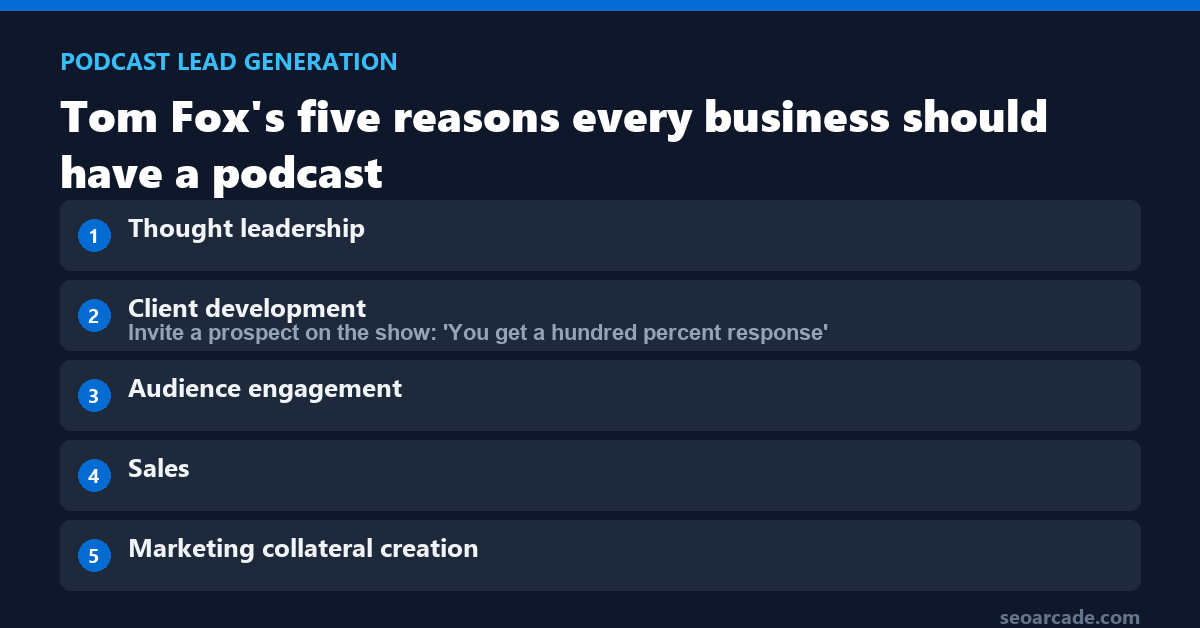
Tom’s list of what a company podcast does is longer than lead generation alone:
There are five reasons for every business to have a podcast, thought leadership, client development, audience engagement, sales, and social media marketing or marketing, collateral creation. And you can get all five of those with a podcast
Tom Fox
Virginia Elder runs Podcast Abundance, a production agency for financial professionals, and her clients don’t chase advertisers. “All my clients shows are sponsored by their businesses,” she told me on Unscripted SEO. “They don’t have like a mattress sponsor, right? They might run a commercial where they talk about their webinar that’s coming up.” The show sells the business. It doesn’t need to sell ads.
Before you plan a single episode, she has you answer one question:
Is this an interview show because this show is intended to be a connector? Or is this a show where I, as the owner, am positioning myself as the authority and I’m really elevating my face and my voice and I’m boosting this personal brand?
Virginia Elder, Podcast Abundance, on Unscripted SEO
If lead generation is the goal, you want the connector show, and your guest list is your prospect list.
Cahill Camden shows what happens when you judge a show only by its ad revenue. In 2017 he “started a podcast on cryptocurrency and blockchain, and it became a top 1 % podcast.” He interviewed the founder of OpenSea and people from Huobi and Binance. Then: “I actually killed it because I couldn’t figure out at the time how to make immediate money from it.” The audience and the guest list were there. What he didn’t have was a business behind the show to send them to.
One recording, a month of content
In that pitch I put a half-hour interview at “3,000, 4,000 words worth of content.” How much content is one podcast episode breaks it down. Your guests are using it the same way:
- Cut it up for social. Cahill, a former CMO at two blockchain companies, described it on Unscripted SEO: “maybe you’re doing those one hour conversations with your staff or with your top customers or whatever it might be, and you take that content and then you start cutting it up and you start distributing it.”
- Publish it on your site every week. Virginia’s team pulls each episode onto the client’s website to “show that they are creating fresh content every week.”
- Give every episode a written twin. Mike Jesowshek, the CPA behind the Small Business Tax Savings Podcast, told Daniel Hill that every episode goes out as audio, video and a blog post.
- Write the marketing from the interview. Mike Montague of Avenue Nine, host of the Human First AI Marketing Podcast, interviews “the founder, the top salesperson, best client or whatever, and then turn that into the marketing material so that I already have their context and expertise built in.”
Mike Jesowshek’s show started as an employee’s idea: turn three YouTube videos into podcast episodes. About six months later, inbound mail started arriving, “these emails saying I’ve heard your podcast I’d love to learn more about working with you and I’m like what podcasts are they talking about.” He has published weekly for more than eight years since. He eventually sold the majority stake in his accounting firm to podcast full time. You don’t have to go that far. His inbox shows what a consistent show does for a service business. The podcast-to-content repurposing tactic lays out the steps.
Your guests bring the audience and the backlinks
Every guest has a reason to share their own episode. Cahill again:
If you want to grow your show, the fastest way to do it is to have guests. That’s the fastest way. Why? Well, because the guest is going to promote your show as well because they’re on the show.
Cahill Camden, on Unscripted SEO
The links follow the same path. In our process each guest gets an article version of their interview to publish on their own site, and the show notes syndicate out to the podcast directories. As I say in the pitch, “take an article, give it back to your guest. Hey, that’s backlinks.” The podcast-powered link building service covers the mechanics. If you’d rather be the guest and collect those links yourself, read the companion piece on building a podcast guesting strategy.
Real conversations are the content AI can’t make up
When everybody can generate a blog post in ten seconds, the hard thing to copy is a real person explaining what happened to them. Mike Montague says AI “needs human conversations, documentation and transcripts of real human conversations. It also needs original research.” His working rule is “any good conversation you have, like capture real human quotes, real human stories, and just document every job.”
Jessica Malnik, who runs the media site, podcast and newsletter The Remote Work Tribe, gave nearly the same list on Unscripted Small Business: “whether it is original research, whether it is getting quotes, whether it is interviewing people within your team, or, you know, kind of showcasing your own first-hand experiences, things that an LLM can’t do.”
A podcast does that for you on a schedule. Each episode is a dated transcript of named experts on your subject, and the same pages and show notes are what LLMs pull from when they decide who to cite. Podcasts, Reddit, and the new citation map covers that side, and podcast SEO is how we run it for clients.
Most shows quit before episode ten
Here’s the catch. Virginia’s numbers are her own estimates, but they’re the right shape:
There are two to four million podcasts out there and attrition is really tough. Most people stop podcasting three to 10 episodes in. … So of those two to four million, there’s less than 500,000 that are actually active. So for you to get to stand out, just think like think SEO, right? Like what if you were only one of 500,000 websites out there?
Virginia Elder, Podcast Abundance
The guests who stuck with it planned for that. Cecily North of Traveling North started Life Between Flights because other travel podcasts “talk about destinations. They talk about companies to work with. They talk about marketing, but they don’t actually talk about the business and how to start a business.” She found a gap and filled it. Richard Hickman, whose agency serves high-ticket coaches, was banking interviews for The Business of High Ticket Coaching before he launched, so the show wouldn’t stall when he fell behind.
Podcast lead generation without running the show yourself
The pattern across these hosts is simple. Invite the people you want to work with, let the recording do the content work, and give every guest a reason to share it. The part most businesses can’t sustain is the production. That’s the booking, the studio, editing, show notes, articles, clips and distribution, every week.
That’s the job our white-label podcast service was built for. You or someone on your team hosts, or we bring a host, and we handle the rest. Before you decide, answer a few questions honestly:
- Who are the 20 people you’d most like to have a 40-minute conversation with this year?
- Is your show a connector or a soapbox? (Virginia’s question.)
- Where does a listener go after the episode, and what happens when they get there?
- Can you keep it going past episode ten, or do you need someone else to carry the production?
If the first list comes easily, you already have a guest list. Tom Fox’s numbers say most of them will say yes.