
Dave Valentine runs Finch, a performance marketing agency, and his podcast guesting strategy fits in one hour a week. Somebody on his team spends that hour pitching eight to ten shows, and four to six of them say yes. When he came on Unscripted SEO, he didn’t hedge about what that produces: “I’ve gotten so many leads out of being a guest on podcasts. It’s absolutely absurd.”
You don’t need a publicist or a famous name to get that result. You need a short list of the right shows, a real story to tell once you’re on, and a plan for the recording after it goes live. Below is what eight past Unscripted guests actually do at each of those steps, in their own words, checked against the recordings. One of them also explains how a guesting habit can go wrong.
Guesting beats polishing your own content right now
Greg Digneo ran growth at Time Doctor and now runs Content Guppy. On Unscripted SEO we got onto whether SEOs should spend their time chunking content for AI search. He pointed at the call we were on:
This podcast, me going on your podcast right now, is way more valuable to me … as a SEO agency than going through my content and being like, all right, is this content too long or is this content chunked?
Greg Digneo, Content Guppy, on Unscripted SEO
Looking back at his Time Doctor years, he described the split: “we focused eighty percent of our budget on SEO, like content and links, and then twenty percent of stuff on like partnerships and podcasts and YouTube channels and outreach and all this other stuff.” Then: “I would just flip the budget.”
Kate Hendrickson of The Strategy Lane gave the small-business version when I asked how she does marketing in 2026. “You’re looking at it right now,” she said. “That is my marketing strategy is truly getting in there and having some face to face time with people. So whether it’s hopping on a podcast, sharing some tips and tricks and my expertise so that way other people can go, man, this would really help me. I’d love to partner or work with this person.” You can’t fake that “face to face time” with a blog post, and you don’t need one to start.
How to get booked on podcasts without a publicist
Dave Valentine’s process is the most copyable thing anybody has told me on air. Here it is, in his words:
I have someone on my team that she spends an hour a week and she’ll reach out to 10 people maybe, maybe eight. And out of those, I’ll get four to six people that are like, hey, we want you to be on the podcast.
Dave Valentine, Finch, on Unscripted SEO
He found my show through PodMatch, which he put at roughly 25 to 30 dollars a month, and he mentioned matchmaker.fm at about 130 dollars a year. Those were his prices when we recorded in January 2025, so check them before you budget around them.
Victoria Bennion has booked guests professionally since 2019 through The Best Podcast Guest Booking Agency. Her clients often show up wanting Oprah or Joe Rogan. She points them at smaller, sharper shows instead: “you don’t need to be on Oprah or Joe Rogan or whatever to see benefits from a podcast interview strategy.”
Put their advice together and you get a short booking routine:
- Block one hour a week. Dave’s team gets four to six yeses out of eight to ten pitches in that hour.
- Pitch niche shows whose listeners buy what you sell. Victoria’s point is that a small, well-matched audience beats a famous one.
- Use a matching platform to find hosts who want guests. PodMatch is how Dave found me.
- Bring a credential hosts already like. Ally Machate of The Writer’s Ally told Daniel Hill on Unscripted Small Business that a book opens doors to stages and podcasts, because people love to interview authors.
- Have an offer ready before you pitch. Victoria is blunt about this: “if maybe you’re not selling anything yet or you don’t have a solid offer worked out yet, then hold off. Hold off on the podcasts till you do.”
What to say once you’re on the show
The pitch gets you booked. What you say on air decides whether anybody calls you afterwards. When I asked Victoria what her team’s speech coach tells nervous guests, she answered before I finished the question:
Share stories. Share stories. It helps you to be more memorable, helps to build connection with the listener.
Victoria Bennion, The Best Podcast Guest Booking Agency, on Unscripted Small Business
Her best example is a coach who loved cats and talked about them as one part of her interviews. After one episode went live, an inquiry came in from someone who said they knew she was the coach for them because she loved cats too. That’s a silly detail doing real sales work. Victoria’s view is that personal stories pull in the right people and push away the wrong ones, and that’s fine.
She has also watched what happens when guests over-prepare. One client, a former teacher, turned up with a script and expected to stick to it. Another, a copywriter, gave a canned introduction. Victoria brought a speech coach onto her team to get clients talking the way they actually talk. If you only prepare one thing, make it two or three stories you can tell without notes.
Ally Machate shows the other half: decide in advance who needs to hear you. She goes on podcasts to reach authors before they make an expensive mistake: “hopefully I get them early, which is one reason why I’m going on podcasts like this, is to try to teach people very early in the process.” If you know which moment your buyer is in, you know which story to tell.
Turn one podcast appearance into links, leads and AI citations
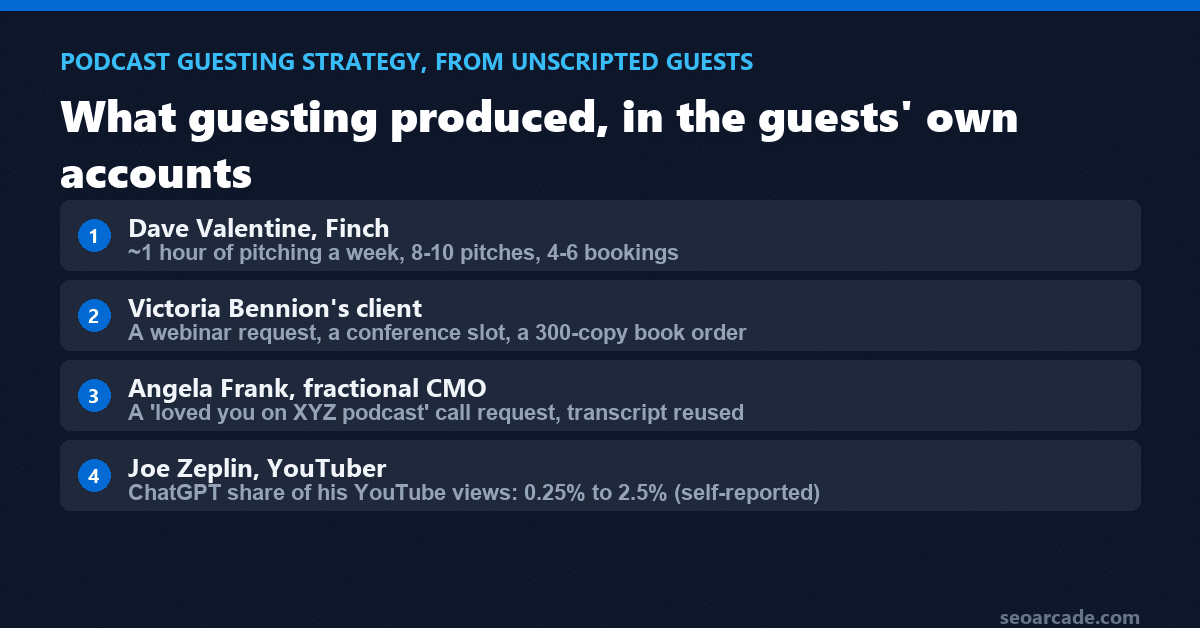
An appearance pays off in four ways, and most guests only collect the first one.
- The backlink. Victoria: “a lot of hosts will give you a backlink to your website in the show notes.” Dave puts it plainly: “One of my favorite ways … to go get backlinks is being on podcasts, just like this.” Ask for the link before you hang up. The podcast guest appearance tactic card covers the follow-up.
- The host. Victoria has seen this happen more than once: “sometimes our clients find that the host is their ideal client and they end up working together.” One of her early clients pitched a show and came away with a request to run webinars for the host’s company. Another host invited him to speak at their conference and bought 300 copies of his book.
- The listener who calls. Angela Frank, a fractional CMO, told Abbey Crane on Unscripted Small Business what happened the week before: “last week I had somebody reach out and said, hey, loved you on XYZ podcast. Can I book a call? And I went, great. I pulled the transcript from that podcast.” Her team now treats each appearance’s transcript like one of their own YouTube videos and cuts it into short posts and carousels.
- The AI answer. Joe Zeplin, who calls himself the corporate guy turned YouTuber, checked how much of his YouTube viewing came from ChatGPT. It was a quarter of a percent. He said ChatGPT told him he only did self-promoted content, so he started doing podcasts. “And I had a quarter of 1%. Now, last time I did a podcast, I checked it was two and a half percent, and that was like three months ago. And the way I did that is I started doing podcasts essentially.” That’s his own number, from one channel, and he hasn’t shown his working. But a tenfold move in the share of views ChatGPT refers to him is worth testing for yourself. Podcasts, Reddit, and the new citation map explains why third-party conversations carry this kind of weight.
The authority machine trap
More appearances won’t fix everything. Paul Pape, the self-described barkeep and game master at Gamify Business, spent about 18 months moving from 20 years in fabrication into consulting. When I asked about his biggest pain point on Unscripted Small Business, he named the guesting habit itself:
I spent a lot of time putting, you know, hundreds of podcasts, lots of posts, going out and doing speaking events, TED talks, all this stuff to prove that I’m the authority that I am so that you can trust me. The problem is, is that now I’ve … built an authority machine and not a getting customers machine.
Paul Pape, Gamify Business, on Unscripted Small Business
That’s the trap. Every appearance needs a next step for the listener: an offer, a booking link, a page that turns attention into a conversation. Without one, you’re building somebody else’s audience and getting a nice feeling in return. Victoria’s rule about having an offer first covers the same ground from the booking side.
When the guest seat isn’t enough
Every guest spot ends the same way. The host keeps the episode, the audience and the follow-up conversation. Hosting your own show puts you in the seat where your ideal customer is the guest, and I recorded a short pitch on how that works as a done-for-you service:
The host side gets its own write-up in podcast lead generation: why your best prospects belong in the guest chair. If you’d rather not run the show yourself, that’s what the white-label podcast service is for. If you want the links and citations without hosting, see podcast SEO.
Your podcast guesting strategy for the next 90 days
Here’s the plan these eight guests add up to:
- Write down the one offer a listener can act on, and the page it lives on. If you can’t, Victoria says hold off.
- Pick two or three stories that show who you are, cats included.
- Block an hour a week and pitch eight to ten niche shows. Dave’s numbers say about half will book you.
- After every recording, ask for the show-notes link, connect with the host as a possible client, and pull the transcript for your own posts.
- Once a month, ask ChatGPT what it knows about you, and check where your referrals come from. Joe Zeplin’s number moved within months.
Greg Digneo’s version is shorter: “find the podcast, find the people with the audience that you want to serve and just get on there. And like the rest of it’ll take care of itself.”