
The digital landscape is in a perpetual state of flux, and keeping up with the latest trends and updates is a necessity for anyone looking to make their mark online.
Recently, the SEO community came together on #SEOCHAT to discuss the impact of the Helpful Content Update (HCU) and the changing dynamics of search engine optimization. The conversation was insightful, with experts sharing their thoughts on how websites are being affected and how to adapt to these changes.
In this blog post, we curate some of the key takeaways and wisdom shared during this engaging #SEOCHAT discussion. From the effects of AI-generated content on website visibility to strategies for content creation and SEO adaptation, we delve into the world of SEO with insights from industry leaders.
Join us as we explore the traditional and innovative approaches to SEO in a post-HCU era. Whether you’re an SEO professional, a content creator, or a business owner looking to boost your online presence, this discussion is packed with valuable insights to help you navigate the ever-shifting SEO landscape.
Let’s dive in and uncover the wisdom shared by experts like Caitlin Hathaway, Travis, Mordy Oberstein, and more, as they discuss the evolving strategies for SEO success in 2023 and beyond.

We’re at the (estimated) midpoint of the September Helpful Content Update – what is everyone seeing so far? Has anyone observed any notable impacts or trends (good or bad)?
Q1: We’re at the (estimated) midpoint of the September Helpful Content Update – what is everyone seeing so far? Has anyone observed any notable impacts or trends (good or bad)? #SEOchat pic.twitter.com/Ask9G0b2xS
— Caitlin Hathaway (@CaitlinTheSEO) September 21, 2023
A1: So far, seeing some examples on
Caitlin Hathaway
@sistrix
of websites with what looks like AI generated content hugely plummet in visibility since the HCU dropped, this one was a hairstyle brand with questionable content and author pages
A1.2: Also websites who were actively participating in Parasite SEO tactics (publishing content on high-authority sites to rank on search engines) are seeing a biiiiit of site-wide impact since the HCU. Google communicated it was targeting such tactics
A1: As always, a period of depression, then right-sizing.
It’s like surfing:
Those who produce quality, original content just have to wait for the next wave & ride.
Those with a wrong “board” will have deficiencies exposed. A longboard is no good in high surf.
travis
Been rummaging around the Helpful Content Update a bit. Here are some musings… Let’s start with the KW: Texas Driving Practice Test One URL wins and one loses… But the HCU is site-wide… so let’s have a look at the domains.
Mordy Oberstein
Clearly with one site, we have a visible loss of rank and the other a slight slight increase And looking at the content it kinda makes sense
With 1 site you have well-structured content that’s pretty easy to digest & straight-forward. Is it amazing? IDK But it’s pretty “helpful”
While with the other we have: 1) A lot of ads 2) More ads 3) And a spattering of info with no structure whatsoever 4) Moreover it’s a ton of info endlessly – almost as if trying to rank for a heap of keywords…. hmmm Unhelpful.
Same story…. tons and tons of ads and where there wasn’t an ad the content was generic and…. unhelpful
How are you adapting content strategies and priorities to align with Google’s evolving signals around helpfulness?
Q2: How are you adapting content strategies and priorities to align with Google's evolving signals around helpfulness? #SEOchat
— Caitlin Hathaway (@CaitlinTheSEO) September 21, 2023
A2: I see it as less of an adaptation, more of a sharpening.
Put simply, if I want to know the best soil mix for homegrown basil, I want a site that breaks that down with real answers. I don’t want “5 Basil Varieties To Try At Home.”
Create content through that lens.
travis
A2: Continuously check the queries to make sure that the match the intent of the other results. I think screenshots over time can be highly useful for keeping up with these changes on your most competitive keywords.
Sweepsify
A2: Reorganising, auditing focusing on trust by becoming an authority on the topic. I also think credibility is super important right now and it’s built off page, seen some good increases on my own sites in visibility just from relevant brand mentions
Ray Saddiq
Google’s guidelines suggest that its more open to AI content, if it’s helpful and clearly signposted to users. Has your approach to incorporating AI in content changed?
Q3: Following the HCU chatter, Google’s guidelines suggest that its more open to AI content, IF it's helpful and clearly signposted to users… has your approach to incorporating AI in content changed? Thoughts on risks / opportunities? #SEOchat pic.twitter.com/fRRmKr5OVY
— Caitlin Hathaway (@CaitlinTheSEO) September 21, 2023
A3: No. I’m not against using AI within content at all, and use it regularly during my content creation process. But, as a general rule, I don’t use AI to write content for me. I use it to help me start sentences when stuck, or structure content. That’s it really.
Ryan Jones
A3: It’s analogous to AR vs. VR. One augments the environment; the other paints an artificial one. I don’t advocate for AI “in content.” It can augment content creation. As a tool, it can streamline thinking, shorten processes, audit work. True shortcuts are rare.
travis
A3: Similar to what
@ericlanderseo said you need both. If you want to stay competitive anyway and provide the best answer AI can help AI isn’t just written content. Interpreting and organising your data Reviewing your content Expanding ideation Scaling production
Ray Saddiq
After a core update followed swiftly by a helpful content update, how are you communicating algorithm shifts and implications to stakeholders during such a volatile period?
Q4: After a core update followed swiftly by a helpful content update, how are you communicating algorithm shifts and implications to stakeholders during such a volatile period? #SEOchat
— Caitlin Hathaway (@CaitlinTheSEO) September 21, 2023
A4: As with many things, the solve is quick, yet thoughtful communication. Here’s the short of what’s happening now. Here’s what we need to do, near future. Here’s what we need to watch for over time. Our vulnerabilities are X, strengths are Y, modified approach is Z.
travis
A4: During any of the more volatile updates, I prioritize transparent, data-driven communication with stakeholders. Weekly briefings to detail performance metrics, SEO shifts, and possible action plans. I’ve learned not to overreact before the dust settles
Eric Lander
Not in agency world, and my boss is a huge help as he understands SEO massively which is amazing! Thanks, Nick!
But ensuring we’re being open, monitoring upticks or downturns if there are any and approaching fixes if needed after updates are rolled out.
Ryan Jones
What methods are working well to balance being proactive with actions/optimisations during the HCU (and core update), while avoiding knee-jerk reactions?
Q5: What methods are working well to balance being proactive with actions/optimisations during the HCU (and core update), while avoiding knee-jerk reactions? #SEOchat
— Caitlin Hathaway (@CaitlinTheSEO) September 21, 2023
A5: An action plan framework, ahead of time, helps navigate updates: 1. With an update, we observe for X weeks. 2. We determine vulnerabilities & chart a course for content revisions (weeks Y to Z). 3. Future-facing, we plan content with these changes clearly in view.
travis
Balance SEO proactivity during updates. Monitor, analyse data, focus on quality, UX, and long-term strategy. Avoid knee-jerk reactions
Matthew Dorrington
A5: For me, it has been to focus on updating content that’s shown performance gains in the past 6-9 months. I want to make sure they’re up to current best practices before they hit another seasonal interest spike. Helps level out if other content suffers even a little
Eric Lander
The Helpful Content update is only halfway through the rollout – do you think there are more big shifts to come?
Q6: Closing question, and time to put on your tin foil hats… the Helpful Content update is only halfway through the rollout – do you think there are more big shifts to come? The more conspiracy answers, the better 😀 #SEOchat pic.twitter.com/kfCOHLbBMf
— Caitlin Hathaway (@CaitlinTheSEO) September 21, 2023
A6: Change is the constant, not the variable. This brings me *some* peace. My one (negative) theory is: Google now rewrites Meta Titles/Descriptions. This may increase over time. At some point, Google will decide what of our own written content is “best,” regardless.
travis
A6: Whether there are any more major updates to come or not, I’m not sure. I think we’ll see another Core Update before the end of the year, personally. And I think we’ll see at least 4 next year too. It needs it, given how much everything is changing
Ryan Jones
A6: Expect the unexpected. More time and data means that more analysis on CMSs, verticals, etc. will find a way to say “this impacted us.” Stay focused on what matters (1st party data and observations).
Eric Lander
The recent Helpful Content Update (HCU) has left many of us reevaluating our strategies and tactics. As we’ve seen from the insights shared during this #SEOCHAT discussion, the landscape is evolving, and staying ahead of the curve is essential.
One of the recurring themes in our conversation is the importance of quality and user-centric content. Google’s algorithm updates, like the HCU, are increasingly favoring content that genuinely helps users. Gone are the days when keyword-stuffed, ad-heavy pages could dominate the rankings. Today, it’s all about providing value and answering user queries effectively.
We’ve also touched upon the role of AI in content creation and SEO. While AI can be a valuable tool for streamlining processes and generating ideas, it’s crucial to remember that it’s not a shortcut to success. The best results come from combining human expertise with AI assistance.
Transparency and communication have emerged as critical elements in adapting to algorithm changes. Whether you’re an SEO professional or a website owner, keeping stakeholders informed and having a proactive action plan can mitigate the impact of updates and position you for long-term success.
As we move forward, we must embrace change as a constant in the SEO world. Google’s commitment to improving search quality means that updates will continue to roll out. It’s up to us to stay agile, monitor data, and focus on delivering the best possible user experience.
In closing, the Helpful Content Update is a reminder that SEO is not a one-time effort but an ongoing journey. By creating high-quality, user-focused content, using AI wisely, and staying adaptable, we can ride the waves of change and ensure our websites thrive in the ever-evolving digital landscape.
Thank you for joining us in this discussion, and we look forward to navigating the exciting future of SEO together.
Jeremy’s Take: The Helpful Content Update Rewards Receipts
The throughline of every Helpful Content Update is the same: prove it. Content that cites its sources gives Google and the LLMs something to verify against — and verified content earns trust. If you want to survive the next update, stop asserting and start showing your receipts.
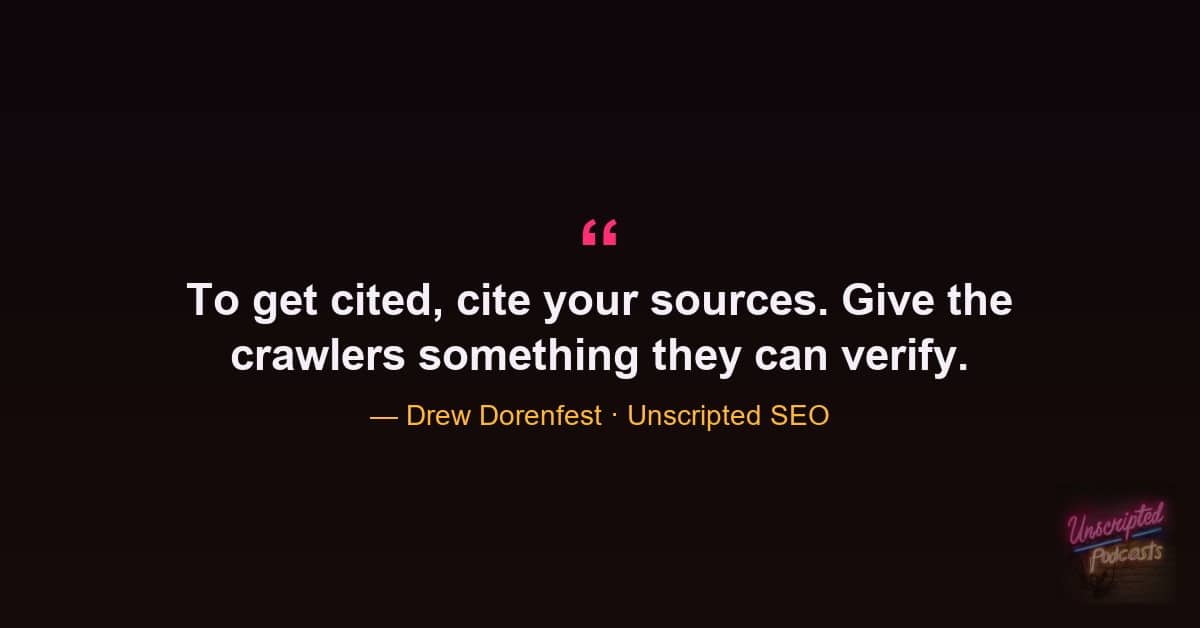
The key to all of this, especially to get cited, is to cite your sources. To point to Google, this is where I got this information. Then when those crawlers come and they check against your information, they see the source, they can verify it. Then they go, okay, this is legit.
Drew Dorenfest, Unscripted SEO Podcast
Receipts build trust. Drew Dorenfest on cited content and E-E-A-T in his Unscripted SEO episode.
Make your expertise legible to Google.
Our E-E-A-T Signals Building service surfaces the experience, authorship, and citations that prove your content deserves to rank.