

Keyword research is often described as a magical blend of lunacy and detective work. Experts like Travis and Jamar Ramos add a touch of whimsy to this essential practice, with Travis comparing it to finding the bullseye in a vast landscape. Diana Richardson paints a more profound picture, likening it to becoming a mind reader. It’s about delving into the words and phrases people use to find what they want, a way to understand how they think, speak, and make decisions.
Efficiency is a common theme in this discussion. Travis highlights keyword research as an efficiency play, providing insights into competition, cost, and market size. It’s not just about finding any keywords; it’s about identifying the most efficient path to your target audience. Darth Autocrat emphasizes that it helps build the right business context.
The frequency of keyword research is a matter of debate. Travis and Diana suggest revisiting it quarterly, finding the balance between staying updated with trends and not wasting time on overly frequent updates. It’s a continuous journey that adapts to changing search behaviors.
Quality reigns supreme in keyword selection, as Travis and Diana stress. It’s not about sheer volume but about the intent and relevance of keywords. The experts caution against solely relying on search volume and advise considering intent, competition, and the search engine results page for a comprehensive keyword strategy.
Amidst the plethora of tools available, our experts emphasize the value of human insights in keyword research. Darth Autocrat reminds us of the power of client interactions and understanding their language as sources of keyword inspiration. It’s a reminder that in the age of automation, the human touch still holds significant value.
Keyword research is an ever-evolving field, as Travis wisely puts it, and there’s no one-size-fits-all approach. It’s a realm without boundaries, where authenticity and dedication are your compass. As Diana Richardson aptly states, users seek solutions, not just products. Keyword research is the compass guiding you to provide those solutions, ultimately leading to revenue.
If Keyword Research were a fictional character, who would it be?
Q1: #SEOChat: If Keyword Research were a fictional character, who would it be? Share a GIF to answer pic.twitter.com/O5Bi9m7PKU
— Diana Richardson (@DianaRich013) September 14, 2023
A1. Erm … that’s a tough one. Keywords are magical … … but the difference between basic and proper research…
Darth Autocrat
A1: Part lunacy, part detective, always fun!
travis
A1 Collin Robinson from WWDITS
Jamar Ramos
Why is keyword research important to you? Why is it important to marketing?
Q2: #SEOChat Why is keyword research important to you? Why is it important to marketing? pic.twitter.com/TipEJe46Vl
— Diana Richardson (@DianaRich013) September 14, 2023
A2: #SEOChat Doing keyword research is the closest thing we have to becoming mind readers. By investigating the words, phrases, and language people use to find what they want, we get to know how they think, speak, and do.
Diana Richardson
A2: No matter how much I know about a topic, I never know enough. & I also never know enough about a company. KW research helps me learn more about both so I can help users get what they need through marketing
Jamar Ramos
A2: Keyword research is an (initial) efficiency play. At the onset, you’ll have a clearer read on efficiency, competition / cost to participate, and total addressable market. If you start by shrinking an audience to the “bullseye” of your target, always room to grow.
travis
A2. It’s largely unique to Digital (SEO/Ads), but part of the broader Audience/Market research that most marketing should include. It provides you insights into your prospective/preferred audience(s), and can give you insights into their demographics etc.
Darth Autocrat
It helps me build the right business context.
Suresh
How often do you do keyword research for your brand or for the same client? Why that often / infrequently?
Q3: #SEOChat How often do you do keyword research for your brand or for the same client? Why that often / infrequently? pic.twitter.com/dBYMvNDyzN
— Diana Richardson (@DianaRich013) September 14, 2023
A3: Quarterly at a minimum. Desired pace of growth & compensation are 2 important factors. For the 1st, can you drink from a fire hose, or just a garden hose? For the 2nd, will you compensate a team for the time to uncover more information…? Then repeat question #1
travis
Depends on the role/task, budget etc. But it shouldn’t be a “done once”, nor left for too long. Ideally, there should be a large delving initially, (but with focus on prioritised items (by client margins for products/services etc.)).
Darth Autocrat
This is like a daily rituals for business.
Suresh
A3: #SEOChat I’m a fan of quarterly research, especially as you start to learn search trends & seasonality of a brand or client. Too often, i.e. monthly, may be wasted time. But once a year, well you risk missing opportunities. So, somewhere in between is ideal.
Diana Richardson
A3: I constantly monitor important KWs, & do new research quarterly. That’s my sweet spot to make sure we’ve got enough data on how our last set of KW research is performing, & if we just need to tweak vs added new KWs for max benefit #seochat
Jamar Ramos
What do you do with your keywords once you research them? How do you integrate them into your marketing strategy?
Q4: #SEOChat What do you do with your keywords once you research them? How do you integrate them into your marketing strategy? pic.twitter.com/O457LNGSn1
— Diana Richardson (@DianaRich013) September 14, 2023
A4: A critical lens for me – Is this current fuel, future fuel, or noise. If current, consider/evaluate revisions to current content. If future, map out a plan. If noise, define *why* and communicate that appropriately. It boils down to resource allocation.
travis
It depends. No really what’s google doing on the serp kinda thing but as a rule I’m pretty topical with my approach but that’s not to say
@geochingu doesn’t get on me a lil for being too “seo-ish” #seochat
Mordy Oberstein *mediocre at best*
I segregate them by intent/journey stage, value type, and tag them if they are vanity terms (these are then printed out, wrapped around bricks, and thrown at the client until the submit :D). More seriously … tape them to the bricks, else they come off.
Darth Autocrat
Starting with the seed keyword. Go in depth manually by applying several manual filters. Filter kws according to intent/model. Sort by difficulty.
Hamzah Iqbal
You have a ton of keyword variations — how do you choose the ones the right ones? What are your credentials for a quality keyword?
Q5: #SEOChat You have a ton of keyword variations — how do you choose the ones the right ones? What are your credentials for a quality keyword? pic.twitter.com/jT1zuiovSF
— Diana Richardson (@DianaRich013) September 14, 2023
A5: What a great Q! Tough to answer… Search volume (1,000+ / mo) for a specific phrasing rings truest to me. From here, naturally fold variations into the content itself. If distinct enough, develop content against it. Search engines ding duplication, not nuance.
travis
A5 (1/2): #SEOChat Two things: 1) Intent & 2) Ranking difficulty. I don’t waste time. I hone in on keywords with (usually) commercial & transactional intent with medium difficulty.
Diana Richardson
A5. Depends on what data is available, and what the SERPs/Competitors show. Though there may be numerous variants, you’ll often find that the results do differ (because G still looks at “strings” and “matching”). So depending on goals, resources, site equity
Darth Autocrat
A5: This is where I do some manual labor & search KWs to see the SERPs. What sites pop up? What content types pop up? What PAAs pop up? Any GMBs? Local Map packs? This way I can show the KWs we should optimize for, & how best to optimize for them
Jamar Ramos
What does your keyword research process look like?
Q6: #SEOChat What does your keyword research process look like? Walk us through it… pic.twitter.com/2nAy4Zvj0J
— Diana Richardson (@DianaRich013) September 14, 2023
A6: Now that I work with SMBs, its different. Research is mostly about shoring up their local footprint, beating competitors, & optimizng for conversion-based KWs. Revenue has to be the ultimate goal of my research, now
Jamar Ramos
I pick a word and then I ask out loud “is this a good keyword” and then I shake a magic 8 ball and do whatever it tells m
Mordy Oberstein
A6.1: Step 1 is determining goals from SEO. Newer brands seek revenue. This necessitates sifting the info-seeking from the revenue-producing. Graduated brands seek revenue AND can afford some noise. They develop content that attracts, converts, and retains over time.
travis
Not giving out all the secrets, but I don’t like “just tool data”. I ask the client to talk to the insight trinity, and see what words/phrases/questions come from sales, services and support. Then there’s scripts/crawling…
Darth Autocrat
What keyword research advice do you want to share with other marketers?
Q7: #SEOChat What keyword research advice do you want to share with other marketers? ? pic.twitter.com/6kXkx3ME3r
— Diana Richardson (@DianaRich013) September 14, 2023
A7: Look for questions, not just keywords. This way you can identify the problems users have & provide solutions using your client’s products/services. Users want solutions, not products. Give them solutions & revenue will follow
Jamar Ramos
A7: #SEOChat If you choose your keywords solely based on search volume, we can’t be friends.
Diana Richardson
Get away from : Keyword Move towards : Query phrases Get away from : Single keyword Move towards : Groups/Sets Get away from : Quantitative Move towards : Qualitative + Quantitative Get away from : Tool data Move towards : Looking at the SERP
Darth Autocrat
A7: It’s endless. Human minds can only absorb so much. Don’t beat yourself up (ever) for falling short, esp. w/ the advent of AI/ML tools. Be authentic. That’s what quality search engines reward. Create thoughtful work & develop worthy content. Lather, rinse, repeat.
travis
What tools are you using for your keyword research?
Q8: #SEOChat What tools are you using for your keyword research? ? pic.twitter.com/w6g8qducID
— Diana Richardson (@DianaRich013) September 14, 2023
A8: I find myself gravitating towards Ahrefs (and others, for ideation), requiring hefty sifting/refining. Google Keyword Planner surfaces auction prices (albeit estimated, biased) that signal if a phrase is viable, from a cost + volume POV. Where does trust lie?
travis
Google keyword planner Google trends Google suggest keywords Semrush Ahrefs Answer the public
Sandeep Pitla
The standard ones: Semrush, Ahrefs, Google Adwords etc., but also extracting complete/suggestions/PAA, crawling sections of certain sites, scripts/database (php/mariadb) for parsing/grouping etc.
Darth Autocrat
A8: #SEOChat
@ContentAtScale just released 3 brand new keyword research features, Keywords, Keyword Insights AND a new NLP Optimization tool. Head on over to https://contentatscale.ai to check it out.
Diana Richardson
Keyword research remains a cornerstone of effective SEO and digital marketing. While the tools and techniques have evolved with technology, the core principles of understanding your audience, speaking their language, and delivering value have not changed. The #SEOChat discussion serves as a reminder that in the ever-evolving digital landscape, traditional marketing wisdom still holds true.
Jeremy’s Take: In an LLM There’s No Rank — Only What You Give It to Interpret
A ‘fresh take’ on keyword research starts by dropping the obsession with rank. In an LLM there is no position 1; there’s only how clearly the model can interpret what you’re about. So the real research question isn’t ‘what’s the volume’ — it’s ‘what am I giving the machine to understand?’ Mine the language, then size it.
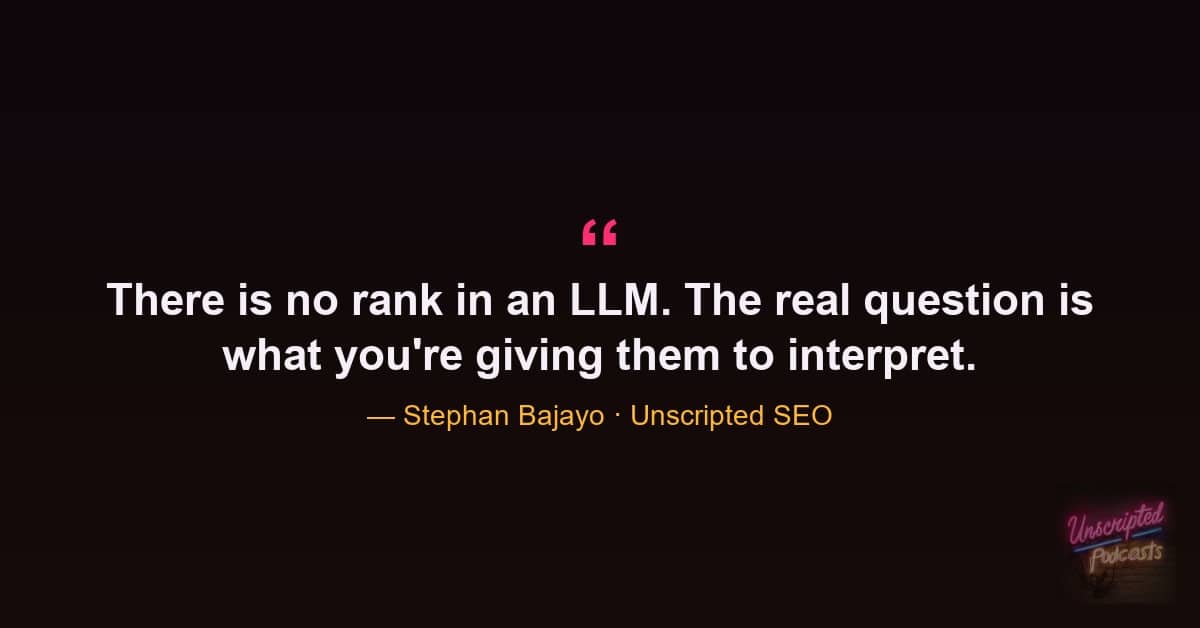
There is no rank in an LLM. You’ve been trained to believe that ranks. That’s because you’ve been trained in the wrong things. The real question is: what are you giving them to interpret?
Stephan Bajayo, Unscripted SEO Podcast
Research intent, not just volume. Stephan Bajayo in “There Is No Rank in an LLM.”
Find out what your keywords are actually worth.
SEO Arcade turns your keyword research into a revenue forecast — projected traffic and ROI per term, before you write a word.