
Most GEO advice I see is keyword research with a new label: find the prompts, write the pages, hope a model cites you. Ross Hudgens, founder and CEO of Siege Media, came on Unscripted SEO with something more useful: moves his agency tested across client sites, including a correlation study on what the sites with the most AI search traffic have in common. I pulled six of them out of our conversation and turned each into steps you can run this month. The full framework is in his book, Generative Engine Optimization: The Definitive Guide to AI SEO, out from Wiley on October 12, 2026.
1. Build the versus pages your buyers already ask about
Siege used Claude to run a correlation study across its clients’ transactional URLs. The attribute most tied to AI search traffic was having versus articles, with a Spearman correlation Ross recalled as about 0.56.
“Those with versus articles were the most likely to have AI search traffic.”
Read that carefully. The versus pages weren’t the top traffic pages. The sites that had them got the most AI traffic. It’s a correlation, not proof, but the logic holds up: people use LLMs for deep, late-stage product comparison, and a versus prompt is less competitive than a head term.
- List the three to five competitors your sales team hears about most.
- Write one honest comparison page per matchup, including where the other product wins.
- Link each one from the matching product or pricing-adjacent page, so a crawler finds it in one hop.
2. Put the proof where a bot doesn’t have to hunt for it
Ross’s shorthand, borrowed from a conversation with Andy Crestodina of Orbit Media, is “CRO is GEO.” The things that lift conversion rate are the same things that get you recommended.
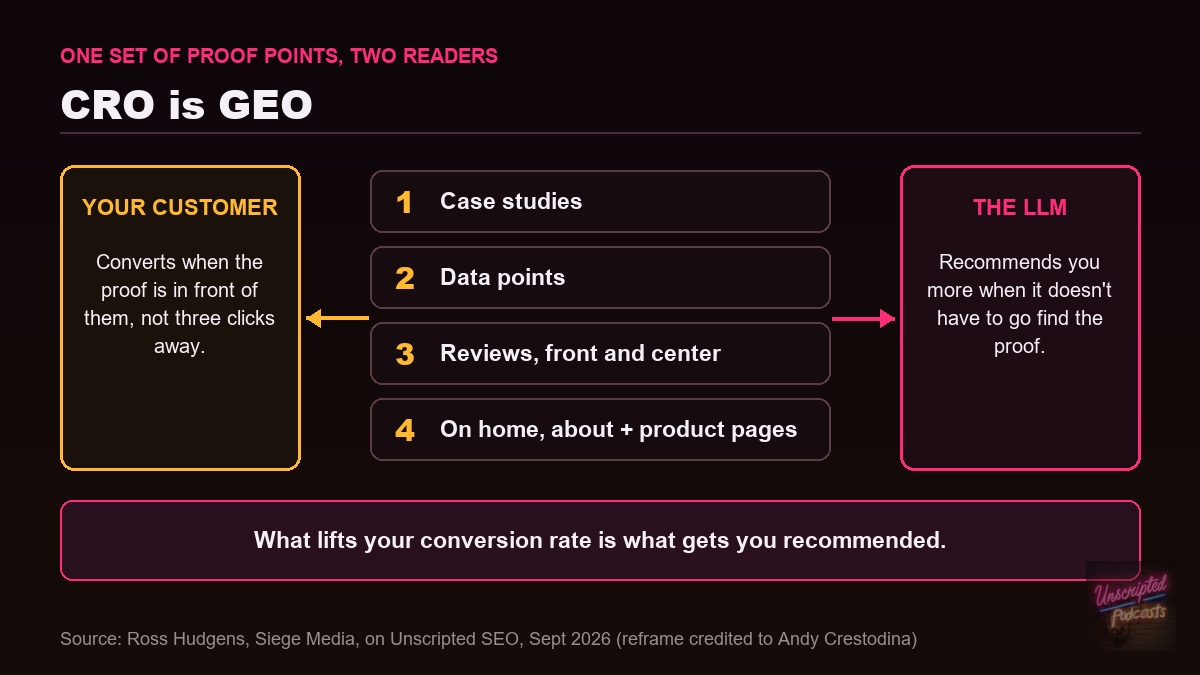
Audit your home page, about page and top product pages against three questions he asks:
- Are case studies on the page, or buried in a resources section?
- Are the data points visible, with numbers a model can quote?
- Are reviews front and center, or only on a third-party site?
If the answer is “somewhere else,” move it. The model may go find it, but you don’t want to count on that. Neither does your buyer.
3. Go one layer deeper on use case pages, using review language
Buyers now include “bots with wallets,” agents shopping on someone’s behalf. Ross recommends long-tail use case pages that go three layers deep into what your business solves, not two.
- Export your reviews and pull out the descriptors customers use for their situation.
- Run those phrases through Ahrefs, Semrush or your tool of choice for volume and SERP intent.
- Build a landing page for each permutation that has real demand and a real answer.
That’s how you “educate that robot buyer,” in Ross’s words.
Turn move 3 into a procedure with the SEO SOP: Turn Review Language Into Long-Tail Use-Case Pages – the one-page PDF is free inside The Vault.
4. Position as best for something, not best overall
A Siege client ranked several times on page one for a “best X” search and still wasn’t in the AI Overview. Ross’s thesis was that they called themselves the best overall.
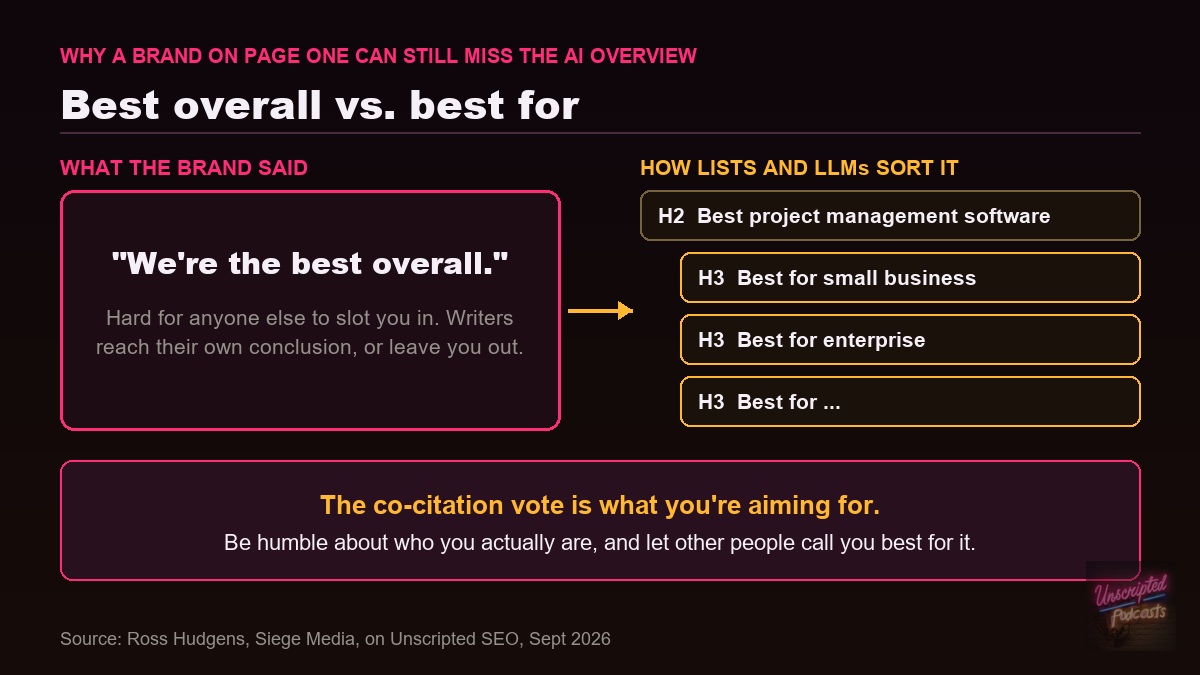
LLM answers break a topic into situations, like best project management software for small business, then for enterprise. When you claim everything, other writers can’t easily “slot you in their own decision.” What you want is the co-citation vote: many sources independently calling you best for the same segment.
- Pick the segment you win most often in closed deals.
- Rewrite your own “best” claims around it.
- Pitch roundup authors on that segment specifically.
5. Carve AI traffic out of your direct bucket
Eric Wu at Ramp told Ross how they track it: direct visits to non-branded URLs, anything other than the home page, are probably bots. Segment those out and you have an AI proxy. Ramp is also working on flagging visits with a distinct engagement rate as AI.
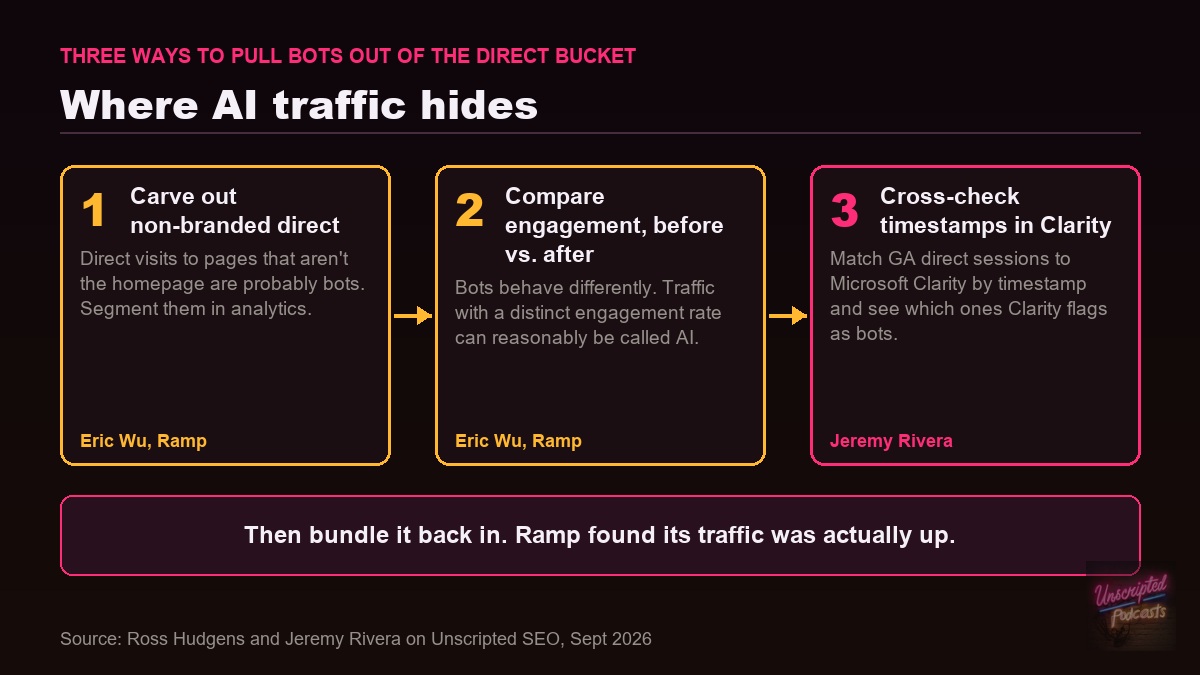
I found a second check while researching dark clicks in Search Console. With Claude Code connected to Google Analytics and Microsoft Clarity, visits GA called direct matched Clarity sessions by timestamp, and Clarity labeled them bots. You can run that comparison with a single prompt if both tools are on your site.
6. Check a placement’s traffic before you chase the citation
Ross is bullish on affiliate listings as a signal: if a brand like Geico can win the listings on “car insurance quotes,” that says something about the business. But every placement Siege goes after, Reddit and affiliate included, still gets judged on SEO fundamentals.
“People go get citations that have zero traffic. And I just think that’s pretty challenged.”
Before you pitch a page, pull its organic traffic and traffic value. A citation on a page nobody visits is ephemeral.
Where this leaves your GEO playbook
Every move above comes back to one idea Ross put plainly: the work that matters is “best practice independent of how the things change.” Community management, reputation management, CRO and reviews will matter whichever model wins. It’s the same durability test practitioners raised in what actually got people cited in AI search: would the tactic still be worth doing if citation behavior changed next quarter? So build the page, put the proof on it, and be specific about who you’re best for.
Hear the full conversation on Unscripted SEO, connect with Ross Hudgens on LinkedIn, and get the GEO book when it ships.