
Ross Hudgens, founder and CEO of Siege Media, has a cheap way to find the pages your site is missing: read your own reviews. On Unscripted SEO he described building long-tail use-case pages from the words customers use to describe their situation, then putting the proof for each one on the page itself, so a buyer, or the LLM shopping for one, never has to go looking for it. Long-tail use-case pages are a pillar of his book, Generative Engine Optimization: The Definitive Guide to AI SEO (Wiley, October 12, 2026). This SOP turns his method into seven steps a small team can run this week.
The printable SOP – plus every other SOP, playbook and episode pack – is free inside The Vault. Create a free account and take it with you.
Open The Vault →Objective
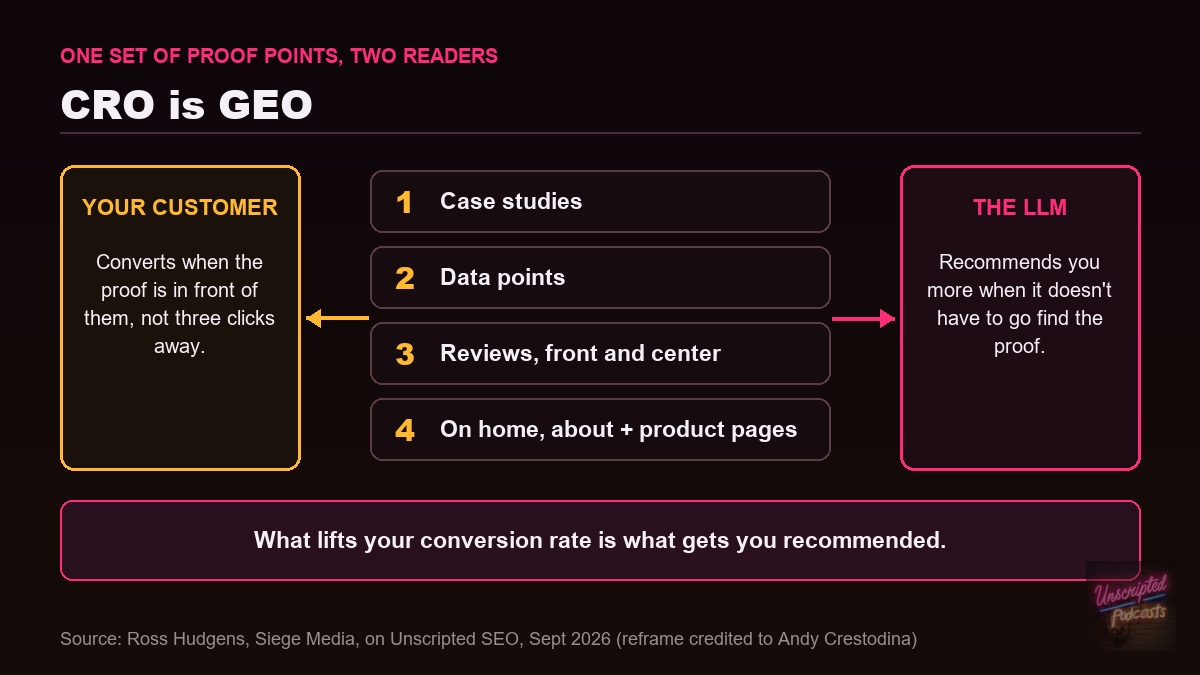
You finish with a short list of use-case pages, one layer deeper than your site goes today. Each targets a situation your customers named in their own words, is checked against keyword data, and carries its own evidence: the matching reviews, the data points and a case study. That covers both halves of Ross’s argument. The long-tail page answers a search your current pages are too broad for, and the proof on it is the thing that lifts conversion and makes an LLM comfortable recommending you. In his words: “CRO is GEO.”
Key Steps
- Pull every review you can reach into one file. Google Business Profile, G2, Capterra, Trustpilot, Amazon, app stores, testimonial forms, NPS comments. Keep the review text, the platform, the date and the reviewer name. Ross’s starting point: “you could use review data, see what kind of descriptors people are using in your review data.” (inferred – the platform list is the operational version; Ross says “review data”.)
- Have an LLM extract the descriptors. Paste the file in and ask for every situation, industry, team size, problem and “I used it for…” phrase customers use, with a count and two example reviews for each. Ross: “LLMs make it super easy to combine that with Ahrefs data, Semrush data, your tool of choice.” (inferred – the prompt fields and counts are the operational version.)
- Join the descriptors to keyword data. Run the top descriptors through Ahrefs, Semrush or whatever tool you already pay for, as “[category] for [descriptor]” and “[problem] + [descriptor]” permutations. Note volume and what the current results look like.
- Go one layer deeper than your current site. Map each permutation to an existing page (expand it) or a new use-case page under the right parent. Ross: “What are the unique permutations that your business solves? Maybe you had two layers deep, but now maybe it’s worth going three layers deep in just the complexity of what that user searches.”
- Cut the list to real demand and real fit. Keep permutations with search volume, or with a question a buyer would plainly put to ChatGPT, that your business actually serves well. Drop the rest. A page with no real answer behind it is a doorway page, and it will not convert anyone. (inferred – Ross does not describe the filter; this is the safeguard that stops step 4 producing thin pages.)
- Build each page with the proof on it. Put the reviews that use that descriptor, the data points and a case study for that use case near the top of the page. Ross asks three questions of home and product pages: “Do you have case studies there? Do you have the data points? Do you have your reviews front and center on your website to make it very obvious to LLMs, so they don’t have to go find them?” Say plainly who the page is for. Ross’s point about positioning applies here: a page that claims “best overall” is harder for anyone else to cite as best for a specific situation.
- Link the pages in and measure them as a group. Link each new page from its parent category or solution page and from your navigation, then report the set together. Track AI referrals and direct landings on these URLs, not only rankings. Ross passed on a proxy from Eric Wu at Ramp: most direct visits to URLs other than the home page are probably bots, so carve them out in analytics as an AI proxy. (inferred – the linking and group reporting are the operational version.)
Cautionary Notes
- Do not rewrite the descriptors into marketing language. The value is that they are the customer’s words. “Scheduling for crews of five” beats “workforce optimization for SMBs.” (inferred)
- Do not edit or invent review text. Quote reviews as written, with a name and platform, and only use reviews you have permission to show. (inferred)
- Do not expect review stars in the search results from your own reviews. Google stopped showing star rich results for self-serving reviews, where a business or organization marks up reviews of itself on its own site, in September 2019. The reviews still do their job on the page; the markup will not win you stars.
- Do not paste the same testimonial on every page. The proof has to match the use case. A generic quote repeated across twelve pages is the thin-content problem in a new place. (inferred)
- Do not skip step 5. Step 4 will happily produce a hundred permutations. Most of them should not be pages.
- This is a recommendation, not a measured result. Ross gave it as advice Siege gives clients, not as a test with a traffic number attached. Measure your own pages before you scale the pattern.
Tips for Efficiency
- Start with the platform where you have the most reviews. One large set gives cleaner descriptor counts than five small ones. (inferred)
- Put the same proof on your home page, about page and product pages. Ross’s list of spots that matter: “about page, home page, all the other important transactional spots.” The use-case pages are the long tail of the same audit.
- Ask sales and support which descriptors they hear on calls. It is a free second source that catches the situations reviewers skip. (inferred)
- Pair the use-case pages with versus pages. In the same interview Ross described a Siege correlation study where sites with versus articles were the most likely to have AI search traffic. See move 1 in the recap.
- Re-run the extraction every quarter. New reviews bring new descriptors, and the second run is one prompt. (inferred)
Sources & Relevant Episodes
- Ross Hudgens, Siege Media – he framed long-tail use-case pages built from review descriptors as a way to “educate that robot buyer,” and called them a big pillar of his book.
- Full interview recap: GEO Playbook: 6 Moves From Ross Hudgens to Earn AI Search Traffic
- Episode page: Ross Hudgens on Unscripted SEO · listen on Castos
- The book: Generative Engine Optimization: The Definitive Guide to AI SEO by Ross Hudgens (Wiley, October 12, 2026)
- More procedures: the full SEO SOP library