
What is a local citation, actually? Ask five SEOs and you will get a directory submission service quote from four of them. The most useful definition I have heard came from Bradley Benner on the podcast, and it has nothing to do with directories at all.
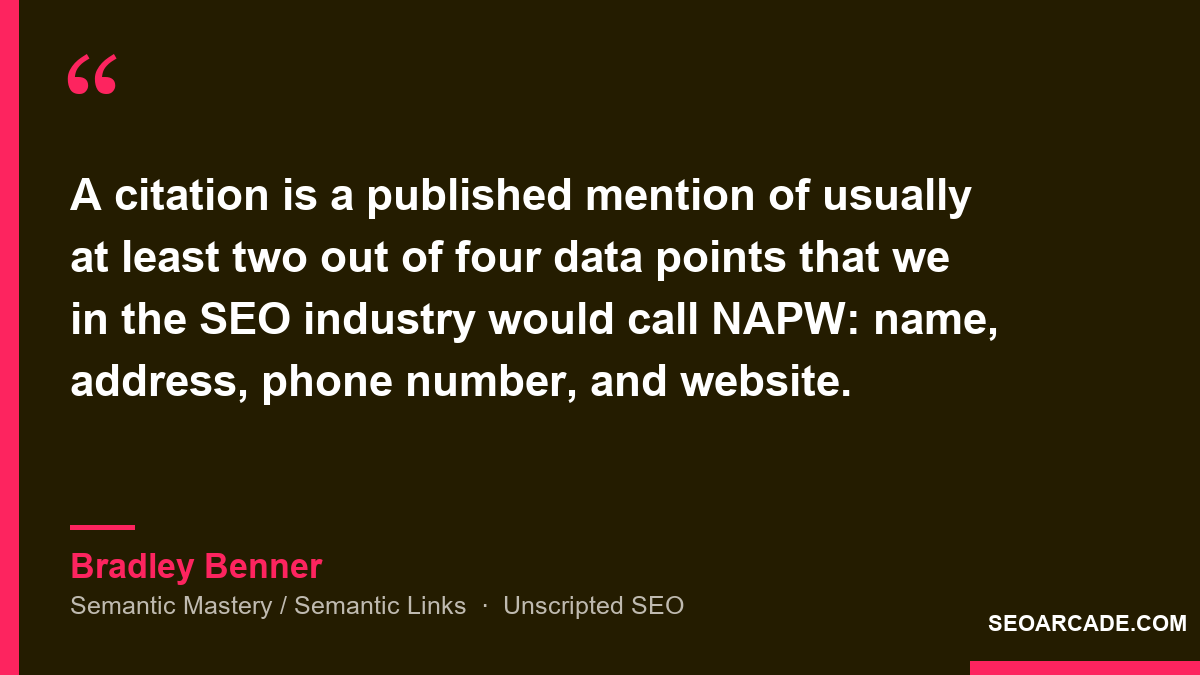
Two of four. Name, address, phone number, website. That is the whole test, and once you apply it you find citations in places no directory tool will ever show you — a chamber of commerce member list, a sponsor line on a little league page, a quote in a local paper with your town named next to your business.
Here’s how to build them properly, how to audit the ones you already have, and where the work has actually moved.
A citation is two data points, not a directory submission
Benner runs Semantic Mastery and a white-label off-page service, and he has been doing local SEO since 2010, when he was an electrical contractor trying to make his own phone ring. His framing splits citations by format, not by vendor:
“A structured citation is going to be very strict name, address, phone number with or without a website, but in a very structured format, like business directory listings. But unstructured citations are brand mentions with one of those other data points elsewhere on the web.”
Bradley Benner, Unscripted SEO
So a Yelp listing is structured. A sentence in a local news story that says your business name and the town you operate in is unstructured. Both are citations. Only one of them is sold as a monthly package.
How a citation actually gets used in a local search
This is the part that makes the rest make sense. Rob Bonham of The SEO Advisory walked through the sequence on the show, using the query everybody in home services cares about:
“You know, Google’s gonna first look at their GBP, what are the reviews look like there? And then it will start looking at other sources. It’s gonna look at Yelp. It’s gonna look at maybe a Home Advisor or other places where that plumber might have listings across the web, and they can get a reasonable understanding of what this individual [is].”
Rob Bonham, Unscripted SEO
Read that as a verification loop rather than a ranking factor. The profile makes a claim. The other sources either agree with it or they do not. Citations are how a search engine — or now a language model — checks whether the business you say exists is the business the rest of the web describes.
Which tells you exactly what a bad citation is. Not a low-authority one. An inconsistent one. A listing with your old suite number is worse than no listing, because it introduces a contradiction into the thing whose entire job is agreement.
Build the structured set once, then stop paying for it
The structured layer is a finite job. There is a core set for any local business, and once it is accurate and consistent, adding your four hundredth directory does nothing.
- Google Business Profile first. Get the name, category, address and hours exactly right, and match the guidelines for representing your business. Your business name field is the name on the sign, not the name plus three keywords.
- The big aggregators and the obvious platforms. Apple Maps, Bing Places, Yelp, Facebook, and whatever the two or three vertical platforms are in your trade — the ones a customer would actually check.
- Your own site. Mark up the NAP with LocalBusiness structured data so the canonical version of your own data is machine-readable on the property you control.
- One written source of truth. A single document with the exact string for name, address, phone and URL. Every future listing gets copy-pasted from it, by whoever does the work.
That last one sounds trivial and it is the reason most citation audits fail. Inconsistency does not usually arrive as a mistake. It arrives as a well-meaning employee typing “Ste 4” where the last one said “Suite 4.”
Google’s own explanation of how local rankings are determined is three factors: relevance, distance and prominence. Structured citations are how you get the first one right and how you contribute to the third. They are table stakes, and table stakes are worth exactly one careful afternoon.
Unstructured mentions are where the work moved
Benner is blunt about which half matters now:
“Press releases, branded assets, brand mentions on blog posts, things like that, those all can act as unstructured citations. And that’s what influences LLM or AI search visibility right now, more than anything.”
Bradley Benner, Unscripted SEO
And for local queries specifically, he is explicit about where to aim: “if it’s a local search query … then having brand references on hyper-local sources can help.” The whole 49 seconds is worth watching, because the structured-versus-unstructured distinction is the thing most people have never heard stated out loud:
Hyper-local sources are the ones a directory tool will never sell you, because they cannot be bought at scale:
- The chamber of commerce and your trade association’s member directory
- Sponsor pages — youth sports, a 5K, a school fundraiser, a community cleanup
- The local paper, the regional business journal, the town’s “new businesses” column
- Supplier and manufacturer “where to buy” or “certified installer” pages
- Event listings, permit notices, and neighbourhood association newsletters
- Podcast show notes and guest bios, if you go on local or trade shows
Every one of those puts your business name next to your town in a document somebody else published. That is the definition, satisfied, without a submission form.
Earn the unstructured ones with something checkable
Drew Dorenfest of Client Magnet CRM came at this from the AI-visibility side, and his answer to “what actually gets you cited” was not a tactic. It was a standard.
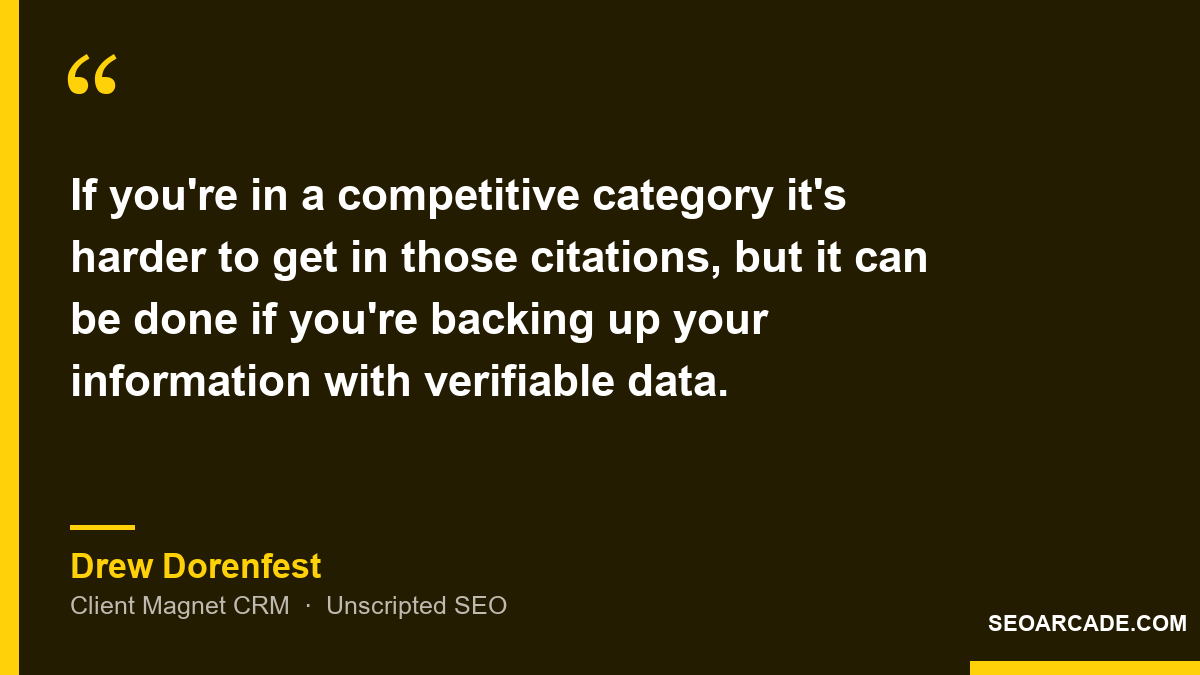
He is describing the same mechanism as Bonham, one layer up. A source cites you when citing you is safe. Verifiable data, a named person, a real address, a claim somebody can check — those make you a low-risk thing to mention, and low-risk things get mentioned.
The practical version for a local business is unglamorous. Have an About page with a real address and real people on it. Put your license number where a journalist can find it. Publish the one number you know that nobody else in your market has published, even if it is small.
Audit what you already have before you buy anything
You almost certainly have more citations than you think, and a handful of them are wrong. Run this before you spend a dollar on new ones:
- Search your own phone number in quotes. Then your business name in quotes, then the name plus the street. You are looking for pages you did not know existed, and versions of your data that disagree.
- List every variant you find. Old address, old phone, abbreviated suite, a former business name, a franchise-era spelling. This list is the actual job.
- Fix the top of the list first. The aggregators and the platforms that feed others. A wrong record upstream repopulates itself downstream after you fix the copy.
- Claim before you create. A duplicate listing you make because you could not find the original is a new contradiction, not a new citation.
- Reclaim the unlinked ones. Where somebody already named you without a link, a short thank-you email asking for one converts more often than any cold pitch will.
Tools help with the structured half. Whitespark’s citation finder and Moz’s primer are both reasonable starting points. Neither of them will find the sponsor page from the 5K you paid for in 2023, which is why the manual phone-number search stays on the list.
Spread beats repeat, and I have the numbers on that one
Here is one piece of evidence from my own network rather than from an interview. I crawled 25 of my WordPress properties in September 2026 — 1,350 published pages, 17,256 in-content links — and correlated what pointed where against Search Console and GA4 for the window 1 May 2025 to 1 September 2026.
The wording of the links did almost nothing: term overlap between anchor and query correlated with clicks at ρ 0.04, p 0.55. What did correlate was the number of distinct sites linking in, at ρ 0.33. The full method, including the trap that nearly produced a false positive, is in the anchor text study.
That is a link study, not a citation study, and they are not the same thing — I did not measure unlinked mentions and I cannot tell you they behave identically. But the shape of the finding matches what both Benner and Bonham describe: a mention on a tenth distinct source is worth more than a tenth mention on a source you are already on. Breadth of agreement is the signal. Volume on one property is not.
What I can’t tell you
Nobody outside the search engines can put a number on how much a single citation moves a local pack position, and anybody selling you one is guessing with confidence. What is verifiable is the mechanism: your data either agrees with itself across the web or it does not, and every system that decides whether to recommend you is checking.
So go search your own phone number in quotes right now. How many versions of your own business did you just find, and which one is the one you would want an AI to read out loud?
More on this: the short companion piece on Benner’s definition, the local citation building tactic and Google Business Profile optimization in the tactic library, and the wider local SEO and home service marketing guide.