
Ever feel like Google Search Console was lying to you?
Ever look at GSC data and feel…vaguely unsatisfied? Like, you might have more accuracy if you flipped a coin?
Welp. There’s a reason for that.
Google is ommiting MOST click data from it’s reports to you. I can prove it.
Looking across an annonymized cross section of 38 of the GSC profiles I have access too, looking at 4 million clicks, I had Claude identify just how much data click data Google is actually hiding behind a vague blanket statement about “annonymization”.
So… How bad is it?
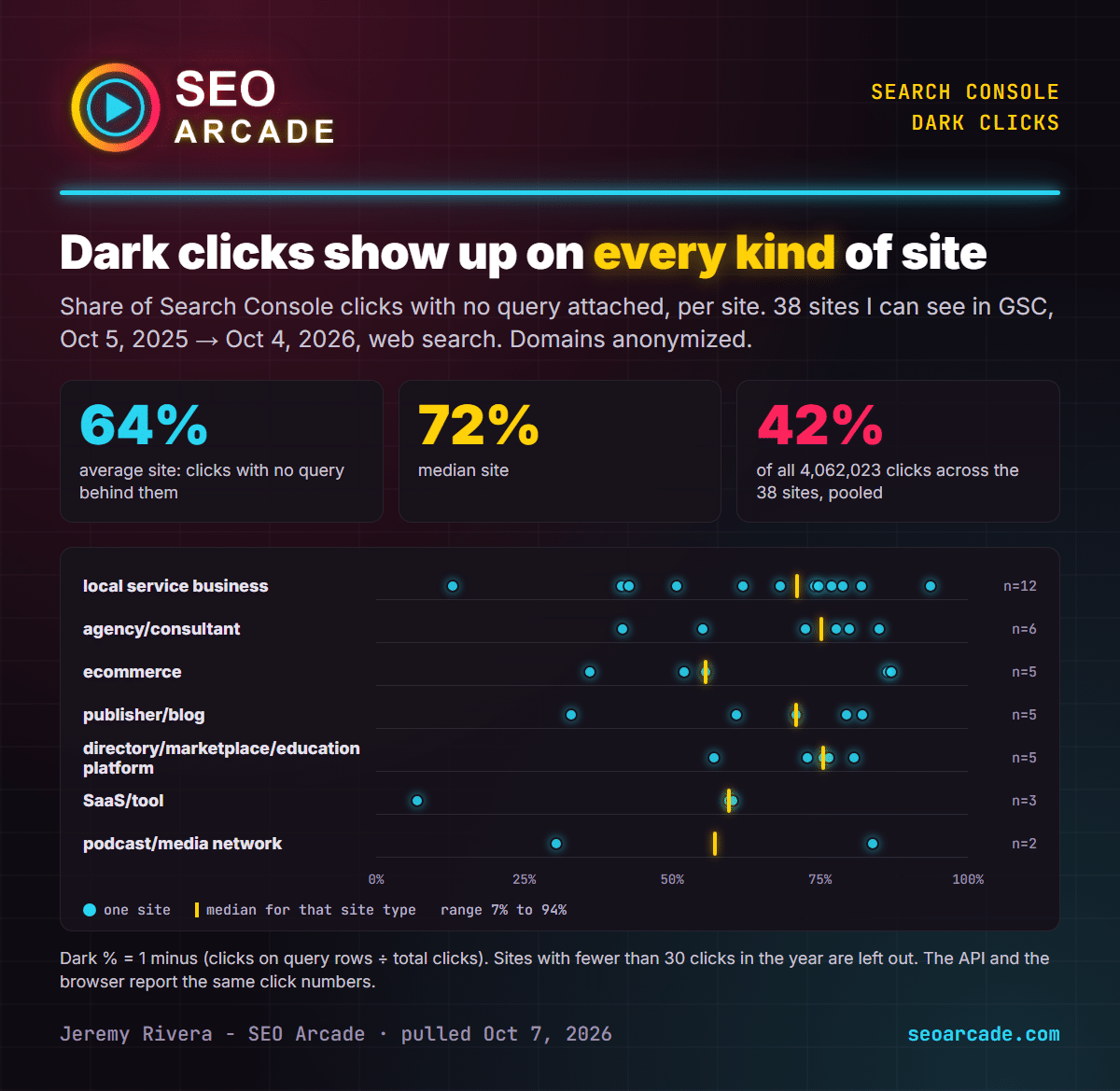
On the average site, 64% of the clicks Google Search Console reports arrive with no query attached.
Across 12 months of data from 38 sites, the median site is worse: 72% of its clicks are dark.
You can’t see what anybody typed to get them. You’re still expected to plan a campaign around them.
I’ve been saying a version of this on my podcast for a year. Here’s how I put it to Josh Shankowsky of Snap SEO:
“If you have a hundred clicks that’s reported in Google Search Console, you get table details for maybe 40 or 60% at most. That’s generous. And there’s many projects where it’s far, far even less… That’s less than a flip of a coin. And you’re making big SEO decisions based off of an average position data, based off of detail clicks for thirty percent of your queries. It’s attribution madness, honestly.”
Jeremy Rivera, Unscripted SEO with Josh Shankowsky (34:21)
If you think the table matches the total, you’re screwed
Open any Performance report and add up the Clicks column under Queries. It won’t match the Total clicks number at the top of the chart. It never does. The gap is what I started calling dark clicks, and I said it out loud for the first time talking with David Wilson of Zozimus:
“Google Search Console has what I call dark clicks. I don’t know if there’s another terminology out there, but if you look at the total number of clicks, then do the math on the table below, it does not match.”
Jeremy Rivera, Unscripted SEO with David Wilson (15:05)
With Greg Digneo of Content Guppy, I was blunter:
“If you go into Google Search Console data and think that the tabular query data actually matches the click data, then you’re screwed.”
Jeremy Rivera, Unscripted SEO with Greg Digneo (7:37)
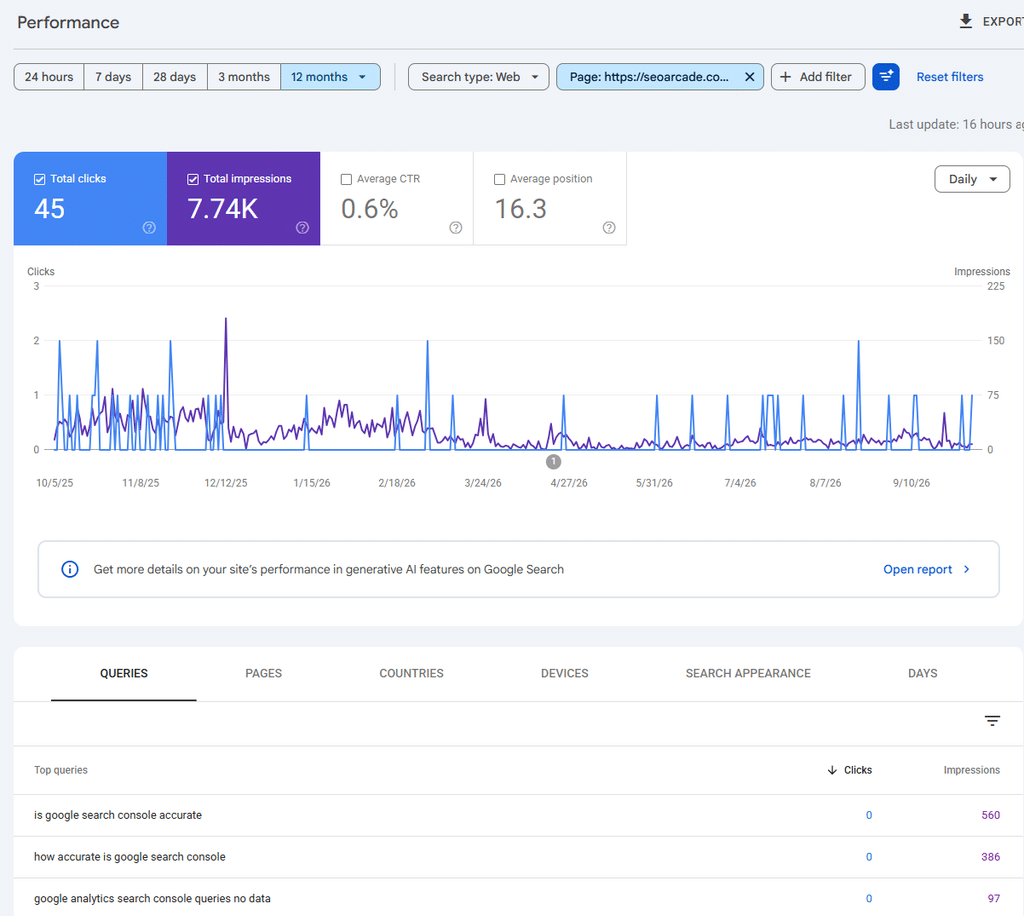
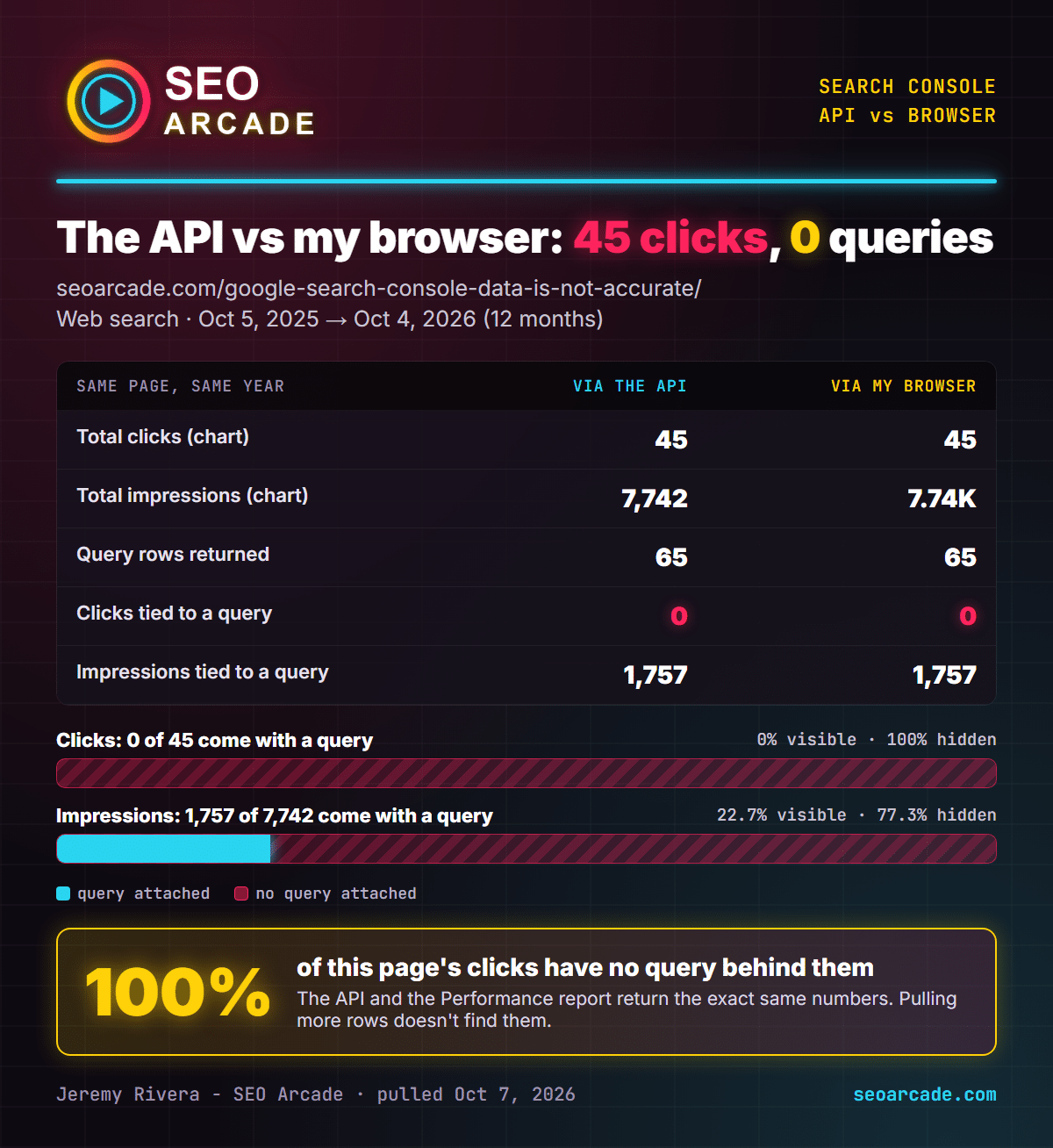
The irony is my own article. Google Search Console Data Is Not Accurate ranks, gets clicked, and over the last 12 months Search Console credited it with 45 clicks.
The number of those clicks with a query attached? Zero.
When I told Gert Mellak about it, the best I could manage was “it feels vindictive why they don’t want to give me that data.” Laura Iancu got the shorter version: every new report Google ships is “one more drip of attribution in a sea of dark clicks.”
Google says the hidden queries are still in your totals
This isn’t a bug, and Google doesn’t hide it. Here’s the definition, straight from Google’s performance data deep dive:
“Anonymized queries are those that aren’t issued by more than a few dozen users over a two-to-three month period. To protect privacy, the actual queries won’t be shown in the Search performance data. This is why we refer to them as anonymized queries. While the actual anonymized queries are always omitted from the tables, they are included in chart totals, unless you filter by query.”
Google Search Central, October 2022
Read that last sentence again. The clicks are counted. The words behind them aren’t. So your total is honest and your table is a sample, and Google doesn’t tell you how big the sample is. You have to do the subtraction yourself.
“A few dozen users over two to three months” sounds like a rounding error. It isn’t, because the long tail is where most sites live. A local plumber, a niche blog, a SaaS feature page: most of the searches that reach them are phrased a little differently every time, and every one of those phrasings sits below Google’s threshold.
Google’s John Mueller Says: “this privacy threshold is not going away”
If you were hoping this was temporary, Google’s John Mueller closed that door in The SEO Community Slack on October 8, 2026:
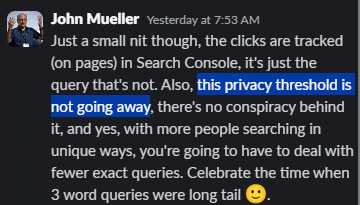
“Just a small nit though, the clicks are tracked (on pages) in Search Console, it’s just the query that’s not. Also, this privacy threshold is not going away, there’s no conspiracy behind it, and yes, with more people searching in unique ways, you’re going to have to deal with fewer exact queries. Celebrate the time when 3 word queries were long tail.”
John Mueller, Google Search Relations, in The SEO Community Slack
Two things in there matter for you. First, the clicks are real. Your page totals are right, and only the query is missing, which is exactly what the documentation says. Second, the threshold is permanent. Searches keep getting longer and more unique, so the share of clicks with no query attached grows from here. Build your reporting around the dark share instead of waiting for Google to shrink it.
Five decisions you’re making half-blind
Dark clicks don’t break Search Console. They break the decisions you stack on top of it. If you report on organic search, you’ve probably made at least three of these this quarter:
- Which page to refresh. You pick the page whose top queries dropped. But if 70% of that page’s clicks have no query, the queries you can see may not be the ones that moved.
- Your brand vs non-brand split. You tag the named queries as brand or non-brand and report the ratio. The dark share, often the majority, is left out of both buckets.
- Which keyword earned the lead. A client asks what someone searched before they called. For most clicks, Search Console can’t tell you.
- Average position as a progress metric. It’s computed across all impressions, but you can only read the queries Google chose to show you. That’s the “attribution madness” I was complaining about to Josh.
- Pruning content. A post with almost no named queries looks like it’s doing nothing. My own GSC-accuracy article looks like that, and it’s earning clicks every month.
You’re not the only one who has stopped trusting the table. Greg Digneo told me he mostly uses Search Console for a quick rankings check now: “I’ll get some like indicator of like, okay, impressions are up and maybe clicks are up. Like but like you said, it’s so bad at telling me that.” Gert Mellak went further and wrote off precision altogether: “Whatever data we get is flawed. Every single platform’s data is flawed… Google Search Console obviously is flawed as well.” And Laura Iancu, who is deep into AI search research right now, put it in four words: “It’s murky to say the least.”
You can claw some of it back. On the episode with David Wilson I walked through triangulating with regex filters, a third-party rank tracker and the Search Console MCP. I wrote that method up for OpenSEO in The Dark Query Problem, and you can paste the three prompts from Your Actual CTR straight into Claude. But you can’t recover what was never sent to you. That’s what the numbers below are about.
The numbers: 38 sites, 12 months, 4.06 million clicks
The study covers every Search Console property I have access to, collapsed to one per site, keeping the 38 sites with at least 30 clicks between October 5, 2025 and October 4, 2026 (web search). For each site, dark clicks = total clicks minus the clicks that sit on a query row.
- Mean site: 63.6% of clicks are dark.
- Median site: 71.8%. The middle half of sites runs from 52% to 80%.
- Range: 7% to 94%. Only 2 of 38 sites are under 25%. 30 are over 50%, and 15 are over 75%.
- Pooled across all 4,062,023 clicks: 42.3%. That’s lower because the two biggest sites, a restaurant chain and a smoothie retailer, attach more of their clicks to queries. Don’t quote 42% as “typical”. The typical site is the median.
Every kind of site goes dark
If dark clicks only hit tiny local sites, you could shrug. They don’t. Here’s the median by site type:
| Site type | Sites | Median dark clicks |
|---|---|---|
| Directory / marketplace / education platform | 5 | 76% |
| Agency / consultant | 6 | 75% |
| Local service business | 12 | 71% |
| Publisher / blog | 5 | 71% |
| SaaS / tool | 3 | 60% |
| Podcast / media network | 2 | 57% (small sample) |
| Ecommerce | 5 | 56% |
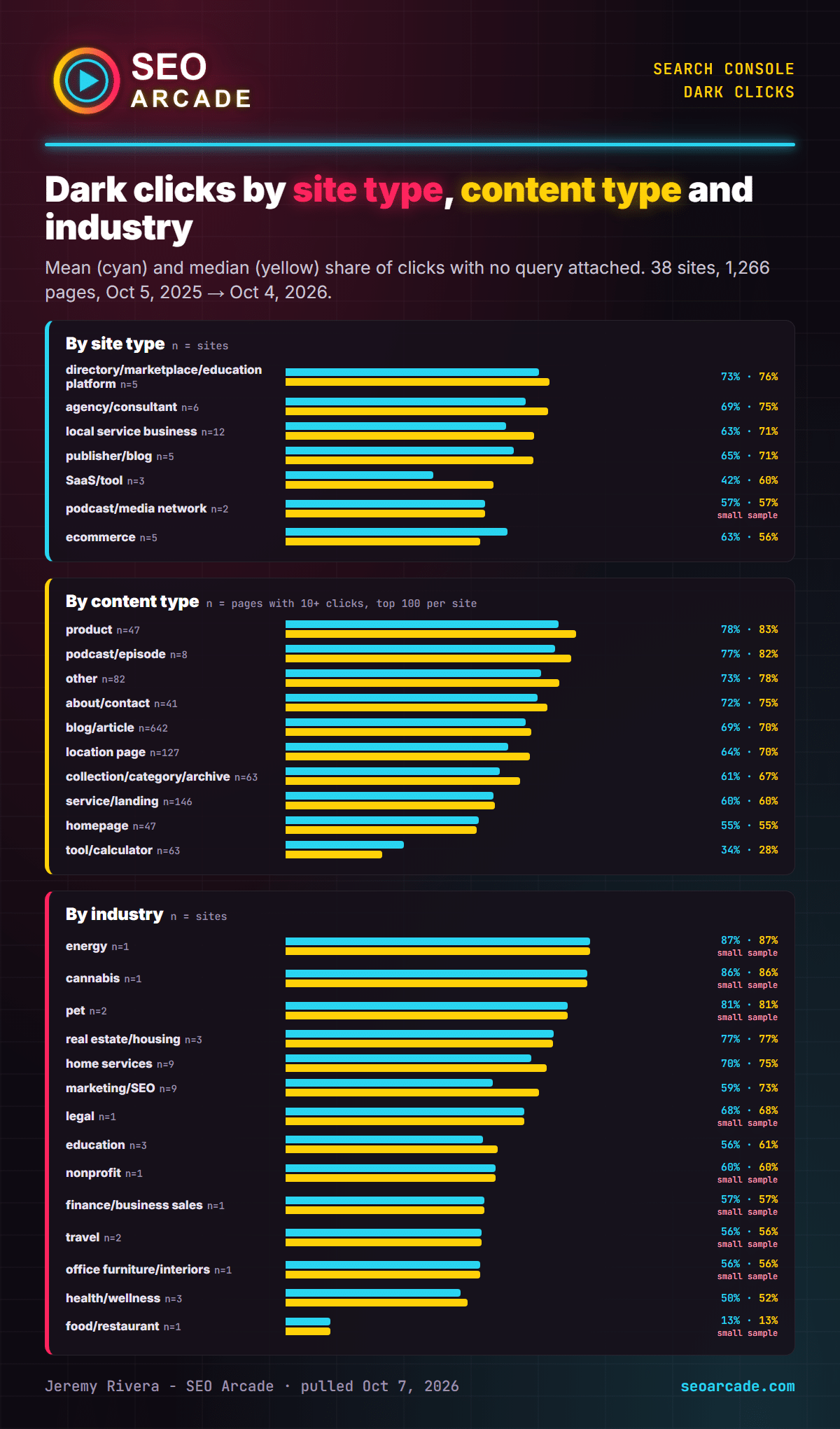
By industry the pattern holds wherever there’s enough data to say anything: home services 75% (9 sites), marketing and SEO 73% (9 sites), real estate and housing 77% (3 sites), health and wellness 52% (3 sites). Most other industries have one or two sites, so I’m not putting a number on them.
Every kind of page goes dark
The study also scored 1,266 individual pages (each site’s top pages with at least 10 clicks), so you can see where your own templates probably land. The median page is 69% dark. By content type:
| Content type | Pages | Median dark clicks |
|---|---|---|
| Product | 47 | 83% |
| Podcast episode | 8 | 82% |
| About / contact | 41 | 75% |
| Blog / article | 642 | 70% |
| Location page | 127 | 70% |
| Category / archive | 63 | 67% |
| Service / landing | 146 | 60% |
| Homepage | 47 | 55% |
| Tool / calculator | 63 | 28% |
Tools and calculators are the one category that stays mostly visible, because people search for them with the same few phrases over and over. Everything built around a story, a product or a person goes dark. Your blog posts, the pages you write to rank, sit at 70%.
Size matters, but not the way you’d hope. Sites with under 100 clicks a year run 85% dark. Sites with 100k+ clicks still run 47%. Getting bigger helps; it doesn’t fix it.
Pulling more rows doesn’t bring them back
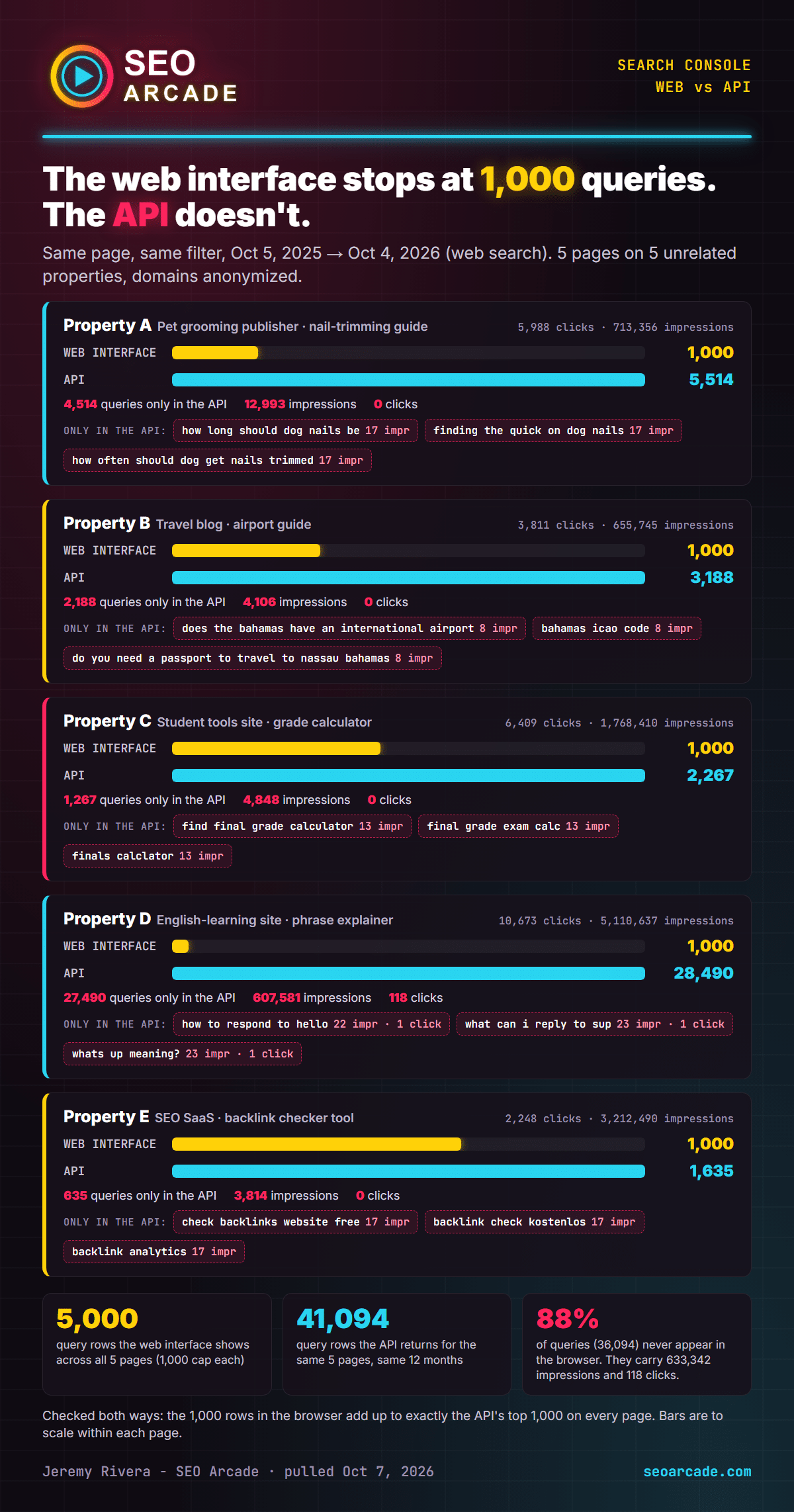
The usual answer to “Search Console hides data” is “use the API”. David Wilson made that point on our episode: “There’s a lot more information in Google Search Console than people think. The number of people I’ve spoken to who think you can only export a thousand lines of file.” He’s right about rows. The web interface stops at 1,000 query rows; the API doesn’t. More rows don’t touch dark clicks, though, and I checked.
Same page, same 12 months, pulled both ways. My GSC-accuracy article: 45 clicks, 65 query rows, 0 clicks on any of them, identical in the browser and the API.
Then five bigger pages on five unrelated properties, each with more than 1,000 queries. The API returned up to 28,490 query rows where the browser showed 1,000. The browser’s 1,000 rows added up to exactly the API’s top 1,000 every time. The extra rows were almost all long-tail impressions: 633,342 impressions and 118 clicks across all five pages. Meanwhile 13,159 of those pages’ 29,129 clicks had no query in either view.
Three whole sites, checked in the browser against the API, matched to the click on both total clicks and clicks on query rows. So the dark share isn’t something your export setup causes, and no tool you buy will undo it. It’s what Google sends you.
Reader-contributed sites
After the census went up, I asked other SEOs to run the same pull on their own Search Console and send back one row per site. Kyle Alm of SEO Bandwagon sent the first three on October 22, 2026, all from the same October 2025 to October 2026 window.
| Site | Site type | Industry | Clicks a year | Dark clicks |
|---|---|---|---|---|
| Northwest Hardwood Flooring | Local service business | Hardwood flooring | 100-999 | 78.5% |
| Schodowski Law | Local service business | Legal services | 1k-9.9k | 78.0% |
| Master Control Press | SaaS / tool | Developer tools | 100-999 | 66.7% |
All three land above the median for their site type in the original 38. With them in, the census is 41 sites: median 72.6%, mean 64.4%. Local service businesses move from 71.2% to 74.5% (14 sites), and SaaS / tool holds at 60% (4 sites). The pooled 42.3% stays on the original 38, because contributed rows don’t include click totals.
Want your site in the next update? Email me at jeremy@seoarcade.com and I’ll send you the prompt. It takes about five minutes, and your row stays anonymous unless you ask for credit.
How I measured it
- Source: Google Search Console API, search type web, final data only, October 5, 2025 to October 4, 2026.
- Sites: 84 properties deduplicated to 62 sites (domain property preferred, otherwise URL-prefix properties summed). 24 sites under 30 clicks were dropped from the averages, leaving 38.
- Dark clicks: 1 − (sum of clicks on query rows ÷ total clicks), per site and per page.
- Large sites: nine sites returned so many query rows that a single pull risked truncation, so their query clicks were re-pulled month by month and summed.
- Labels: site type, industry and content type were assigned by hand from each site and URL. Groups with fewer than 3 members are flagged.
- Contributed rows: readers run the same API pull on their own property and send back site type, industry, size band and dark-click share, never click counts. A site name only appears if the contributor asks for credit. Those rows count in the medians above, not in the pooled figure or the charts.
This is a census of the sites I can see, not a random sample of the web. My sites lean toward local businesses, publishers and SEO agencies. If your mix is different, your number will be too. Run the subtraction on your own property and find out.
For the other half of the accuracy problem (Search Console under-counting clicks it does report) see Is Google Search Console Accurate? I Checked It Against Clarity on 4 Sites. For the first dark-click study I ran on this site, see Hey Search Console! Where Are My Clicks?
So here’s what I’d ask you. When you tell a client which keyword is working, how many of their clicks are you actually describing? When you prune a post for “no traffic”, did you check the dark share first? And if 72% of your typical site’s clicks have no query, what exactly is your keyword report reporting?