
Your client’s competitors are feeding the same prompts into the same models, and the answers all sound alike. Josh Shankowsky, who runs Snap SEO in Edmonton, calls AI tools “consensus engines”: they report what most people are saying. On Unscripted SEO he walked through how he adds what those engines can’t guess and how he gets local businesses into the places AI answers come from. Here are the plays, written so you can run them this week.
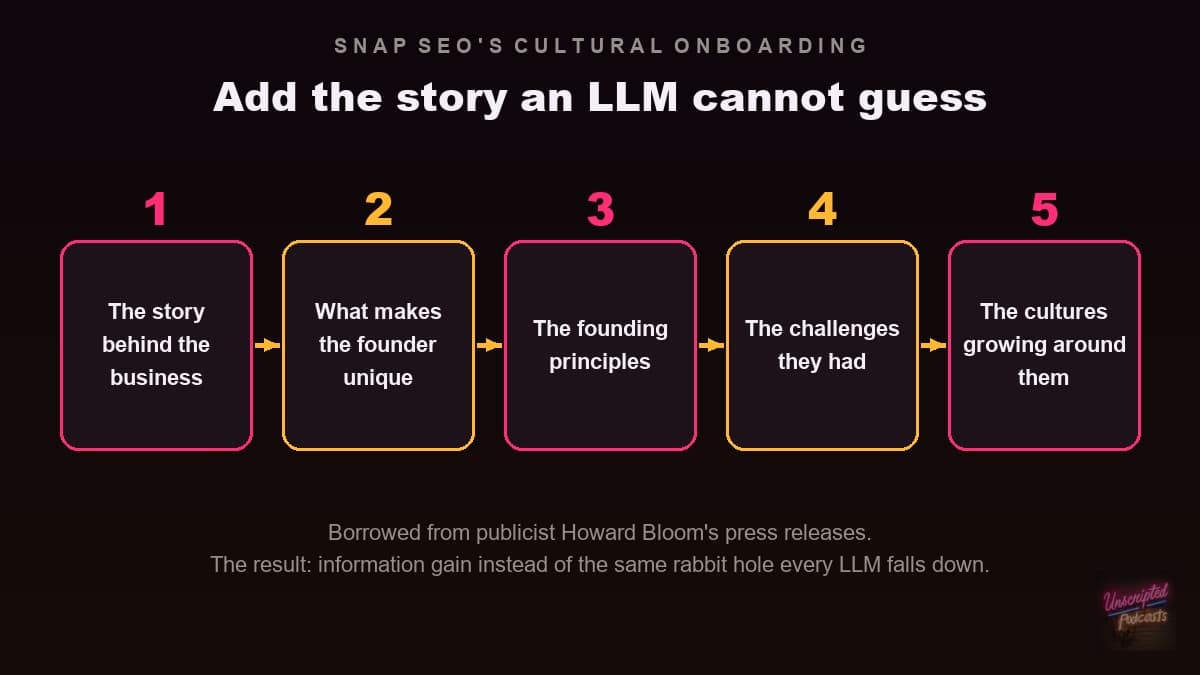
1. Run a cultural onboarding before you write anything
Josh reverse-engineered press releases from Howard Bloom, the publicist behind Prince and AC/DC, and turned Bloom’s focus on culture into a client intake. Ask for:
- The story behind the business.
- What makes the founder and the business unique.
- The founding principles.
- The challenges they had along the way.
- Which communities around them are growing or shrinking.
Then write those answers into the pages. That is information gain: detail a model can’t pull from the shared pool. His own gut check before any article is 10 to 15 minutes on “What is my brand? Who are my target clients? Why am I doing this in the first place?”
2. Check the copy against the information gain patent
Josh reads Google’s information gain patent and asks a blunt question of every landing page: is this commodity content? If a model could have written it from the consensus, it adds nothing to the results it’s competing with.
“These are consensus engines. They’re looking at what most people are saying.”
3. Sponsor local nonprofits for links that last
Find a little league, community league, charity or food bank. Donate. Ask for a link back and a social mention. Then publish your own blog post and social post about it, for yourself and for your clients. Nonprofit websites rarely change, so most of those links last over a year, and you pick up the nonprofit’s local audience. Josh finds candidates by giving Claude Cowork his browser, his criteria and a budget. One of his sponsorships, Santa’s Anonymous, turned into a Google Ads client.
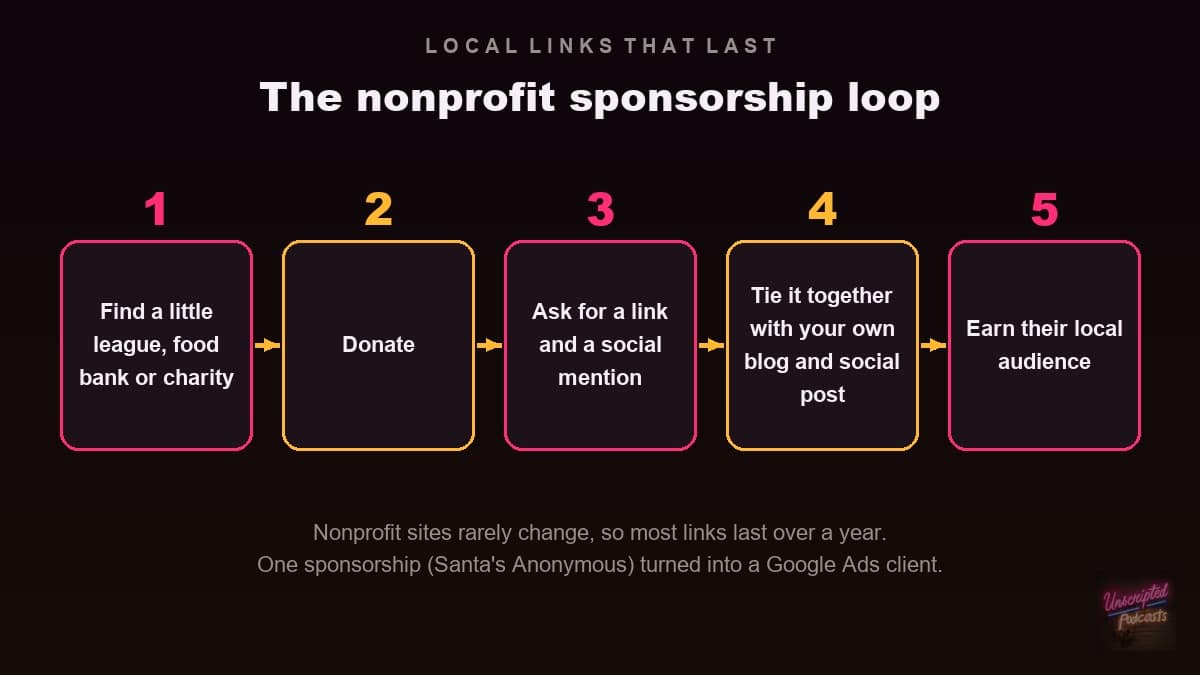
Run Josh’s sponsorship play with the SEO SOP: Build Local Links by Sponsoring Nonprofits – the one-page PDF is free inside The Vault.
4. Filter Search Console for “I am”
Open Google Search Console, add a query filter for “I am,” and read what comes back. Some people type their whole situation into the search box. Those queries show you customer pain points in their own words. Josh uses AI to write the regex and runs similar filters for “how to” and recommendation-style queries to build a secondary keyword list.
5. Use Bing to find the sources ChatGPT cites
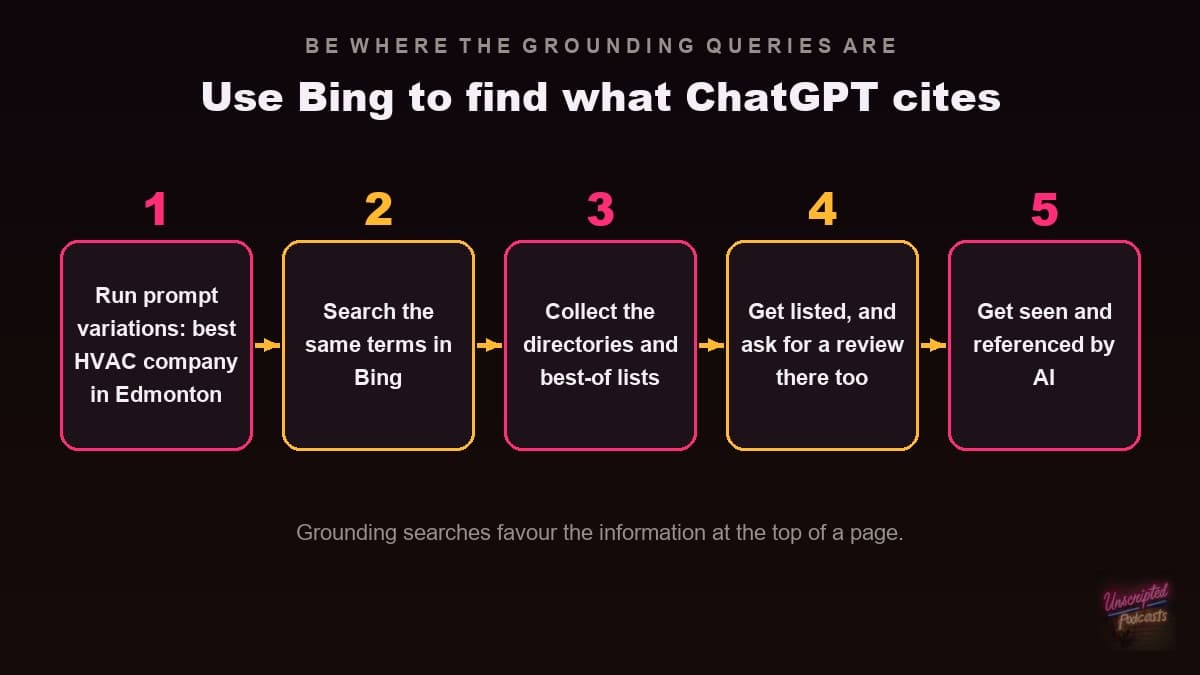
- Write prompt variations for the client’s money terms, for example “best HVAC company in Edmonton,” “best heat pump company,” “best heat pump company for commercial.”
- Run the same terms in Bing. ChatGPT leans on Bing, so the results line up closely with what it cites.
- List every directory and best-of article that shows up.
- Get the client listed, and ask a happy customer to leave a review on that directory too. Most competitors never bother.
- Pitch the best-of lists and look for guest post openings on the rest.
Grounding searches favour what sits at the top of a page, so put the facts you want cited first.
6. Localize the words, not just the city name
Canadian and US search behave alike, and Josh still uses US-traffic links. The difference is vocabulary. Toronto searches for home renovations. Edmonton searches for home reno and home remodeling. Research who lives in each city, including whether a pattern is generational or regional, before you pick the terms.
7. Hold course when rankings dip
Some of Google’s systems drop a rising site on purpose to see how it reacts. When a client panics, Josh tells them “you’re going to hate me, but it depends,” explains why, and holds course. Consistency, following Google’s documentation and steady link building beat reacting to every move.
Listen to the full conversation in the Josh Shankowsky episode of Unscripted SEO. For measuring what these plays do, see how far Search Console and Clarity drift apart in our 4-site accuracy check.