
What does a good service area page actually look like? Ask for examples and most of the internet hands you a template with a city name in brackets. So I went and found the pages that named local SEO experts have held up publicly as worth copying, checked whether each one still says what it said when they praised it, and put that next to what six of my podcast guests told me about building these pages for real businesses.
Here’s the short version. The experts agree on what belongs on the page: reviews from people in that town, photos of jobs done there, and something about the place that a template can’t fake. Where they don’t agree is how many pages to build. One of my guests builds fifty per keyword. Phil Rozek caps it at ten. Both have results to point at.
Ten pages or fifty? My guests don’t agree
Tom Malesic has run EZMarketing since 1997, with a team of about 27 people serving small businesses. When I asked him which local levers actually move, he didn’t hesitate:
“For the local business, I’m going to take whatever the core keyword is, and I’m going to build out local town pages for that. And then I’m going to take their next keyword, and I’m going to build out those same pages. So if it’s somebody with a tight radius, let’s say they have an hour radius around their business, well, then I’m going to look for towns that have maybe 2,000 or less… So I really view it as quantity.”
Tom Malesic, Unscripted SEO
Earlier in the same conversation he put a number on it: “let’s build 50 local service pages and keyword load those and make them unique. That’s been really effective for us.”
Now read Phil Rozek, who has been writing about city pages at Local Visibility System since at least 2015:
“My somewhat arbitrary limit is 10 pages. Beyond that number, it’s hard to make good pages and to avoid spreading your time and resources thin.”
Phil Rozek, 25 Principles of Building Effective City Pages, April 2015
He goes further, and it reads like a direct reply to Tom’s grid: “Don’t create a page for every city-service permutation. Sometimes I see companies that offer 5 services and want to reach 10 cities end up creating 50 pages… Yeah, don’t.”
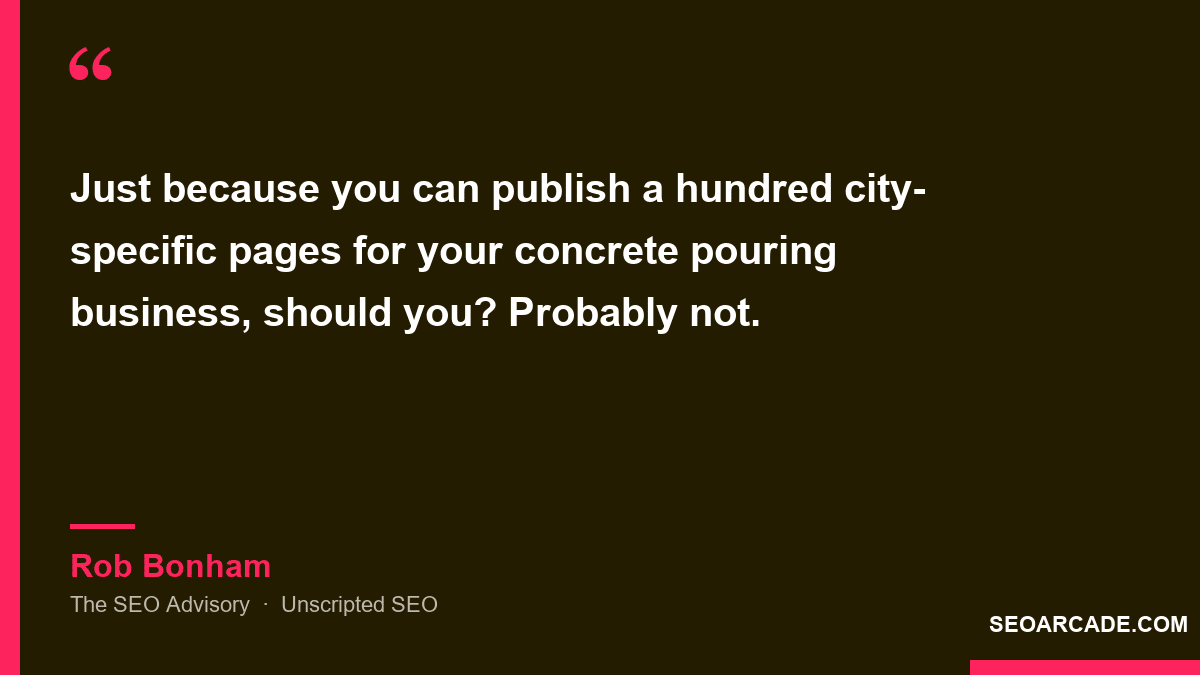
Rob Bonham, who runs The SEO Advisory, landed closer to Rozek. His worry is the new version of the old mistake. AI makes a hundred pages cheap, and “AI at its essence is typically regurgitating what it can find from other websites.”
Well, the truth is that the quantity camp has a condition attached that people skip. Tom said make them unique. Jake Melendy of Ignitvio told me his team ships fifty service pages at a time, and he was just as blunt about the rule:
“You can’t template it either, right? You can’t have like it be like whatever X, Y, and Z location, Roofer, and then have the exact same page 10 times on 10 different service pages. You need to put unique information for each of those towns or each of those zip codes.”
Jake Melendy, Ignitvio, recorded for Unscripted SEO
His engineers wrote a Python script that pulls local facts for each town from the local government site and its Wikipedia page, then hands that to a human copywriter who does the writing. He says it saves 20 to 30 hours a project. So “fifty pages” in his shop means fifty researched pages, not one page photocopied.
Two more guests push the count in a different direction: deeper instead of wider. Alex Zweydoff builds pages for named sub-communities inside a city, because property owners in Orlando’s Baldwin Park search for Baldwin Park, not Orlando. And Jonathan Schüßler built his wedding photography business around the ring of small towns outside a competitive region instead of fighting for the metro. Both plays have their own SOPs: sub-community and neighborhood geo pages and satellite-town location pages.
The service area page examples experts actually point to
Most “examples” posts are screenshots from an agency’s own portfolio. These are different. Each page below was named by a local SEO specialist, in public, with a reason. I checked every one on September 29, 2026, because a page praised in 2016 is often not the page you’ll find today.
| Page | Who pointed to it | What they said makes it work | Status today |
|---|---|---|---|
| Home Pride, kitchen remodeling (SF Peninsula) | Miriam Ellis, Whitespark, Oct 2025 | The main heading names the service area, plus photos, pricing, reviews, FAQ and a quote form | Live as praised |
| TE Certified, Buford GA (electrical, plumbing, HVAC) | Phil Rozek, 25 Principles, 2015 | Shown under “Include testimonials” | Live, now with a “Recent Jobs and Reviews in Buford, GA” section |
| Ice Dam Guys, service areas hub | Phil Rozek, Service Areas Page That Hunts, 2020 | “Lots of content on the places where the business has done jobs,” internal links to city pages, photos and videos | Live as praised |
| Ice Dam Guys, Massachusetts | Phil Rozek, city page template, 2016 | Reviews that cite the reviewer’s name and town | Live as praised, with dated job photos by town |
| Kamme’s Colorworks, service areas | Phil Rozek, 2020 | “Photos of jobs in specific areas,” and “a blurb on why each town is in the service area” | Live as praised |
| Pringle Law, Fort McMurray | Phil Rozek, 2015 | City info that even non-customers find useful (it has a section on the local courthouse) | Live (redirected) |
| Landscape Guys, White Bear Lake | Phil Rozek, 2015 | A genuine connection to the town, and city-specific offers | Live (redirected) |
| Central Mass Auctions, Boston | Phil Rozek, 2020 | “A ton of proof elements (photos, videos, reviews, and news appearances)” | Live as praised |
| American Eagle Investigations, Bronx | Colan Nielsen, Local Search Forum, 2019 | “Not the prettiest page in the world but man does it convert well” | Live |
| Roto-Rooter, San Ramon | Joy Hawkins, Local Search Forum, 2016 and 2019 | “I like the map, the list of services, the photo… and the awards” | Changed: the praised “Trusted in San Ramon for Over 80 Years” line is gone |
Two of Rozek’s examples have since died: the Tri-S Pest Control areas page now redirects to the homepage, and the PR Home Care domain is parked. That’s worth knowing before you send a client a list of “examples” from a 2016 post.
Notice what’s missing from the table, too. Not one of these is famous for its design. Nielsen said it outright about the Bronx page. The pages earned their place for what’s on them.
What those pages have that yours probably doesn’t
Line the expert checklists up against each other and the same items keep showing up. Here’s the overlap, with who said it:
- Reviews from customers in that town. Miriam Ellis, in her 2026 Whitespark guide to service area landing pages: “There is no more influential form of content you can include on a service area landing page than reviews from customers in that city.” Rozek wants the reviewer’s name and neighborhood cited.
- Photos of jobs done there. Ellis, back in her 2016 Moz post, asked for photos or video of one to three projects per city, labeled with the city. Rozek: “Photos of specific projects in specific cities are the best.”
- A real connection to the place. Rozek’s third principle asks whether you grew up there, whether employees live there, or whether you did your first or biggest job there. Elizabeth Rule at Sterling Sky lists company and employee connections to the area too.
- Local specifics a template can’t produce. Codes, weather, terrain, the problem every caller from that town seems to have. Rule adds cost data from your own jobs: “If you’re a roofer, add in cost info based on your own sales.”
- A way to act right now. A booking button high on the page, a phone number, a quote form. Ellis puts it near the top of her template.
Rozek’s own test is the one I’d use before building anything. After running through his list of questions for a city, he writes: “If you can’t answer ‘Yes’ to more than about 5 of those, hold off on the city page.” That one line settles a lot of the ten-versus-fifty argument. You can have fifty pages if you have fifty towns you can answer those questions about. Most businesses don’t.
Unique content wins, but duplicate pages still rank sometimes
I’d be lying if I told you templated pages never work. Colan Nielsen at Sterling Sky published an example in January 2023 of 35 service area pages averaging 84% matching content, and his conclusion was that such pages “can rank and drive traffic and leads, even if the content is duplicated or very similar.”
Melissa Popp of RicketyRoo told me the same thing from the other side: city-swapped pages, sometimes with lorem ipsum still on them, “rank because there’s not a lot of competitive space.” That’s the catch. Thin pages win where nobody is trying. The day a competitor in your market publishes a page with real reviews and real job photos from that town, the template stops being enough.
I’ve watched this movie before. Back in 2007 I worked with realtors who built one city page and swapped the name across thirty-five of them — Yorba Linda, Costa Mesa, Corona, the exact same copy. Google was better than that even then. Spend the extra five minutes. Is the town built around a university? Is there a nickname locals use for the main road? Put it in.
A service area page has to close the sale, not just rank
This is the part the ranking debate forgets. Melissa put it better than I can:
“Your location pages are supposed to be your bottom of the funnel content… people should already be convinced when they land there or have an immediate need to take an action. But so often you see these pages and no action takes place because they suck.”
Melissa Popp, RicketyRoo, Unscripted SEO
She also gave me the reason service area businesses need these pages at all. A business with a storefront gets a proximity boost in the map pack, and a service area business mostly doesn’t, so “supporting on the organic side by building out location pages can help mitigate some of that.” (Her full template is in Most Location Pages Suck. Fix Yours.)
Tom Malesic added one more move that matters now that people ask ChatGPT for a plumber. Put the questions on the service page itself, and turn your headings into questions:
“It’s taking the H2s and H3s and having that be a question where normally you might have had that just be more of a sales copy… Because every section of the page technically is answering a question. You just have to figure out what question are they asking that you’re answering.”
Tom Malesic, EZMarketing, Unscripted SEO
And once the page exists, get it found. What works for me is one external link to the new page plus a Google Business Profile post that links to it. When I do both, I rarely have to fight to get a new service page indexed.
So before you build the next one, ask yourself a few things. How many towns on your list can you actually answer Rozek’s questions about? Do you have a single review that names that town? A single job photo from it? And if a homeowner there landed on the page tonight with a failed AC, is there anything on it that would make them call you instead of the next result?
More on this: Melissa Popp’s location page template, the location page strategy in the strategy library, how to build local citations that actually do something, and the full local SEO and home service marketing guide.