
🎧 Listen to the episode:
I sat down with Joshua Altman of Beltway Media — a fractional Chief Communications Officer with a background covering Congress as a multimedia journalist — and walked away with a sharper way to think about the thing SEOs quietly struggle with most: proving that any of this actually works. His answer reframes attribution, AI, and content in a way that maps almost perfectly onto how I now run SEO Arcade.
The attribution problem SEOs won’t admit
Joshua doesn’t soften it. The old “7 to 14 touchpoints to a purchase” number, he says, is ancient history:
“That number’s probably a lot higher now, close to 30 or more, just because we see so much more content. Think about everything you see when you scroll on your phone — that’s one touchpoint. You see the same ad four times, that’s four.”
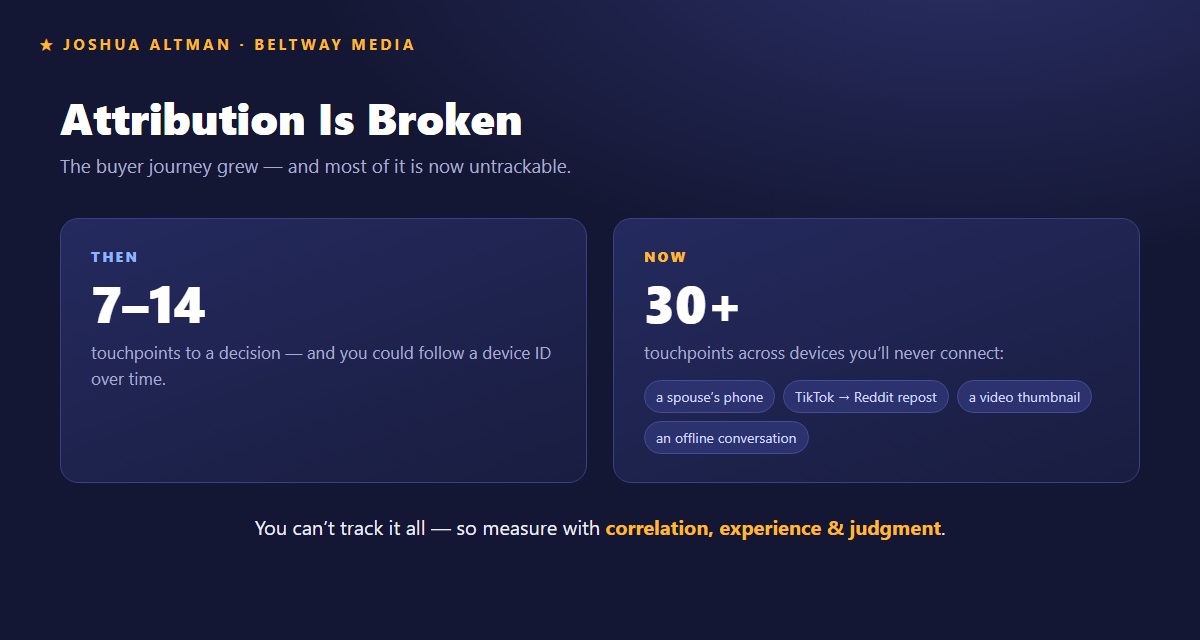
And the worst part is the touchpoints that matter most are the ones you can never see:
“Especially if you watch something on your spouse’s phone — that’s you watching it. It primed you, but you watch it on a totally different device that will never be tracked to you. That conversation you had with your spouse about it, that was an important part of that buyer journey. But we can’t measure that.”
His warning is the part every performance marketer needs to hear: chasing one-to-one cause and effect doesn’t just fail, it actively backfires.
“Looking for it and making decisions based on that frequently leads to the opposite of the results people want, because you’re losing what builds up the buyer to make the decision.”
This is exactly why I keep arguing that the data in your analytics isn’t as accurate as you think. It’s a proxy, not the thing itself.
What to measure instead
Joshua isn’t a “trust us, ignore the numbers” guy. His replacement is correlation plus judgment, tested deliberately:
“If your clicks and your buying and your inbound traffic and all those things are going up, if your subscribers are going up, if all these things are trending in the right direction and happening together — yes, it’s just correlation. But you could drop everything for a short period of time and focus on one specific channel. What happened to sales? What happened to inbound leads? What happened to mentions?”
And his historical gut-check is the line I keep repeating to clients:
“We didn’t have all these metrics for most of modern history … Businesses grew. Businesses made money. The system worked without knowing the exact device someone used and how deep they scrolled on a page. That’s Sears — they sent catalogs to people’s homes and people made purchases.”
The Four Languages model
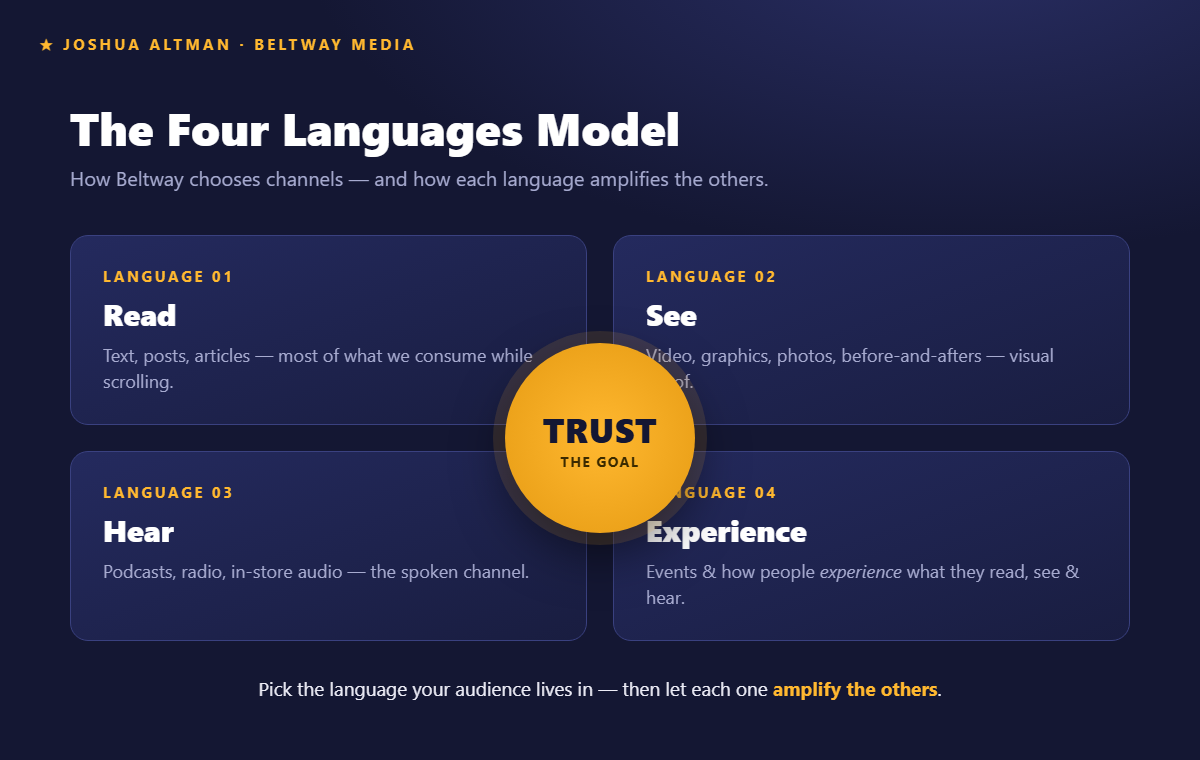
When I asked how he chooses channels, Joshua reached for his core framework:
“We start with our four languages model — what people read, see, hear, and experience … and we look at how each of these languages amplifies the others.”
He’s refreshingly anti-hustle-culture about output, too — which is the healthiest content advice I heard all year:
“There are no content police. These aren’t laws of nature. No one is gonna come after you … So if you do one a week, you do two a week, and that makes sense in your cadence — that makes sense in your cadence. And we repurpose a lot. One post, one idea can become a post on every channel.”
That repurposing instinct is the entire premise behind the resources in our SEO Knowledge Hub.
AI: the tool, not the voice
Joshua uses AI openly, but he’s precise about where it belongs:
“Bots are really good at talking to other bots. So there are bots that optimize websites and sales pages, front end and back end … But if you need to fill a new page with all the keywords and metadata and schema and all the back end stuff so it surfaces correctly for the bot, we have a bot that does it — and then of course we check it, because we all know it hallucinates.”
That “fill the page with schema so it surfaces for the machine” move is a tactic in its own right — see schema markup for AI visibility in the Tactic Library. His research workflow was just as disciplined:
“It could only use official government sources — Census Bureau, Department of Public Health. It couldn’t just use Josh’s website of things to do in Orlando as the source. And it had to provide all the sources to us. It did that within minutes … but you have to be very specific. It doesn’t know if you want Paris, France or Paris, Texas.”
Honestly, this is the same thing I did to build the SEO Tactic Library in an afternoon — strict parameters, real sources, human verification.
Here’s how granular that gets for me: I’d just interviewed Ben from OpenSEO, and now I can turn those notes into a resource doc for myself, a blog post, or a quote graphic — then push it live through an MCP that cross-posts once I approve it. The friction kind of goes away.
Useful content is link-earning content
Joshua’s closing philosophy doubles as the best link-building brief I’ve heard:
“Everything you produce should be useful. An ad that’s just a billboard doesn’t help anyone. But things that provide value and help people will drive people to you … Even if you’re a home remodeler — DIY tips. Give them a reason to discover you and learn about you.”
Useful assets earn discovery, citations, and trust. A billboard earns nothing. It’s the same reason my friend Matt Brooks at SEO Teric and the team at OpenSEO keep pushing genuinely helpful tools over thin content — and it’s the whole thesis of the SEObits library.
Where to find Joshua
Beltway.media · free tools & quizzes · LinkedIn · JAltman@Beltway.media. Heard on the Unscripted podcast, hosted by Jeremy Rivera.