
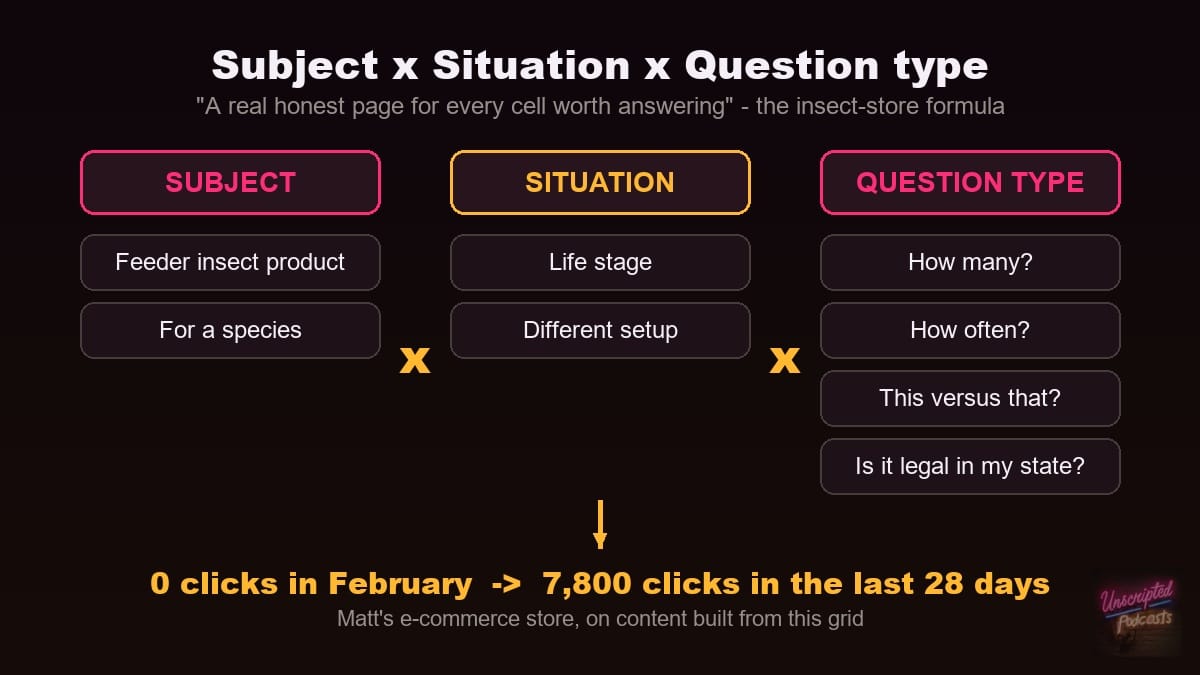
A question map is a grid of everything you sell, every situation a customer buys it in, and every kind of question they ask about it, with one honest page written for each cell worth answering. Matt Goren of RunOctopus laid out the formula on Unscripted SEO in November 2026: “the subject, the situation, and the question type, and then a real honest page for every cell worth answering.” This SOP turns his formula into a process you can start this week, by hand, with a spreadsheet.
The printable SOP, plus every other SOP, playbook and episode pack, is free inside The Vault. Create a free account and take it with you.
Open The Vault →Objective
You finish with a question map for your business: a sheet of subject, situation and question type cells, the cells worth answering marked, and a publishing order. Each page you write from it answers one real customer question in a way a page about a different cell couldn’t. The goal is to become the source an AI tool recommends when a customer asks it about your topic. Everything attributed to Matt comes from the November 2026 recording.
Key Steps
- Write the ten questions you want to be the answer to. This is where Matt tells people to start if they aren’t using a tool: ten questions customers would ask ChatGPT where “you would want to be recommended for, you’d want to be the answer.” Write them the way a person talks to a phone, not the way a keyword tool lists them. (inferred)
- List your subjects. A subject is a product or a service. Matt’s store sold feeder insects, so each product was a subject. A local installer’s subjects are the jobs they do. Put one per row in a sheet.
- List the situations each subject meets. For the insect store, Matt said a product is for a species, the species is at a life stage, and it can live in a different setup. For a local business, the situation is the place, the season, the weather and the size of the job. When I offered a concrete wall installer in Pensacola, he went straight to hurricanes: “can I do concrete walls after a hurricane?”
- List the question types. Matt’s list: “How many, how often, this versus that, is it legal in my state” and why won’t it work. His Pensacola riff added cost (“How much do concrete walls cost in Pensacola?”), timing by season, and who to hire for a big project.
- Cross the three lists and keep the cells worth answering. Every subject x situation x question type combination is a cell. Cut the ones no customer would ask. (inferred) Don’t cut a cell because a keyword tool shows zero searches. Matt’s point on low-volume queries: if a tool shows a fifty-a-month search as zero, “it’s like, well we shouldn’t work on it. No, you should.”
- Write one honest page per cell, built on the real difference. A winter page and a summer page have to say different things about that season in that place. Matt’s warning about the old way: “We used to be able to just be like, in winter and there’s change three words.” If you can’t name what changes for the customer in that cell, merge it into a neighbor. (inferred)
- Make the set easy for machines to move through. Matt’s bar for the pages: “But now they have to be great and they have to be navigatable by technology.” Give each subject a hub page, link it to its situation and question pages, and link sibling cells to each other. (inferred)
- Check where you stand, then repeat. Run your ten questions through ChatGPT and Claude by hand and note who gets recommended. Matt says you can do this without his tool. In Search Console, study the clicks and the query phrases that do show, and remember that a large share of clicks arrive with no query attached (see SEO Arcade’s dark clicks study). Add the next ten questions each cycle. (cadence inferred)
Cautionary Notes
- Don’t generate the pages in one prompt and paste them up. Matt said getting an article from ChatGPT or Claude and putting it up is “just not going to cut it.”
- Don’t publish near-duplicates. A cell whose page only swaps the city or the season name is a cell to merge, not a page to ship. (my judgment)
- Get “is it legal in my state” pages checked by someone who knows the rules in that state, and date them. (inferred)
- Treat the results as Matt’s own report. He says his insect store went from zero clicks in February to 7,800 in 28 days on this formula. That’s his on-tape figure, and his case study page reports a different window. RunOctopus sells software that builds these maps, so he has a stake in the method.
- Short pages won’t carry it. Matt doesn’t think “five hundred word articles, even nine hundred words or a thousand word articles are enough anymore.”
Tips for Efficiency
- Build the map in a spreadsheet with one row per cell: subject, situation, question type, the question in plain words, page URL, status. (inferred)
- Ask the people who answer customers. Matt’s framing: “What are they up to? What are they asking? Why would they be asking?” Your installers, sales staff and inbox already hold those answers. (sources inferred)
- Start with the cells where the job is expensive and the competition is thin. Matt’s example was a concrete wall job he guessed at several thousand dollars with few searches. (prioritizing is inferred)
- Local businesses have room here. Matt’s test: ask ChatGPT for the best coffee shop near you, and “Starbucks is never going to be recommended.”
- Browse more repeatable plays in the SEO SOP archive.
Sources & Relevant Episodes
- Matt Goren, RunOctopus – described the subject x situation x question type formula behind his feeder insect store, then built a live map for a Pensacola concrete wall installer, on Unscripted SEO, recorded November 11, 2026. Find him at runoctopus.com.
- Read the agency version: Matt Goren on building a question map for AI search on SEO Arcade. Read the episode recap: why AI search recommends the expert, not the biggest brand on Unscripted SEO.
- Listen to the full episode or watch it on YouTube.