
On the Unscripted SEO podcast, Zak Ali — General Manager of Finder US — laid out one of the sharpest working models we’ve heard for where organic search is actually heading. Here are the practitioner takeaways worth stealing.
1. Optimize for surfaces, not a search engine
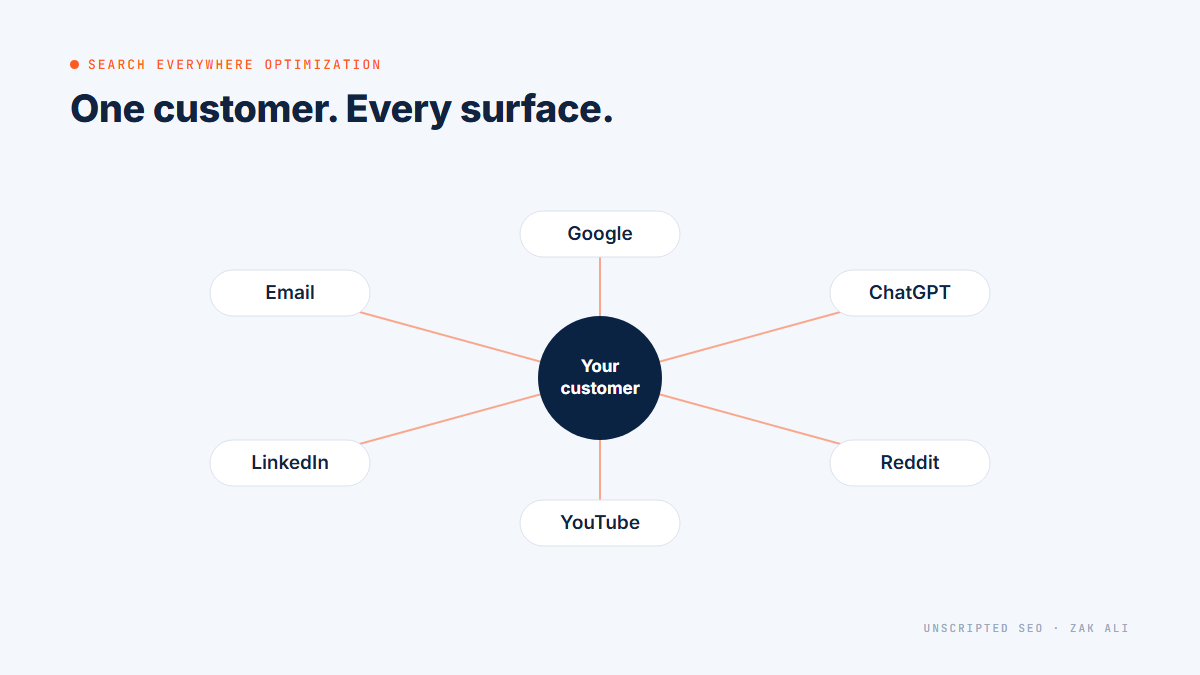
Zak calls it “search everywhere optimization” (see AJ Kohn’s surface optimization). Run a content waterfall — article → YouTube → shorts/reels — because you can’t coast off one surface anymore.
The framing came out of a question I put to Zak — whether SEO and AI search are two circles on a Venn diagram, or something more nested:
Jeremy Rivera: SEO isn’t an overlap on the side of a Venn diagram. SEO is within LLMs, and the LLM shell extends over the top — and it also cross-covers social media and visibility on other sites. Would you agree with that?
Zak Ali: Yeah, totally. I think LLM really is what took it from search engine optimization to search everywhere optimization, as some folks call it. So now it’s really about being on every discoverable surface.
Jeremy Rivera: Did you read AJ Kohn’s newest article this week? He called it surface optimization.
Zak Ali: I agree with that wholeheartedly.
That’s the whole shift in a sentence: you’re no longer optimizing for a search engine, you’re optimizing for wherever the answer gets formed — Google, ChatGPT, Reddit, YouTube. It’s the same idea Federico Fancinelli hit from a different angle when he argued you rank entities, not pages, and it’s why Christopher Gimmer watched a #1 ranking still lose clicks to AI Overviews. (Host note: I’ve started framing it as three nested layers — SEO lives inside the LLMs, which live inside surface optimization.)
2. Your job is digital PR
“There are two types of SEOs… and SEOs who haven’t realized yet that their job is digital PR and branding.” Steer into brand, mentions, and being talked about — the assisted-conversion value you can’t put on a Looker Studio dashboard.
Zak didn’t just say it — he restructured his whole team around it:
Zak Ali: There are two types of SEOs that exist today. There are the technical SEOs, and there are SEOs who haven’t realized yet that their job is digital PR and branding.
Zak Ali: That’s actually why, last May, I decided to kill the SEO team and just had a generalist marketing team… you have to be able to attack every surface. Our editors couldn’t just be editing writing — they had to be a spokesperson. You need to see yourself more as the niche messenger.
It’s a hard pill for a discipline that spent fifteen years perfecting the technical checklist. But the logic holds: in a zero-click world, the value SEO creates — brand preference, community, the assisted conversion — is exactly the stuff you can’t draw a clean line to on a dashboard. It also reframes what “authority” means: as Rob Bonham put it on the show, whoever has the bigger footprint and the most people talking about them wins the SERP.
3. Make retention a KPI
“The traffic you have today is as cheap as it’s going to be.” Treat SEO as audience acquisition and cultivation — capture the ephemeral Discover/News visit before it disappears.
This came out of a riff on whether SEO should really be thought of as audience acquisition:
Jeremy Rivera: Is the long-term play to consider your role audience acquisition — even if you’re installing concrete walls in Florida, capturing the contractors going out to bid the walls, putting out helpful industry material for the sake of a captive audience?
Zak Ali: One thousand percent, yes. The traffic you have today is as cheap as it’s going to be. It’s only going to get more expensive. So as much as you’re getting now, you want to keep it, retain it. Retention should be a core KPI of every SEO… it’s audience cultivation.
He points to Google Discover and News as the cautionary tale — traffic that’s “very ephemeral” (something I’ve watched first-hand consulting on large Discover-driven sites: you’re there, and then you’re gone). The publishers winning that game — Axios and the like — gate even free content behind an email so an ephemeral visit becomes a relationship. If you’re measuring SEO, that means watching where the traffic goes, not just that it arrived — the same lesson behind why your analytics are lying to you.
4. Win with information gain + anecdotes
AI commoditized the drafting; it can’t reproduce first-hand experience. Original research, real anecdotes, and expert commentary are the moat — exactly the thesis behind our podcasting-as-an-SEO-service approach.
The insight AI can’t touch came near the end of the episode, when I laid out the two things that make a real conversation worth more than a generated article:
Jeremy Rivera: There are two factors to each podcast that are super valuable. One is information gain — a factoid or tactic that’s new. But as equal in value are the anecdotes, because LLMs don’t have experiences. At best they can poorly copy somebody else’s. I can just say “Darmok and Jalad at Tanagra” and five slices of meta-information come with it — an LLM can reference it, but it can’t generate a new one.
Zak Ali: That is so smart. And I love the TNG reference… you’re so right. AI automation buys you the time to go find those anecdotes, build the calculator, make the graphic that gives your piece the extra oomph your competitors won’t have.
That’s the practical move: use AI to clear the commodity work, then spend the reclaimed hours on the first-hand experience a model can only paraphrase. It’s the exact premise behind why podcasting works as an SEO engine — every episode is original, un-scrapeable source material.
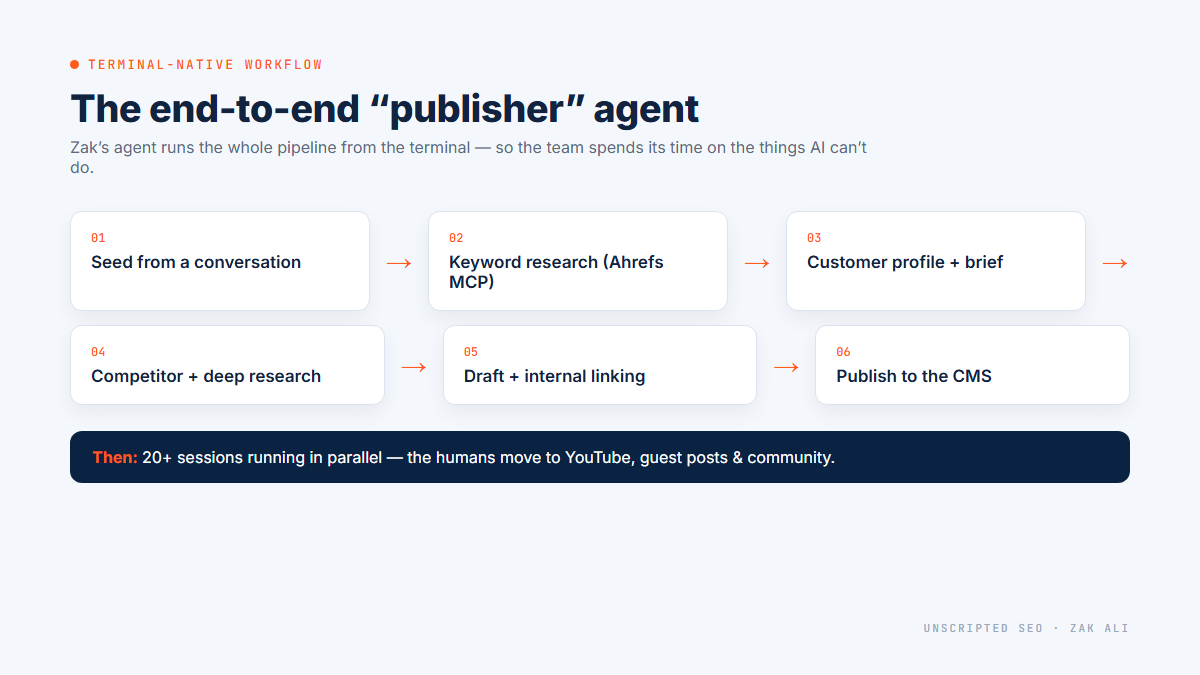
5. Go terminal-native
Ahrefs over MCP in Claude Code, build-your-own trackers on a free DataForSEO tier, and open-source SEO tooling with an MCP. The data has been democratized — use it for direction, then think like your customer. Related: Adrian Nikolov, Federico Fancinelli, Mason MacUmber.
On the tooling itself, Zak was refreshingly un-precious:
Jeremy Rivera: What are some tools you’ve been in love with this season?
Zak Ali: I really love the Ahrefs MCP — we’ve been moving everyone to Claude Code, so being able to call Ahrefs and get keywords and do large-scale analysis from the terminal has been really good… But the landscape has been so flattened that you don’t need to pay thousands of dollars for Profound or Otterly. You can build your own LLM tracker with a free DataForSEO tier and AI.
Jeremy Rivera: There are even open-source SEO tools now — everything in Ahrefs but ten dollars a month, with an MCP. I’ve got my GA and Search Console flowing through it; I’m living so much more in my Claude Code terminal.
The through-line: the data has been democratized, so the edge is no longer access — it’s judgment. Use the tools for direction, then think like your customer. (If you’re shopping the affordable end, we keep a running list of affordable keyword tools for lean teams.)
Listen above; connect with Zak on LinkedIn.
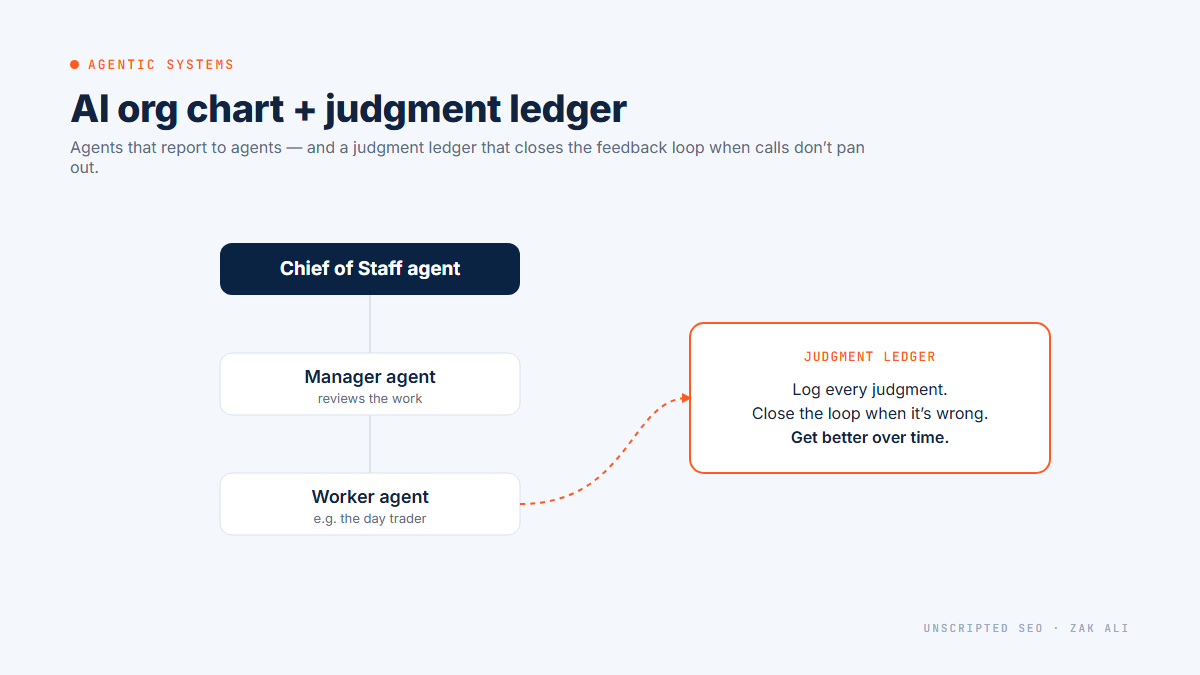
The full episode as a designed eBook, plus the slide deck of the key ideas.
📖 Download the eBook (PDF) →📊 Download the slide deck (PPTX) →
Turn this interview into action with the SEO SOP: Build an End-to-End “Publisher” Agent — plus a free, no-gate PDF.