
Here’s a number I keep coming back to: on the average site, 64% of the clicks Google Search Console reports arrive with no query attached. I measured that across 4 million clicks in the dark clicks study, and it lines up with how people search now. Nobody types “running shoes” into an LLM. They talk for a minute about what they want and why. So when I sat down with Neil Thubron on Unscripted Small Business and he laid out the three kinds of value a customer pays for, I heard a content brief.
Neil is an executive coach, the creator of the Whiteboard Value Selling methodology and the founder of XNRG. He writes about value selling on his blog. You can watch the full episode here.
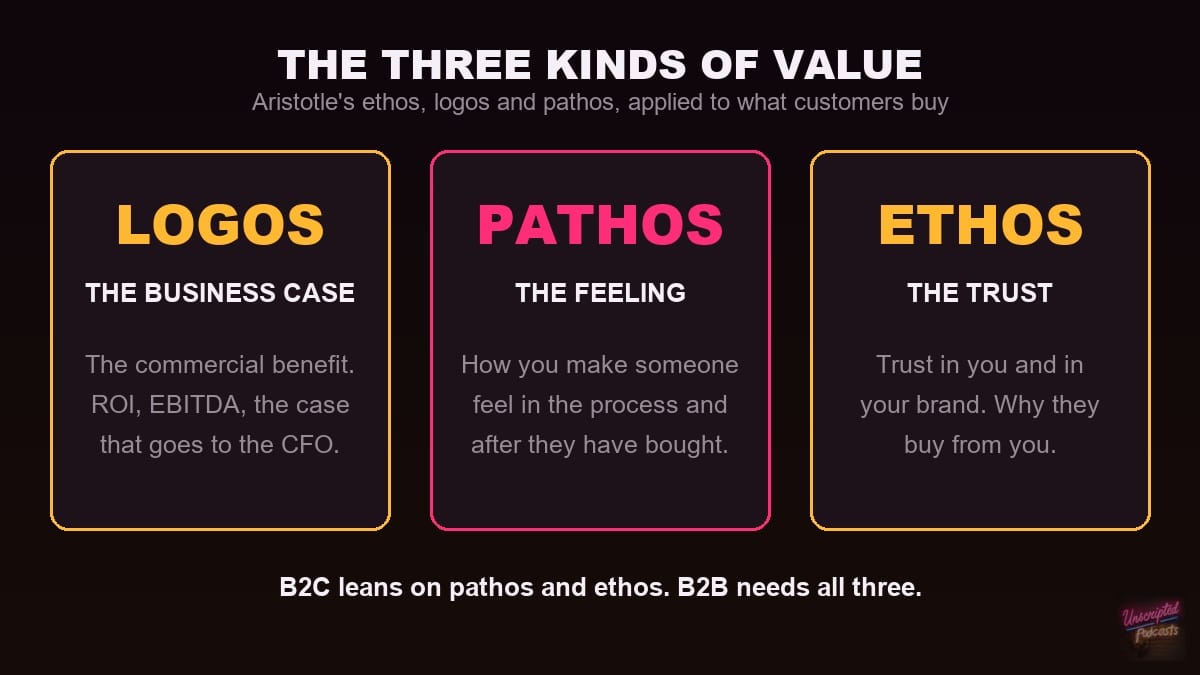
Logos, pathos and ethos are three different pages
Neil borrows Aristotle’s three modes of persuasion and applies them to what customers actually buy.
“And the logos value is the commercial benefit we bring through what we’re selling. And the pathos value is how we make someone feel in the process and how they feel when we bought the product.”
When I asked about the third one, Neil said “brand value is ethos as well. So you know people are buying because they trust this brand.”
If you write content for a living, you can map each one to a page type you already know:
- Logos is the ROI page, the pricing page, the case study with a number in it. It’s what the internal champion forwards to finance.
- Pathos is the customer story, the review, the “what it felt like to work with us” page.
- Ethos is the study you published, the podcast you showed up on, the face the buyer saw in their feed months before they needed you.
Open your sitemap and sort every page into one of the three. If the logos pile is the only tall one, you know where the gap is.
Product-led content answers a question nobody asked
Neil has had several companies come to him recently, frustrated because everything they do is product led: we’ve got a great product, customers must want it, go sell it. His job is to change the question to what business problem, and what business outcome, the product helps the customer reach.
“It’s transforming the conversation from a technical sales conversation to a business outcomes conversation.”
That is the same shift search went through. Keyword-era SEO trained all of us to optimize for the product noun. A long, conversational prompt describes an outcome and a set of values. Here’s how I put it on the show: “if it isn’t going to become even more central for you to effectively communicate through your marketing why they should buy from you, not just what they can buy from you.”
Ross Hudgens made a related case about earning a place in AI answers in his GEO playbook.
B2B buyers need all three, in order
Neil drew a line between consumer and business buying.
“I think there’s definitely more pathos and ethos in the buying decision process in B2C than there is Logos. You know, we’ll spend more on something without putting together a nice business case to take to the CFO.”
In B2B, he said, the ethos and pathos work, the post they liked and the rapport you built, “gets you in the door.” Then you have to show how the product moves the business outcomes the buyer needs to deliver. “So how’s it affecting their EBITDA? And that’s the Logos piece.”
He also pointed to the order decisions happen in. The emotional side lights up first on a big decision, and then gets supported by the analytical work. His conclusion: “you need both and when you’re selling you need to sell both.”
Content that makes your champion look good
I told Neil that a B2B sale usually has more than one chef in the kitchen, and that you’re really trying to create “mini ambassadors” inside the buyer’s company. He agreed, and named it one of the key success factors in selling into corporates: an internal salesperson who’s helping you sell.
The pathos value for that person is personal. You’re helping them look better internally, because they’re the one who brought a new solution to a problem in the company. So ask yourself what your champion needs to carry into the room:
- A one-page business case they can forward without rewriting.
- Proof from a source finance trusts, with the date and the method on it.
- Something with your name on it that they’ve already seen in their niche.
If you can’t point to a page for each of those, that’s your next content calendar.
Where AI fits, and where it doesn’t
Neil tells every owner he works with to look hard at AI, and he’s blunt about the stakes: “If you’re not looking at how to integrate AI and grow AI in your business every single day of the week or every single week, you will be going backwards because other people will be.” But he draws the line at the human side of selling. Coaches, he said, are trained to look for what’s not being said.
For your content, that means the logos pages can lean on AI help. The ethos pages can’t, because the trust comes from the person and the evidence behind them. Read the full conversation on the Unscripted Small Business recap.
So which of the three is your site actually selling? And if a buyer described their problem to an LLM in one long breath, would anything you’ve published answer the why?