
Which AI content tools don’t write slop? The ones that check something before a page goes out. Assertio checks whether each sentence makes a claim someone can verify. Blawgy starts every article from real search volume and holds anything that breaks your rules. Oleno keeps a marketing team’s product facts and approved claims in one place, so people and AI tools stop inventing them. Below are eight tools, what each one actually checks, and which kind of team it fits.
Here’s the filter I used. If a tool’s main promise is “more words, faster,” it didn’t make the list. You already have that, and it’s the reason your feed is full of posts that open with “in today’s fast-paced digital landscape.” Every pick here checks something: the claim, the search data, the house rules or the reader.
Slop is a sentence with no claim in it
Most people describe AI slop by how it sounds: the hedging, the stacked adjectives, the “it’s important to note.” Those are symptoms. The actual defect is that the sentence doesn’t assert anything you could check, so there’s nothing for a reader to use and nothing for an AI answer to quote.
Lum Kamishi, who has spent more than a decade in SEO and builds Assertio, put it bluntly when he came on Unscripted SEO in October 2026. He’d spent part of the episode on how much AI slop is out there, and then told me why he built his tool. Jon Gillham, the founder of Originality.ai, drew a similar line in his interview about when AI should write a page at all: if the only value on the page is words, AI shouldn’t be writing it.
So when you compare tools, ask three questions:
- What does it check? Claims, search demand, brand rules, readability, or nothing?
- When does it check? Before the draft reaches you, before it publishes, or after it’s live?
- Who owns the facts? The model, the open web, or a source you maintain?
Eight AI content tools that check their work
The first three get the full treatment because they each solve a different part of the slop problem: the sentence, the search data and the team. The other five are narrower tools you can bolt onto whatever you already use.
1. Assertio: claim-level writing you can check sentence by sentence
Assertio starts from a rule taken from linguistics: a sentence either performs an assertion or it performs nothing. It keeps the sentences that assert and cuts the ones that only sound like they do. Lum built that on speech act theory, and the whole product hangs off it.
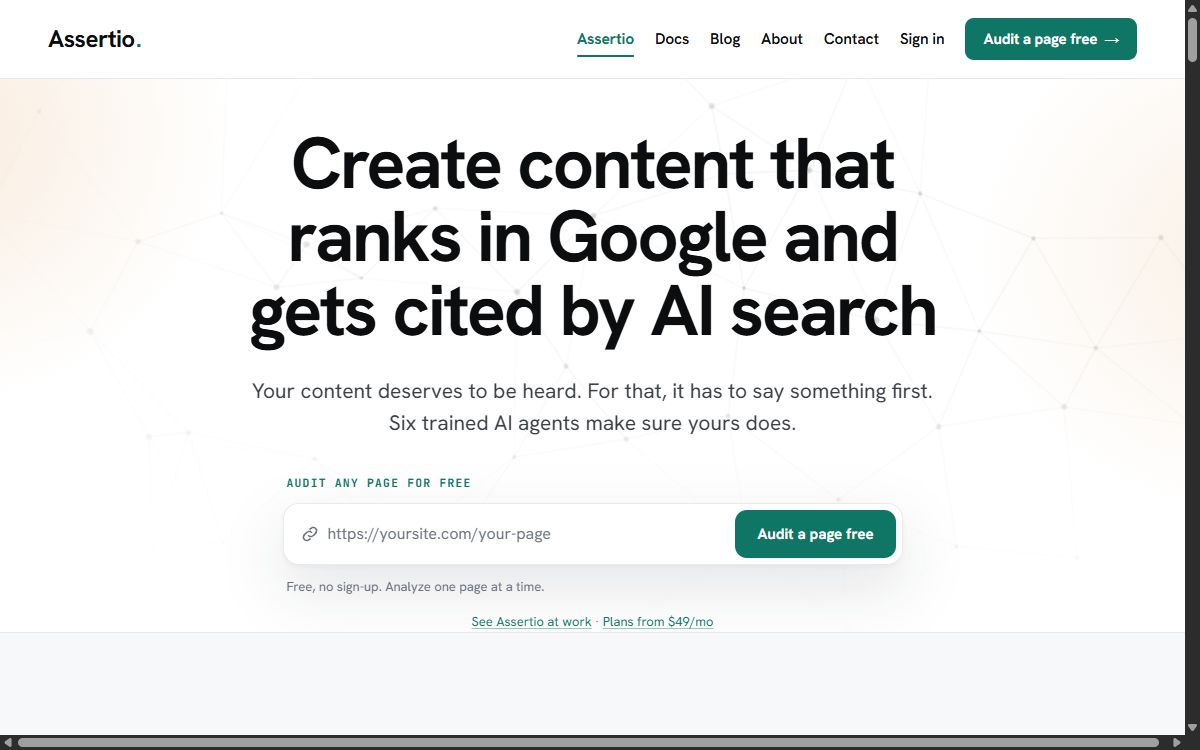
Here’s what actually happens when you use it. You give it a keyword or a URL. Six agents run in one pass (research, fan-out, brief, knowledge, draft and critic), pulling the live search results, expanding the query into its intent cluster and drafting under what Assertio calls a claim contract. Every sentence gets scored across nine dimensions, including assertion density and entity coverage, before you see the page. It takes 15 to 20 minutes, and the draft lands in an editor rather than on your site.
A few details matter if you’re weighing it:
- The free audit scores any page against the top-ranking competitors and shows side-by-side sentence rewrites, plus the unsupported facts, dates and numbers it found.
- A brand file drawn from your own site grounds the claims, so the page says what your business actually does.
- The Contextualizer proposes internal links from your sitemap and picks anchor text that already exists in your draft.
- No direct CMS publishing yet. You export Markdown, Word or PDF, or save to Google Drive.
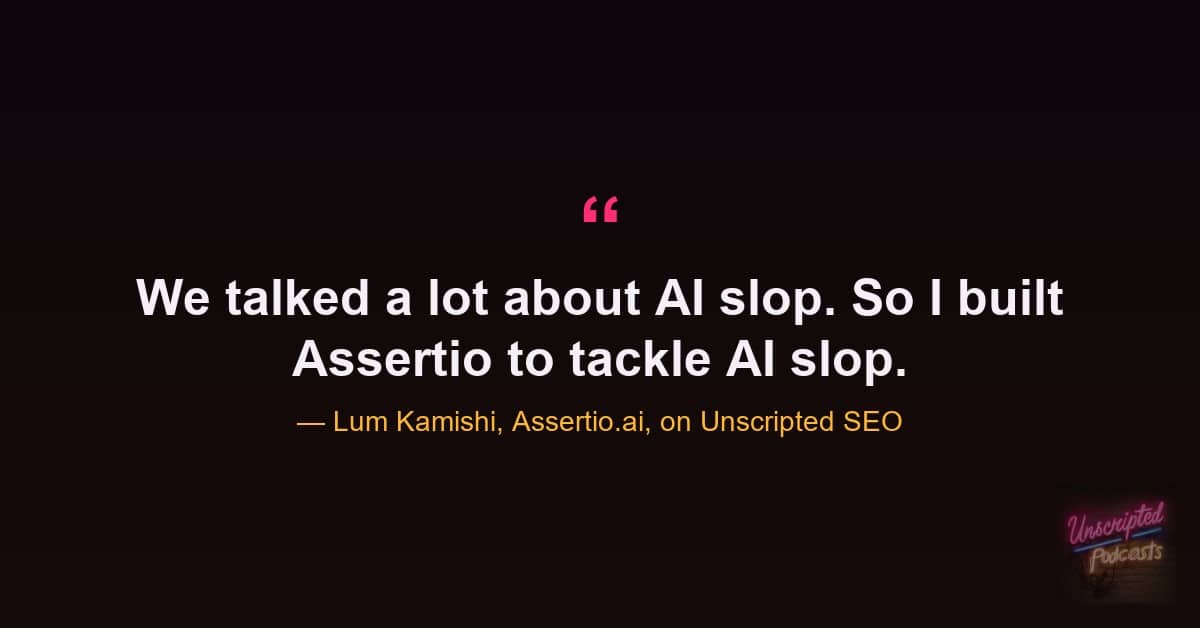
On the show, Lum said the biggest strength is the research step, because one agent does nothing but research. He also said he feeds client databases into it as JSON or CSV, which is the part I’d copy even if you never use the tool: give the model your facts, so it has something real to assert. His site is upfront about who it’s not for. If you want 100 posts a day, or you write in a niche with no facts to claim, it will frustrate you.
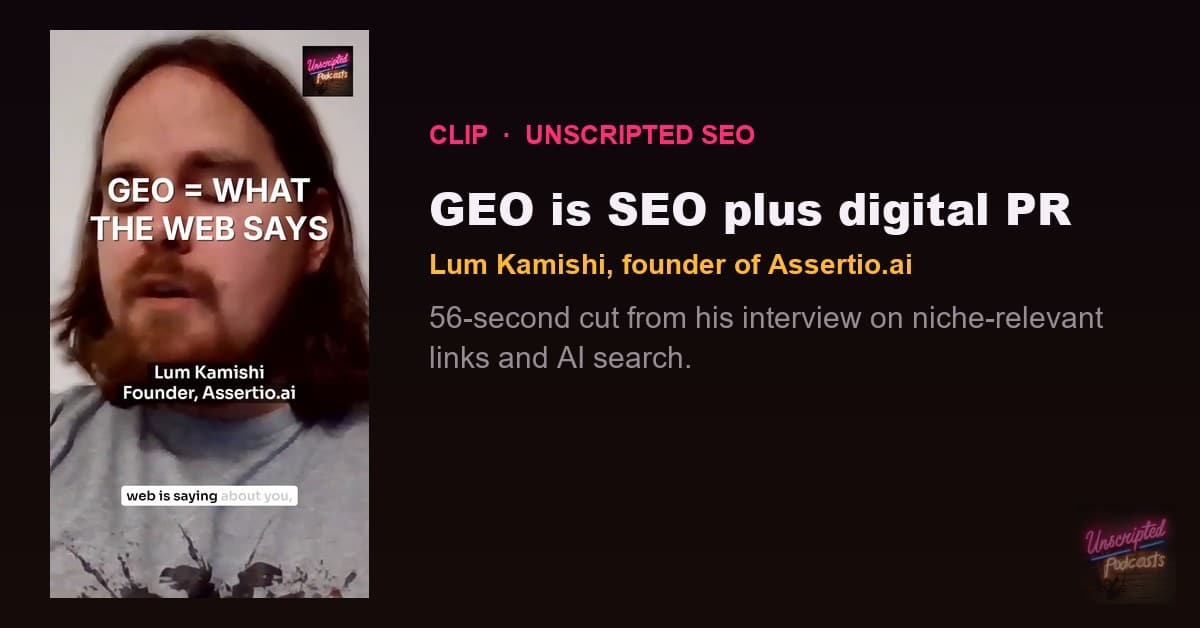
If you want the method behind his content audits, I wrote up Lum’s topical proximity process, the one that cost a client 60% of their blog, and turned it into a step-by-step SOP.
2. Blawgy: an SEO content engine that starts from search data
Blawgy for agencies writes and publishes search-driven articles straight to client sites, and it tackles slop from the other end. Instead of policing each sentence, it controls what gets written in the first place and what happens to a post after it goes live.
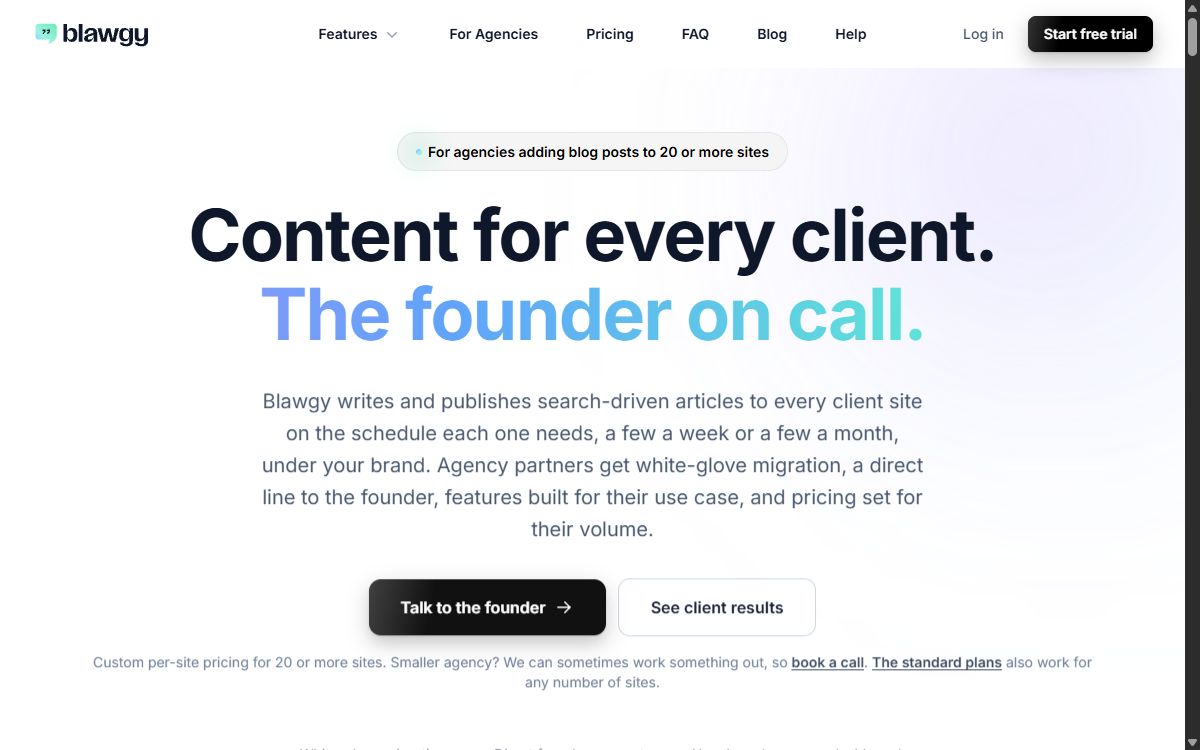
Every article starts from its keyword finder, which attaches volume, difficulty and intent to each topic. Then it publishes to WordPress, Webflow, Framer, Shopify, Wix, Ghost or Duda on whatever schedule you set, with drafts held for review if you’d rather not run it on autopilot.
The two features that actually keep junk off a site:
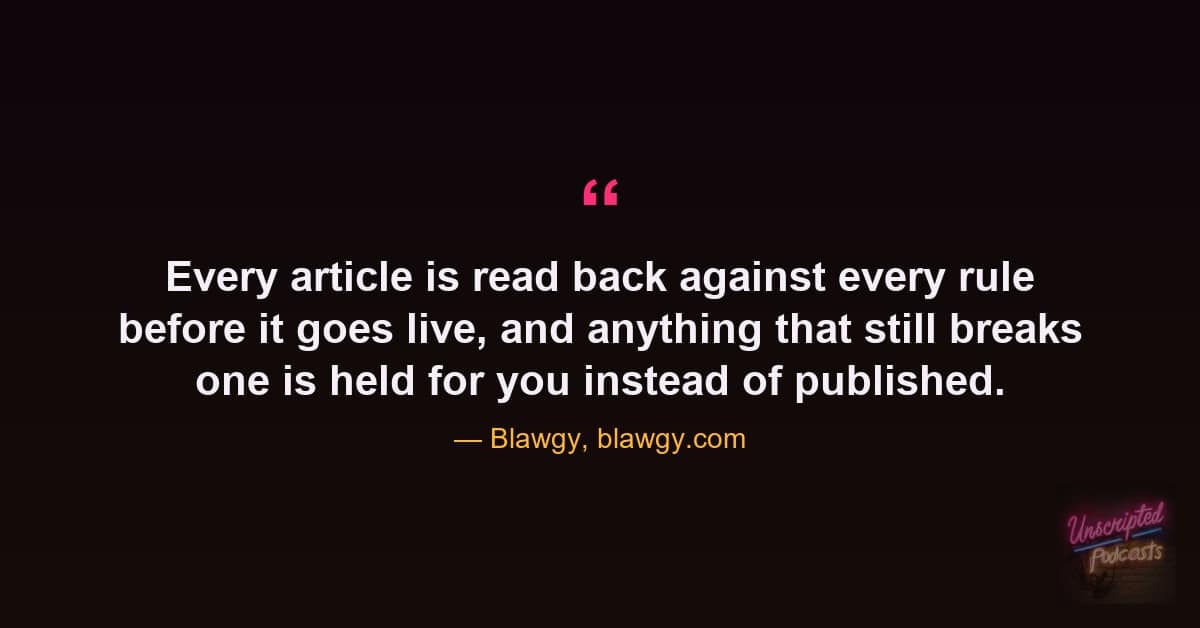
- Rules checked before anything publishes. You write what a business can never claim, price or promise in plain English, and every article is read back against those rules. A post that still breaks one is held.
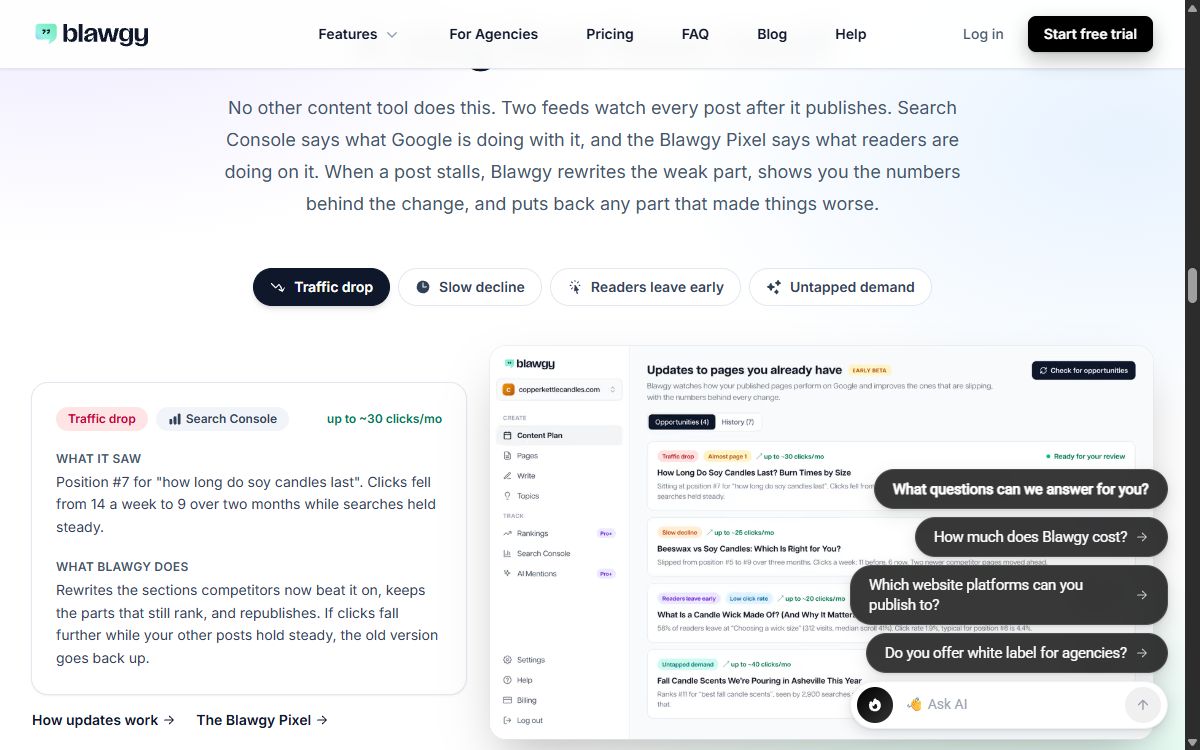
- Posts that fix themselves. Blawgy watches each post in Search Console and through a cookieless reader pixel. When one stalls, it rewrites the weak section, shows you the numbers behind the change and puts the old version back if things get worse.
Blawgy wasn’t interviewed on the podcast, so there’s no clip here. Instead, here’s the part of the site I’d point you to first: the refresh queue, where every card names the signal it reacted to.
For agencies, Blawgy adds white-label dashboards, guardrails you attach per client and a direct line to Adam, who built it. Its case studies run on each customer’s own Search Console numbers.
3. Oleno: governance over marketing work done by people and AI agents
A lot of slop isn’t the model’s fault. It’s a writer, or an agency, or an AI agent filling a gap nobody filled for them: the real product limit, the approved customer story, the claim legal signed off on. Oleno marketing governance is built for that gap.
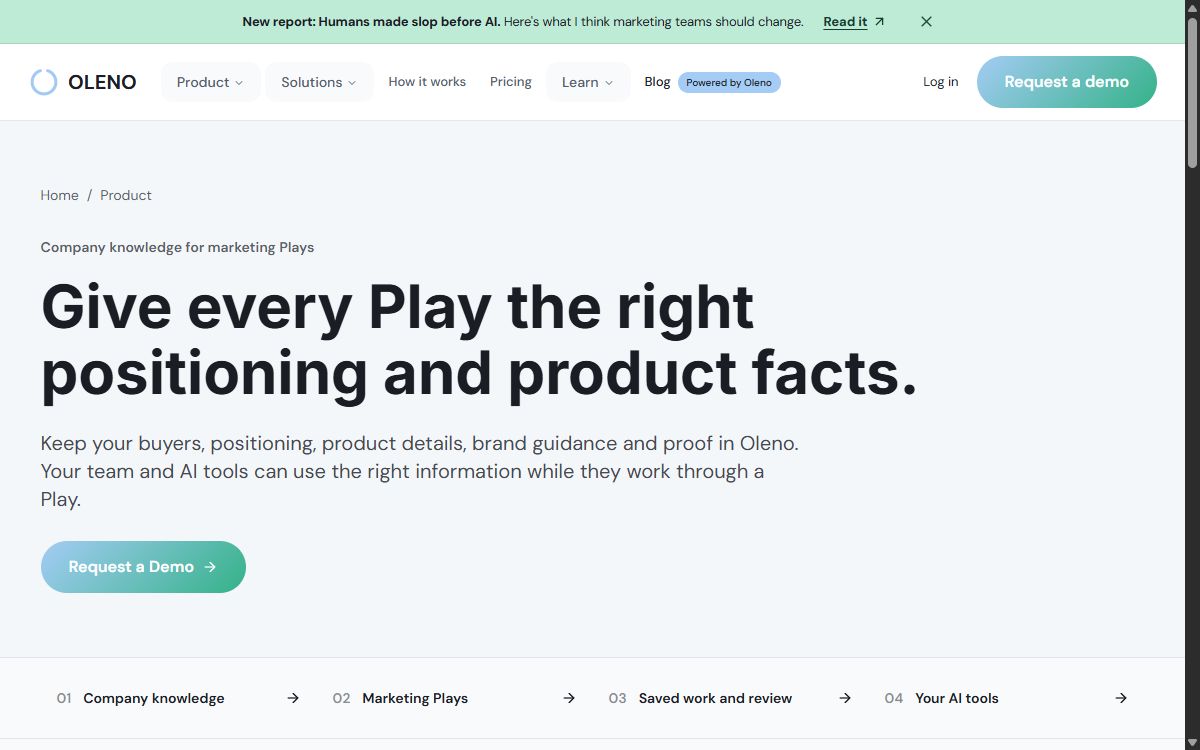
Oleno is marketing workflow software for teams using AI. You keep your positioning, product mechanics, buyers, brand guidance and evidence in Oleno, then turn your processes into Plays. Your team runs those Plays in Claude, ChatGPT or Codex through MCP and saves drafts, feedback and decisions back to Oleno, where someone can review them.
The governance records are the anti-slop part. Each one answers questions like “what should you not promise?” and keeps the source and qualifications beside each claim, so someone adapting a customer story can see how far the evidence actually goes. A marketing owner approves and maintains the records. When a product detail changes, you update it once.
Oleno wasn’t interviewed on the podcast either, so this second screenshot stands in for a clip. It shows how a Play moves from Oleno into your AI tool and back.
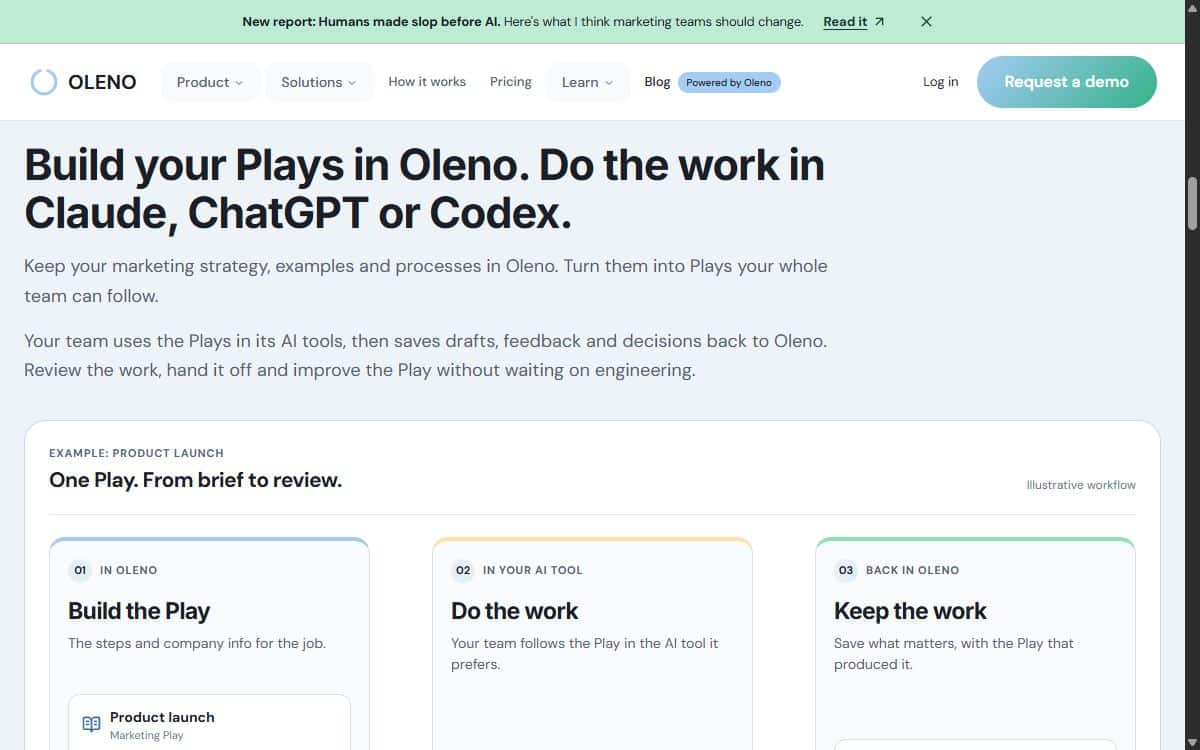
Oleno’s own example positioning record lists two anti-personas: teams with no strategy owner, and solo marketers whose existing setup works. If you’re one person with a good prompt, you don’t need it. If five people and three agents are writing about your product, you probably do.
4. Originality.ai: a fact and hallucination check before you publish
Originality.ai’s Fact & AI Hallucination Checker flags inaccurate statements and likely hallucinations in a draft. It sits alongside the company’s AI detector, plagiarism checker, Content Quality Score and a guideline checker, so you can scan one draft for all of it at once. Use it as the last gate on content you didn’t write yourself.
5. Clearscope: write for the query, then watch the page after it ships
Clearscope covers the content lifecycle: it finds the questions buyers ask, tracks whether Google, ChatGPT, Gemini and Claude mention you, grades a draft against the query’s intent and monitors the live page through Search Console. The grade keeps a writer from missing the subtopics that matter. It works in Google Docs, Word and WordPress.
6. MarketMuse: decide what’s worth writing before anyone writes it
MarketMuse analyzes your whole content inventory, finds the topic clusters where you already have authority and shows which topics are easiest for your site to win. A lot of slop starts as a page nobody needed. MarketMuse’s job is to stop that page from getting assigned.
7. Vale: turn your style guide into rules that fail the build
Vale is an open-source prose linter. You write your style guide as YAML rules (banned phrases, required terms, house voice), and Vale flags violations in your editor or in CI, offline. Datadog and GitLab both run it on their docs. If your banned list starts with “delve” and “in today’s digital landscape,” Vale will enforce it on every writer, human or not.
8. Hemingway Editor: the readability pass every draft should get
Hemingway Editor highlights hard-to-read sentences, passive voice and wordy phrases, and Hemingway Editor Plus adds AI rewrites for the sentences it flags. It won’t tell you whether a claim is true. It will tell you when a sentence is too long for anyone to follow, which is half of what readers mean when they call something slop.
Where each tool catches slop
| Tool | What it checks | When | Best fit |
|---|---|---|---|
| Assertio | Whether each sentence makes a verifiable claim | Before you see the draft | SEOs and site owners writing pages that should get cited |
| Blawgy | Search demand, your plain-English rules, post performance | Before publishing and after | Businesses and agencies publishing to many sites |
| Oleno | Product facts, approved claims and evidence | Before anyone drafts | Marketing teams mixing people and AI agents |
| Originality.ai | Facts, hallucinations, AI text, plagiarism | Before publishing | Editors reviewing outside writers |
| Clearscope | Coverage of the query’s intent, AI mentions | While writing and after | Content teams tracking AI search |
| MarketMuse | Whether the topic is worth a page | Before assigning | Content strategists planning clusters |
| Vale | Your style rules and banned phrases | In the editor or CI | Docs teams and technical writers |
| Hemingway Editor | Readability and wordiness | While editing | Anyone, as a final pass |
How to pick an AI content tool that won’t write slop for you
Start with where your slop actually comes from. If your drafts are fluent but empty, you need a claim check, and that’s Assertio. If you’re publishing to a lot of sites and can’t read everything, you need rules that hold a post before it goes live, and that’s Blawgy. If the problem is five people and a few agents describing your product five different ways, fix the source of the facts with Oleno.
Then add one narrow check you’ll actually run. A fact checker, a linter or a readability pass costs you minutes per draft. Skipping it costs you the reader who notices.
And whatever you pick, feed it your own facts. That was Lum’s point on the show: the tools can only check what you give them. So what do you know about your business that nobody else has written down yet?