
Two link builders on the Unscripted SEO Podcast, working in completely different markets, landed on the same conclusion: the number in your prospecting spreadsheet is not what decides whether a link is worth having. Bradley Benner runs the white-label off-page service Semantic Links, mostly for local contractors. Kristiyan Yankov runs Above Apex, exclusively for SaaS. Neither leads with domain authority. This SOP turns what they each check first into a repeatable pass your team can run before anybody sends an email.
Why DA And DR Stopped Predicting Value
Bradley launched Semantic Links in January 2022 after months of testing through 2021, and he describes the finding as something that should have been obvious far sooner: “it’s not some stupid third party metric like DA or DR or trust flow or anything else that matters about whether a link is valuable or not. What matters is whether it’s relevant.”
He is not banning the metrics outright. He is demoting them, and the ordering is the whole point: “if you want to use a third-party metric like DA, DR, Trust Flow, whatever, as kind of a secondary metric after determining that a potential link source is relevant to what it’s going to be linking to, then fine.” Relevance qualifies a prospect. A metric only ever breaks a tie between prospects that already qualified.
Kristiyan reaches the same place from the SaaS side. In the first few minutes with a prospect he explains that Above Apex evaluates “five to ten different metrics as a starter. We’re not looking at just something like domain rating — that’s a big thing within the link-building industry.” Looking at one number, he says, is “a bit unhealthy.” What “relevant” means in practice is unpacked in our semantic approach to relevant link building.
The Five Relevance Checks To Run Before You Pitch
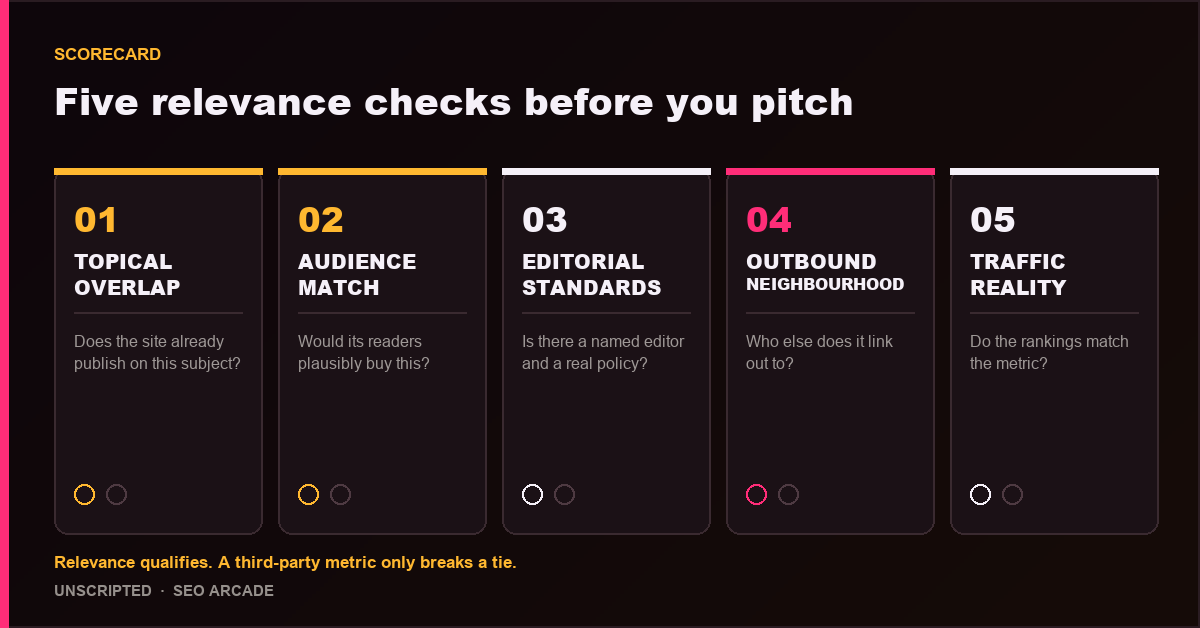
Five checks, in order, before a prospect earns an outreach email. Each is a yes/no; a single hard no ends it.
- Topical overlap. Does this site already publish on the subject your page covers — not adjacent to it, on it? Bradley’s model wants the link sitting in relevant content on a site whose overall topical themes are relevant to the target.
- Audience match. Would a reader of this publication plausibly buy the thing you are linking to? A perfect topical match aimed at the wrong buyer is a link nobody clicks and a mention nobody acts on.
- Editorial standards. Is there a named editor, a stated policy, and evidence a human decides what runs? Kristiyan’s version of this test is whether it is “a genuine website that serves a purpose, it’s not a PBN or whatever.”
- Outbound neighbourhood. Who else does this site link out to? Covered in full below.
- Traffic reality. Does the site rank for terms a real business in its space would rank for? Kristiyan checks whether the link is “seamlessly integrated into the actual copy and the article itself” — whether the placement reads as editorial or as inventory.
Only once all five come back clean does a third-party metric enter the conversation, and then only to sort the survivors. If you want a defensible way to do that sorting, our quantitative link scoring model shows how to weight these inputs without letting one number take over the sheet again.
Reading A Site’s Outbound Link Neighbourhood
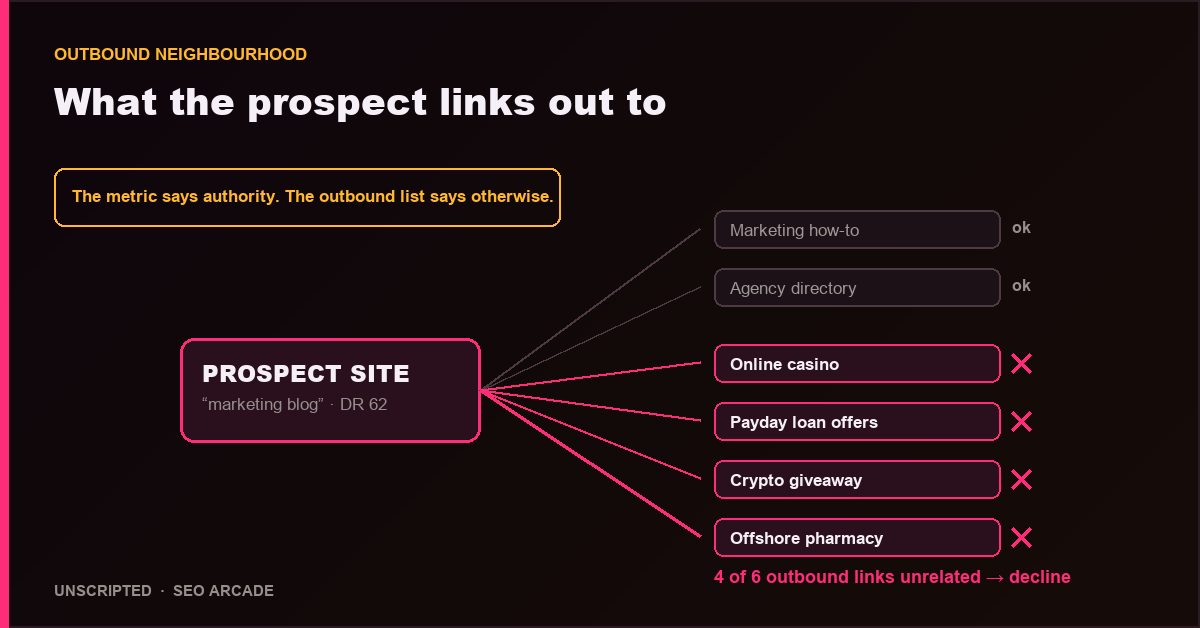
A note on provenance before the method: this check is SEO Arcade’s operational extension, not something either guest laid out on air. What Bradley actually described is the third of his three layers of relevance, and it looks at inbound links: “if you’re looking at the backlink profiles that are already pointing to the referring domain that you’re going to publish the post on… then you should be looking at the backlink profile to determine what is the relevance of the link profile pointing to this domain.” His three layers stack — relevant content, on a relevant site, with a relevant backlink profile behind it — and all of it, he says, strengthens the entity associations between the brand, its products or services and its locations.
We run the mirror image of that layer for a practical reason: outbound links are visible to anyone with a browser in ninety seconds, while a full referring-domain profile needs a paid tool and more patience than most prospecting passes get. Open the site, scan four or five recent articles, and look at what they link to.
A genuine publication links out to sources it needed — studies, competitors, tools, its own archive. A monetised placement network links out to whatever paid. When a nominally clean marketing blog is also sending links to an online casino, a payday-loan offer and an offshore pharmacy, you have learned something the authority score will never tell you: this site’s editorial gate is a price list. Our working threshold is simple. If a meaningful share of recent outbound links have nothing to do with the site’s stated subject, decline — regardless of the metric.
Verify, Do Not Trust: Yankov’s Screening Pass
Kristiyan opened his episode with a line that reads as a joke and functions as a policy. Asked to introduce himself, he said: “you shouldn’t trust anyone. You should verify. You should verify, especially in our industry.”
In practice that means the screening pass is manual and ends with human judgement rather than a threshold. His test is the most useful sentence in either interview: “if I look at a link-building opportunity and it makes sense to me, it would be the same for Google, because Google is definitely not more stupid than me. It’s quite the opposite — it’s actually smarter. So if I look at it and it makes sense to me, the website is a genuine website that serves a purpose, it’s not a PBN or whatever, it has relevant content, the link is seamlessly integrated into the actual copy and the article itself — it looks good, I’m like, ‘This looks really good, Google will probably say the same thing.’”
He applies the same reasoning in reverse to bad links. Reading the leaked Google documentation, his conclusion was that low-quality links are disregarded rather than penalised — set aside and not counted. His logic: “If I see them and I’m like, ‘That’s BS,’ Google’s going to say the same.” That is his reading of the leak rather than documented behaviour. But it cuts both ways usefully: if you can tell a placement is bought, assume the algorithm can too, and stop paying for it.
Turning The Checklist Into A Team SOP
A checklist that lives in a senior strategist’s head does not survive delegation. To make this operational, put the five checks into your prospecting sheet as five explicit columns, ordered left to right, with the authority metric in the last column where it belongs. A prospect with a hard no in the first five never reaches the metric column.
Require one line of evidence per check — a URL, a headline, a screenshot — so a reviewer can audit the judgement rather than the conclusion. Log rejections with their reason, because the rejection log is what actually trains a junior researcher; after fifty entries, what your team turns down becomes teachable in a way no written policy manages. And have a second person re-run the pass on any prospect above a set spend, since a check nobody verifies is a form of trust.
The reframe worth keeping is Bradley’s. The job, as he puts it, “is not about pushing metrics. It should be about creating associations, strengthening those associations, and helping, forcing the models and the algorithms to recognize those associations.” A vetting checklist built around relevance is just that job, done before the money is spent instead of after. If you would rather hand the pass to someone who already runs it, that is what our link building services are built around.