
Press releases have spent a decade as the punchline of link building. Then a language model started sitting behind every search surface. On the Unscripted SEO Podcast, Bradley Benner — who runs Semantic Mastery and the white-label off-page service Semantic Links — made the case plainly: a press release is not a link play any more. It is a citation play, and citations are the fastest lever anyone currently has on AI search visibility.
Why Press Releases Died For Rankings And Came Back For LLMs
Watch: Chris Green on why the old link building playbook still moves AI search.
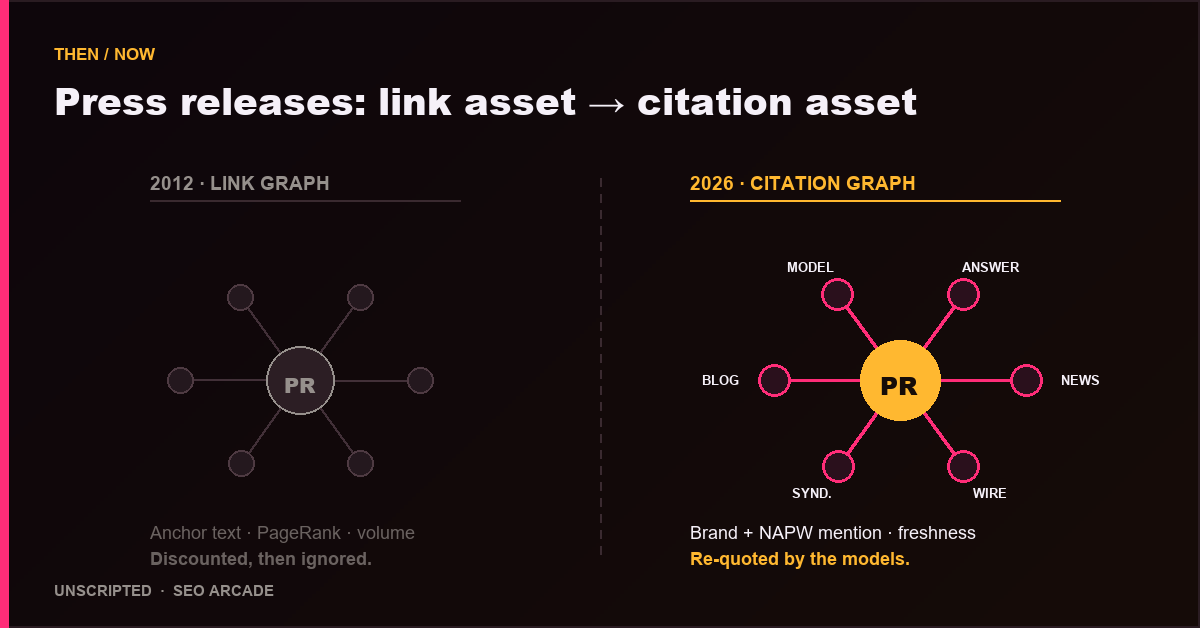
The obituary explains why so many SEOs still flinch. In the 2010s the release was bought almost exclusively for the links inside it: syndication put the same anchor text on a hundred regional news clones, and for a while that moved rankings. Google closed the loophole, told everyone those links should be nofollowed, and the tactic collapsed into a checkbox on an invoice. That history is ours, not Bradley’s — he never eulogised the tactic on the show. What he did do is describe the thing that replaced it.
Bradley’s framing starts with a definition most SEOs use loosely. A citation, he explained, is a published brand mention plus at least one data point from what the industry calls NAPW — name, address, phone number, website. From there he splits the category in two: “A structured citation is going to be very strict name, address, phone number with or without a website, but in a very structured format, like business directory listings. But unstructured citations are brand [mentions] with one of those other data points elsewhere.” Press releases, branded assets and brand mentions inside blog posts all land in that second bucket.
And that second bucket, in his current read, is where the leverage is: “those all can act as unstructured citations. And that’s what influences LLM or AI search visibility right now, more than anything.” He is careful not to let anyone use that as an excuse to skip the basics — you should still optimise on-page — but when the question is what is the quickest way to move, his answer is third-party mentions.
The mental model underneath is one we keep coming back to in our entity optimization and brand authority resource guide: a model is not computing PageRank across a wire syndication network. It is reading language, and a release gives it a brand name sitting in close proximity to a service, a location and a date, on a property it already treats as credible.
The Freshness Factor LLMs Actually Reward
The reason a release outperforms an equivalent brand mention on a static page is recency. Here is Bradley’s line in full, because the mechanism is all in the second half of the sentence: “Press releases work really, really good for helping to improve AI search visibility because you get brand references on high authority media and news style like freshness factor type properties that the LLMs like to cite.”
Two attributes are doing the work there, and they are separable. High authority media is the property’s standing — whether a retrieval layer considers it a source worth pulling from at all. News-style freshness is the format signal — datelined, timestamped, structured like something that just happened. Jeremy agreed on air that freshness is one of the primary factors he is currently seeing in LLM results. That is a practitioner observation from two people, not a published study, and should be held that loosely.
The practical consequence is that a release has a shelf life. A single announcement is a spike, not a programme. If freshness is part of why the mention gets picked up, cadence matters more than any individual placement — a very different budget conversation from “buy one release, count the links.”
How To Write A Release A Model Will Quote
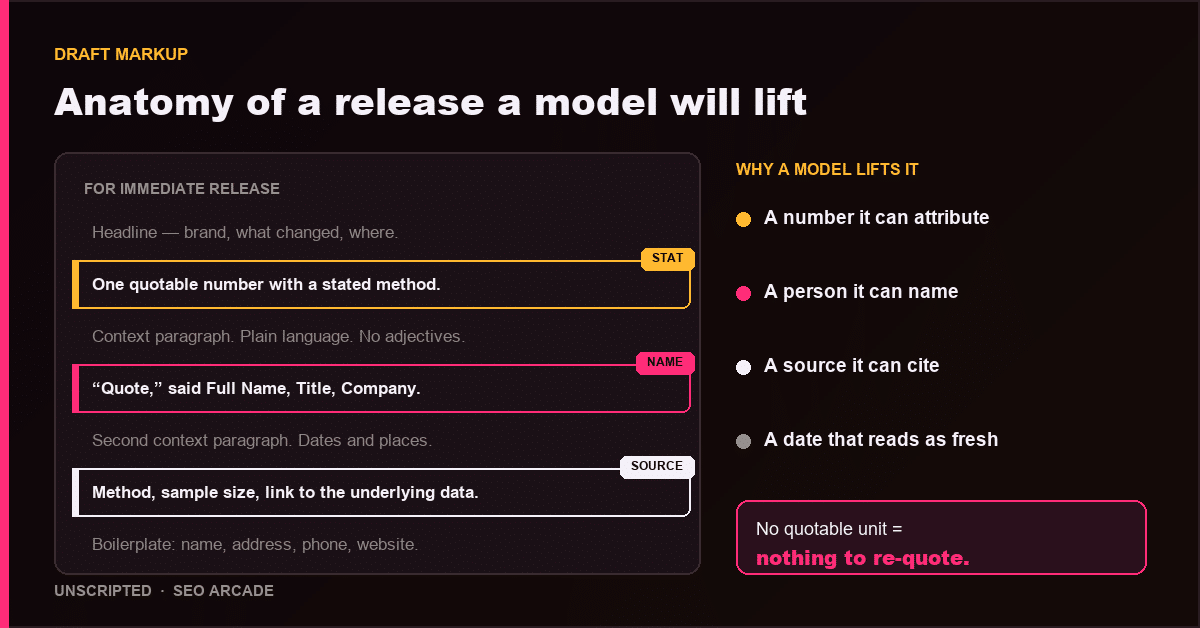
Most corporate releases are unquotable. They are three paragraphs of adjectives wrapped around no verifiable fact, and there is nothing in them for a model to lift. If the goal is a re-quote rather than a link, the draft needs discrete, attributable units.
Give it one number with a stated method — not “significant growth” but the figure, the period and how it was measured. Give it a named human with a title, because “said a spokesperson” is not attributable to anything. Give it a source line: sample size, methodology, a link to the underlying data. Keep the boilerplate complete, since name, address, phone and website are exactly the NAPW data points that turn a mention into a citation in Bradley’s definition. And write in plain declarative sentences, because a summarizer reproduces clauses, not enthusiasm.
The angle matters as much as the structure. A release tied to something already in motion in your market behaves differently from an internal milestone nobody asked about — the same instinct behind newsjacking for editorial links, applied to owned announcements rather than earned coverage.
Distribution Tiers Worth Paying For
Bradley did not price out wire services or rank distributors on the episode, so treat this section as SEO Arcade’s operational reading rather than his. What he did give us is the sorting principle, and it is a good one. Asked what kind of third-party mentions help, he named three qualities and made clear they are situational: “A high authority, highly relevant, or hyperlocal, depending on what the search prompt or query is.”
That is a tiering system, just not a pricing one. High authority earns its cost when the query is broad and the model is picking from well-known sources. Highly relevant — trade press, industry publications — earns it when the query is specialist and general outlets have nothing useful to say. Hyper-local earns it for local-intent queries, which is Bradley’s own focus; a mention in a regional outlet does more for “tree service near me” than a national wire ever will.
What follows is a spending rule rather than a vendor list: buy the tier that matches the queries you want to appear in. A blanket wire blast landing on four hundred syndication clones optimises for a report screenshot. It is the same discipline we apply to earned coverage in our digital PR for link earning notes — pick placements for who reads them, not for how many there are.
Measuring Brand Mentions Instead Of Referral Traffic
Here is where most press-release programmes get killed prematurely. Someone opens analytics thirty days later, finds eleven referral sessions, and cancels. If the mechanism Bradley described is the one operating, referral traffic was never the output. The output is a brand reference sitting on a credible, recent property where a retrieval layer can find it.
So measure that instead. Count placements that actually carry the brand name and at least one NAPW data point — a mention missing both is not a citation by his definition. Track branded search volume, because a mention that works usually shows up there first. Prompt the assistants your buyers use with the questions they would actually ask, log which sources get cited back, and watch whether your properties enter that set over a quarter. Keep referral traffic as a secondary line, because occasionally a trade placement does send real readers.
None of that is as tidy as a referral number, and it should not be sold as though it were. But it matches what the tactic is now for. Bradley’s throughline across the whole conversation was that language sitting at the front of every search surface has dragged SEO back toward ordinary, sustainable marketing. A release written so a person would quote it, distributed where that person actually reads, measured by whether anyone repeated it, is about as ordinary as marketing gets.
Bradley Benner runs Semantic Mastery and Semantic Links. If you want the whole argument, including his three layers of link relevance and why he will not say the word “keywords” to a client, the full interview is on the Unscripted SEO Podcast.
The full case for running a show like this sits in our podcasting as content and SEO strategy resource guide.