
A client asks how their brand got into ChatGPT, and you feel the pull to promise them the next quick win. Laura Iancu, founder of Searchpedia, has watched listicle changes move AI answers within the hour, and she thinks every one of those wins is a wave that’s going to crash. She spent years in-house for big brands before going solo in January, and she takes every client by referral. I pulled the practitioner moves out of our Unscripted SEO conversation and turned them into rules you can run before you sell an AI search tactic to anyone.
Test it on your own clients before you sell it
Here’s the trap. You see a change land in an AI answer the next hour, and it feels like proof. Laura’s view is that the ease is the problem: “the more we abuse a certain thing, especially if it’s an easy thing to implement then and there, the more likely Google is going to penalize it.”
“If you want a quick win and you want to demonstrate to a client then and there, look, I know what I’m doing. That’s not really knowing what you’re doing. That’s just riding a current wave that’s literally going to crash.”
So what does she do instead? She reads the people she trusts, like Aleyda Solis, then tests on her own clients when she gets the chance. Something that worked for an expert “doesn’t mean it’s going to work for my clients.” When she hasn’t tested it, she says so and comes back in a month. You can say that too. It’s cheaper than explaining a penalty.
Turn Laura’s habit into a procedure with the SEO SOP: Check AI Visibility Tool Data Against Your Own First-Party Data – the one-page PDF is free inside The Vault.
Check synthetic AI visibility data against first-party numbers
Laura had access to Ahrefs Brand Radar through a big client, so she held synthetic AI visibility data from October and November last year, months before Clarity, Bing or Google released anything. When first-party AI reporting arrived, she compared the two. “And it’s very different.”
She isn’t telling you to drop your tools. She uses them all the time. She’s telling you not to spend a small client’s budget on “the newest, shiniest SEO tool extension” when free tools and a good prompt get you most of the way. Start with what you own:
- Search Console’s AI and multimodal reporting, which is still thin, but it’s Google’s own data.
- Microsoft Clarity, loaded through Google Tag Manager, which shows you far more bot traffic than Google does. I measured how far the two drift apart in a Search Console vs Clarity check on 4 sites.
- Bing’s own AI reporting, the other first-party source Laura pointed to.
Use the speed of LLMs without abusing it
Well, the truth is that the speed cuts both ways. I’ve changed branding information and clarified pricing on client sites, re-run the prompt within minutes and seen it reflected. Google never let you see that. You edit, wait for the crawl, wonder if it indexed, and ride out the twiddler for weeks.
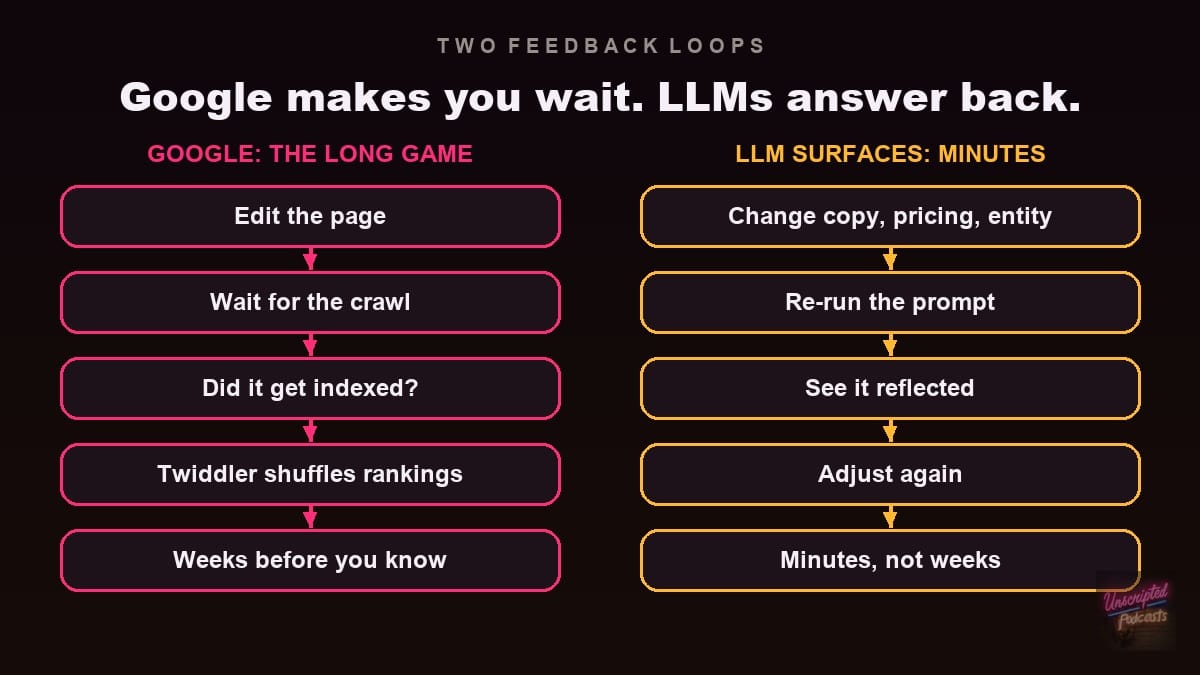
Use that speed to fix what’s true about the business: pricing, positioning, entity details. Don’t use it to game a list. Laura watched how easy it was to meddle with an influential-SEOs list inside LLMs and passed on it. “That’s child’s play.” If you want the longer version of how models pick sources, read how to get recommended by an LLM before you’re in the training data.
Put the question every customer asks on the page
LLMs are just math, and they’re bad at mixing metaphors. What they can’t invent is the detail a customer only tells a human. The precast concrete wall company I interviewed never said on its site that you can’t dig under its walls. The anti-dig design is built into the structure, so nobody thought it needed saying. But every customer asked. If every one of your clients asks about a detail, that’s friction, and it belongs on the page.
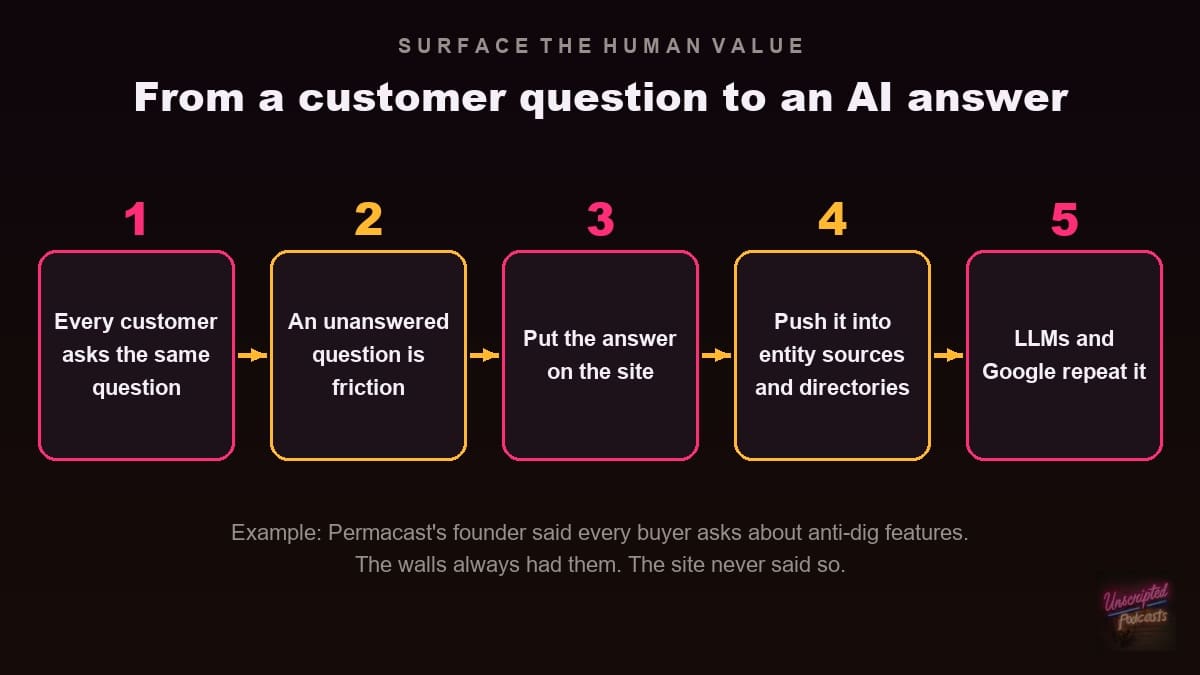
Sometimes the fix isn’t on the website at all. It’s getting the right data into the right directory, the kind of entity work Jason Barnard and Jon Henshaw have both talked about on the show. That’s the same reason the interview is the information gain: the recording is where these details come out.
Hold AI content to a value test, not an origin test
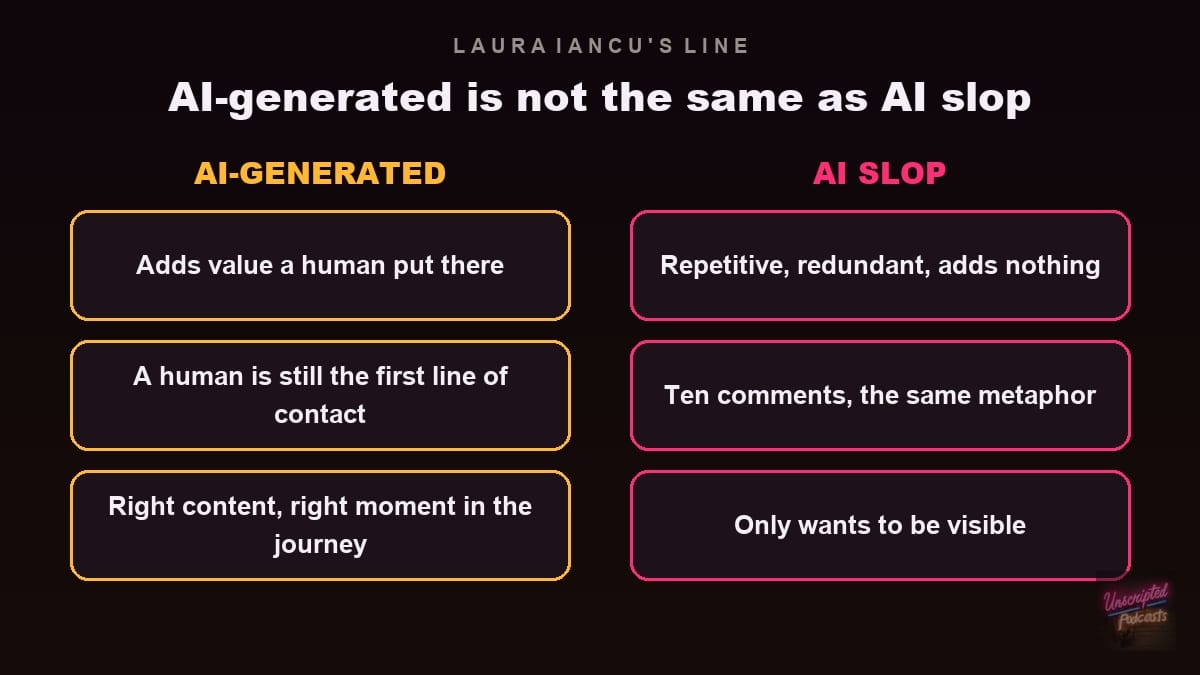
Laura uses AI. Everyone does. Her line is about whether it adds anything.
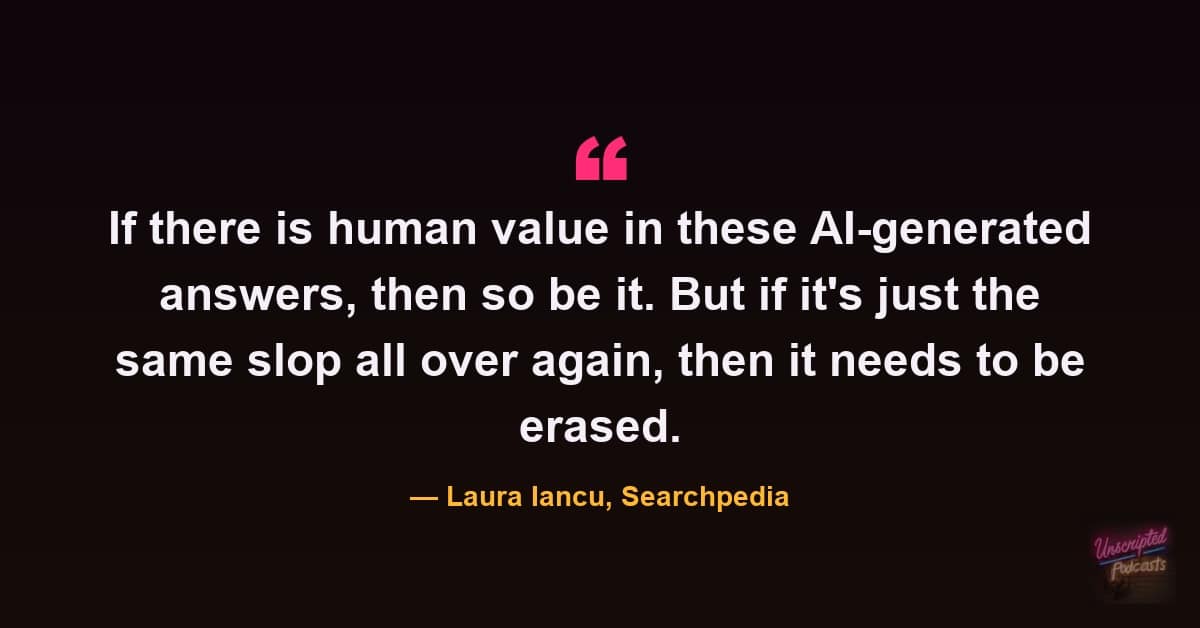
“If there is human value in these AI-generated answers, then so be it. But if it’s just the same slop all over again, that doesn’t add anything to the topic itself, then it needs to be erased.”
Her tell for slop is intent. Ten commenters under one of her LinkedIn posts left the same comment with the same metaphor. “All they wanted to do is to be visible.” Run your own content through that filter. Is a human still the first line of contact with the brand, its audience and the buying moment? Or did somebody abdicate their brain? Malte Landwehr drew a similar line on what actually works in LLM search.
Tell the client when they don’t need you
This is the one most agencies won’t do. Laura has told referrals that their business model doesn’t line up with SEO growth, that email marketing would do more for them, and that a technical audit plus some information architecture is all they need. “You don’t need me.” She’d feel like “a bit of a scammer” selling a tactic she can’t stand behind for more than a month.
So before your next AI search pitch, ask yourself a few questions. Have you tested this on a client of your own? Does your data come from a tool’s model or from the platform itself? Is the page answering the question customers actually ask? And if the honest answer is that they don’t need you, are you willing to say it? You can connect with Laura Iancu on LinkedIn or catch her at BrightonSEO on October 8 and 9, and the full conversation is on Unscripted SEO.