
If you’re not following @darth_na Lyndon NA, you’re missing out on fantastic deep-dives on various and sundry conversational areas in SEO. This morning I was fascinated by his take on our the “generative” search results, because Google, Bing and even Twitter have their own SGE type experiences integrated, and there is no sign that these tools will be less prevalent in the future.
Advice for Optimizing for Generative (SGE)
Watch: Ann Smarty on rankings as the predictable route into AI answers.
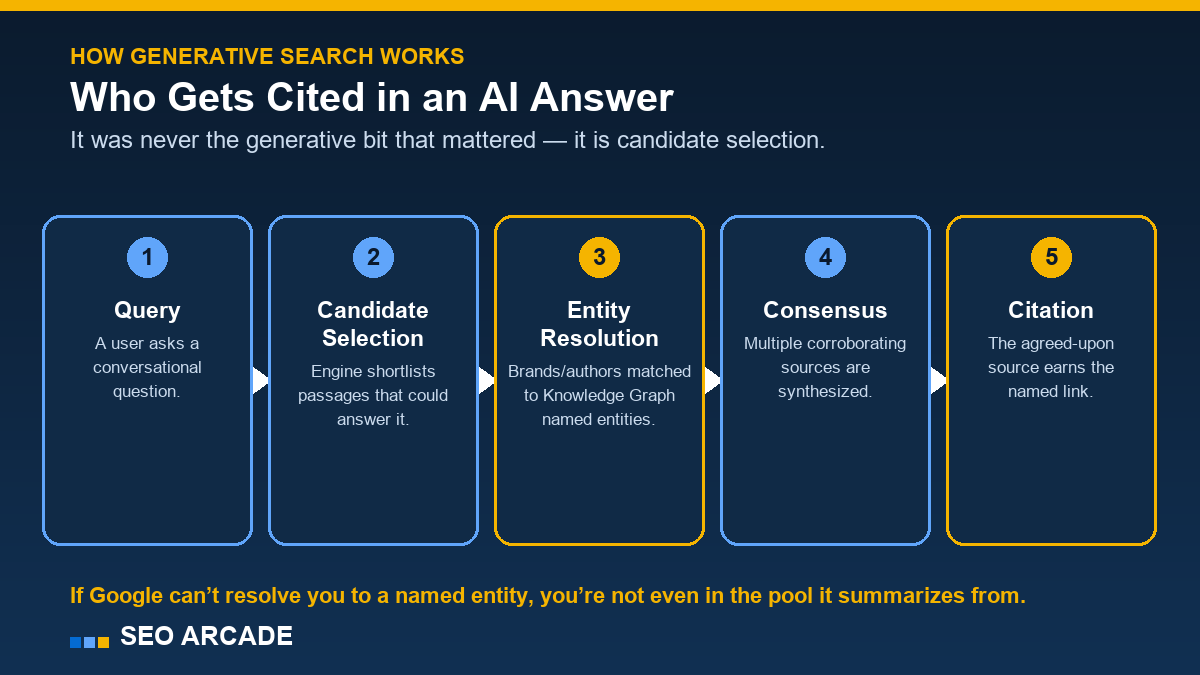
That would make it Candidate selection, and likely on par with FS selection, and for those that do NLP, summary component selection. You might want to look up ordinate/subordinate and check the presence of verbs/adverbs.
Darth NA (Lyndon)
We’re almost into 2024. We’ve only had “Search Intent” be mainstream for 2-3 years? We’ve only had “SERP Features” being tracked a little longer! A % of people still say “LSI Keywords” instead of topical/thematically/semantically related Entities, Taxonomies, term maps…
None of it is new. Much of it has been pushed for a decade. But it takes the sector so damned long! For the SGE – it’s not the Generative bit people need to consider, it’s the candidate selection process, and there’s 20+ years of research on it!!!
There’s literally dozens of papers regarding things like Question and Answer association/alignment, (as well as generating the Q for the A, or the A for the Q). There’s even more for summarisation, esp. older papers looking at highlighting key sentences/strings.
What About Optimizing “Entities” found in SGE Results?
I asked Lyndon what about optimizing entity discoverability an document optimization for LLM assisted tools deployed for platforms with Promethean type connections to search indices? (Aka optimizing brand query results in Bard, Grok and Bing by doing offsite citation/text sentiment analysis?
If you are dealing with an Entity (as in, a proper, Named one, not generic nouns etc.), then yes – but that should be standard. And I think that’s the frustrating part here. A lot of what is being pushed – should be “the norm” to a fair degree.
Darth NA (Lyndon)
There’s literally dozens of papers regarding things like Question and Answer association/alignment, (as well as generating the Q for the A, or the A for the Q). There’s even more for summarisation, esp. older papers looking at highlighting key sentences/strings
LLM Based Scientific Papers To Read To Understand & Optimize
You can do some operator searchers, on sites like Stanford, Princeton, MIT, Carnegie etc.
site:http://princeton.edu NLP ext:pdf "question and answer"site:http://princeton.edu
NLP ext:pdf "question and answer"
- Chain of Code: Reasoning with a Language Model-Augmented Code Emulator – https://arxiv.org/abs/2312.04474 —
- Towards Revealing the Mystery behind Chain of Thought: A Theoretical Perspective – https://arxiv.org/abs/2305.15408 —
- Scaling Data-Constrained Language Models – https://arxiv.org/abs/2305.16264 —
- Language to Rewards for Robotic Skill Synthesis – https://arxiv.org/abs/2306.08647 —
- Tree of Thoughts: Deliberate Problem Solving with Large Language Models – https://arxiv.org/abs/2305.10601 —
- Why think step by step? Reasoning emerges from the locality of experience – https://arxiv.org/abs/2304.03843 — Toolformer: Language Models Can Teach Themselves to Use Tools – https://arxiv.org/abs/2302.04761 — Reasoning with Language Model is Planning with World Model – https://arxiv.org/abs/2305.14992 — ToolkenGPT: Augmenting Frozen Language Models with Massive Tools via Tool Embeddings – https://arxiv.org/abs/2305.11554 — DecodingTrust: A Comprehensive Assessment of Trustworthiness in GPT Models – https://arxiv.org/abs/2306.11698 — QLoRA: Efficient Finetuning of Quantized LLMs – https://arxiv.org/abs/2305.14314 — Direct Preference Optimization: Your Language Model is Secretly a Reward Model – https://arxiv.org/abs/2305.18290 — Are Emergent Abilities of Large Language Models a Mirage? – https://arxiv.org/abs/2304.15004 — Reverse Engineering Self-Supervised Learning – https://arxiv.org/abs/2305.15614 — Learning Transformer Programs – https://arxiv.org/abs/2306.01128 — OpenAssistant Conversations — Democratizing Large Language Model Alignment – https://arxiv.org/abs/2304.07327 — Privacy Auditing with One (1) Training Run – https://arxiv.org/abs/2305.08846 — Language Models, Agent Models, and World Models: The LAW for Machine Reasoning and Planning – https://arxiv.org/abs/2312.05230 — Large Language Models as Zero-Shot Conversational Recommenders – https://arxiv.org/abs/2308.10053 — Zephyr: Direct Distillation of LM Alignment – https://arxiv.org/abs/2310.16944 —
Jeremy’s 2026 Refresh: SGE Became AI Overviews + AI Mode, and the Entity Game Got Real
I wrote this back when “SGE” was still a roped-off Google Labs experiment. It graduated. In 2024 it became AI Overviews, and through 2025 Google rolled out AI Mode as a full conversational surface that, as of 2026, is the default experience for U.S. searchers. The core point aged beautifully: the generative layer was never the hard part, candidate selection was, and that selection now runs on entities, not strings. If Google can’t resolve your brand, product, or author to a disambiguated named entity in its Knowledge Graph, you are not even in the pool of passages it summarizes from. Everything else is downstream of that. For the practitioner view on why this is a consensus problem and not a ranking problem, this conversation is the best primer I can point you to: Justin Oberman on AI search as a consensus engine.
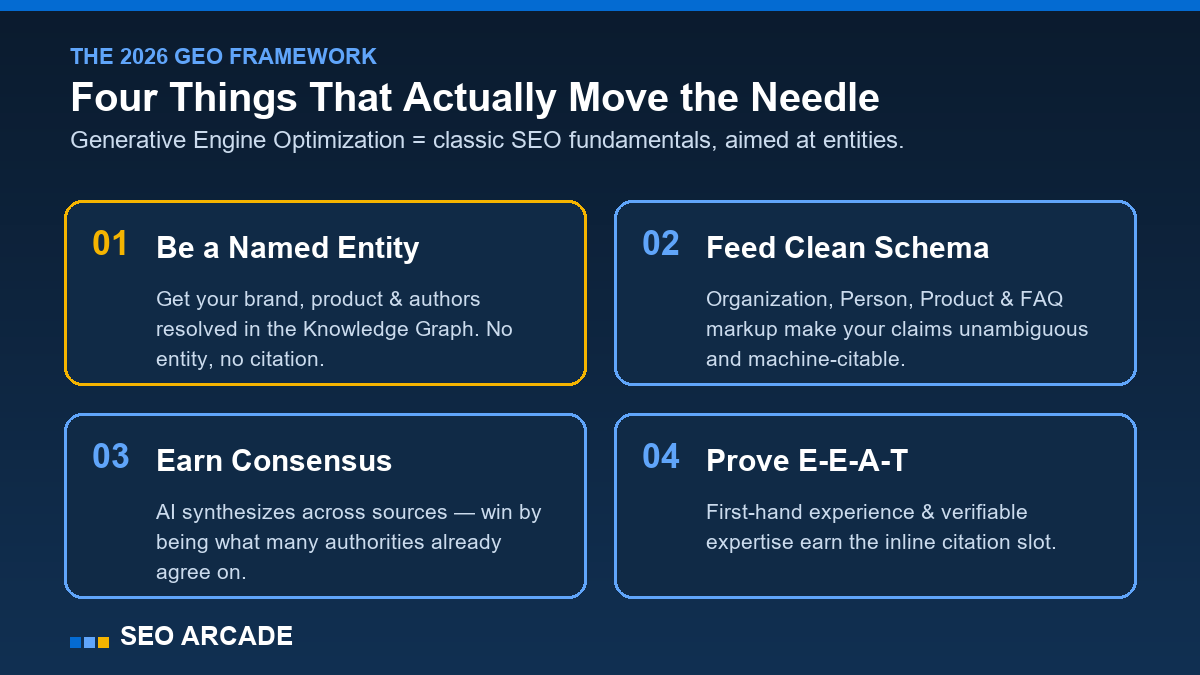
So what actually moves the needle in 2026? Three things. First, become the consensus source: AI Overviews and AI Mode synthesize across many corroborating documents, so you win by being the answer that multiple independent, authoritative sources already agree on, not by out-keywording one page. Second, feed the machine clean structured data — organization, person, product, and FAQ schema — so the entity and its claims are unambiguous and citable. Third, double down on first-hand experience and verifiable expertise (E-E-A-T), because that’s what earns the inline citation slot when the model attributes its summary. Notably, Google’s own guidance confirms there’s no secret AI-specific tactic, standard quality SEO is the path in: Google Search Central — AI features and your website. The fundamentals didn’t change. The penalty for ignoring entities just got a lot more expensive.
The 2026 GEO Playbook: Insights & Actions
Here’s the whole thing distilled into what it means and what to actually do about it — the difference between understanding generative search and getting cited by it:
| Insight | Why it matters | Do this now |
|---|---|---|
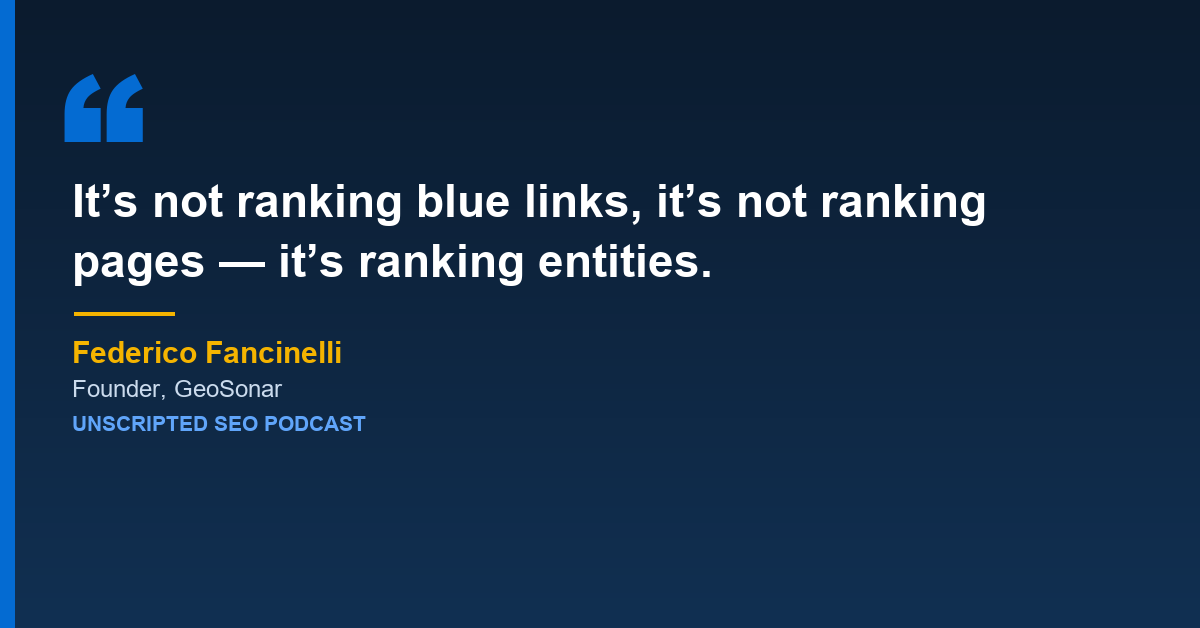
| You rank entities, not pages — Federico Fancinelli | AI answers resolve your brand, product & authors to a Knowledge Graph entity before they cite anyone. No entity = not in the pool. | Claim & disambiguate your entity: consistent name/logo, sameAs links, Organization + Person schema, Wikidata/Wikipedia where earned. |
| Coherence forms your entity — Federico Fancinelli | AI trusts you when your identity is consistent across every source it reads — conflicting versions weaken recognition. | Align name, description, category & bio across your site, socials, directories & schema. One canonical story everywhere. |
| Candidate selection > generation — Lyndon NA | The hard part was never the “generative” layer — it’s which passages get shortlisted to summarize from. | Structure content as clean Q&A passages, use question-shaped headings, and front-load the direct answer. |
| Give AI something it can’t already write — Mike Montague | LLMs won’t cite what they can already generate. They cite what’s genuinely new to them. | Publish first-hand data, original research, tests & proprietary numbers — not summarizable “slop.” |
| Win on consensus, not clever pages | AI Overviews & AI Mode synthesize across corroborating sources, not one optimized page. | Earn independent mentions, citations & reviews so multiple authorities already agree on your claim. |
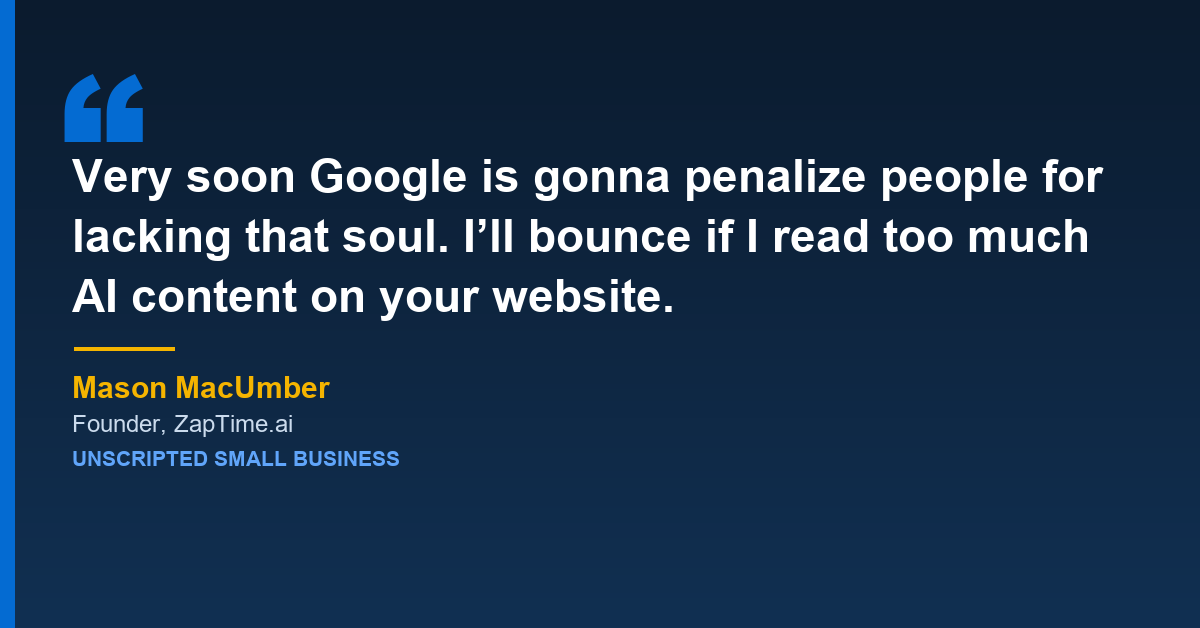
| Human “soul” earns the slot — Mason MacUmber | Thin, unedited AI content loses trust — and the citation. Demonstrated experience wins it. | Add named-author expertise, first-person experience & real examples. Edit AI drafts; never ship raw. |
| Feed clean structured data | Schema makes your entity and its claims machine-readable and directly citable. | Ship Organization, Person, Product & FAQ schema and keep it accurate and in sync with the page. |
What our podcast guests are seeing in 2026
I don’t just theorize about this — I interview the people building for it. Three takes from the Unscripted SEO and Unscripted Small Business podcasts that reinforce everything above:
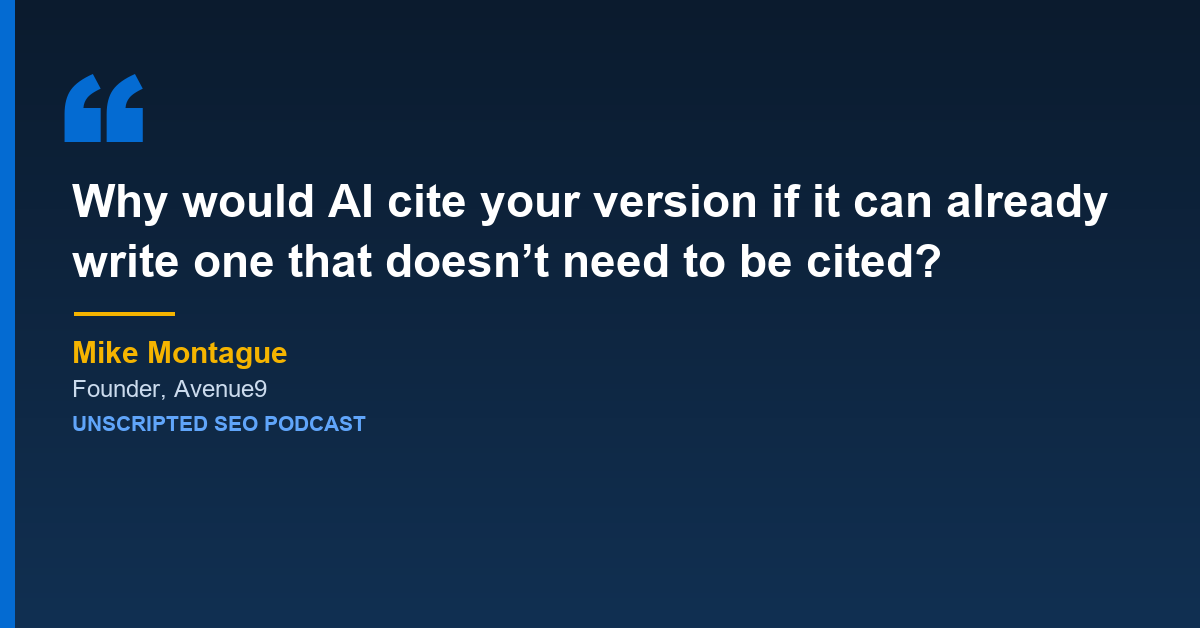
Hear the full conversations: Federico Fancinelli (GeoSonar) · Mike Montague (Avenue9) · Mason MacUmber (ZapTime.ai).