
Most of what we build at SEO Arcade starts with a keyword list, so I pay attention when a consultant with 20 years in the trade says he’s “still a lover of the keyword, even though everyone says you shouldn’t be optimizing for keywords.” Martin McGarry runs Search Assistance in the UK. He started in what he calls the murky world of building WordPress sites and hacking links, fell into the black hat trap, and went clean about ten years ago. He’s spent the decade since as a freelance consultant for small local businesses, a few US healthcare clients and a lot of iGaming. That last one is why he rants online. It’s also why this conversation is worth your time if you sell SEO to clients who need to still be ranking in three years.
Here’s the argument in one line: SEO is still words and links, Google just measures them better, and the gap between what Google can measure and what it has to see in the SERPs first is where the spam lives.
Listen to the episode: https://www.youtube.com/watch?v=X4s7o82vq3I · https://the-unscripted-seo-interview-podcast.castos.com/episodes/martin-mcgarry-on-black-hat-balance-wordpress-exploits-and-perspective-as-currency-in-ai-search
SEO is still words and links. Google just measures them better now
“It still boils down to the fundamentals that SEO is about words and links,” Martin says. “It’s just the quality of those two, the measurement of that, has changed over the years.” The measurement went from lots of words and lots of links to quality words and quality links. Google got better at telling the two apart. Everything else, in his view, is downstream of that.
If you got into SEO because Google was for everybody, you’ll recognise what he says changed. “Google used to be for everybody. And that was the great thing about it.” Then, over the last two years: “It’s a really strict discipline now and the threshold for entry has been put up by Google.”
He watched it from the inside. He was immersed in what he calls quick technical black hat back when you had to build the links and churn the content yourself. The capability available now is, in his words, a thousand times more technical, and the update cycle has gone from named Panda and Penguin releases to sites disappearing with no idea which algorithm did it.
The Helpful Content Update profiled your site. It didn’t read your content
Martin’s read on HCU is that Google was profiling whole sites through the entity graph, and the content itself was almost beside the point. He’d listened to earlier episodes of this show and picked up the thread about WordPress sites with obvious footprints vanishing: the same not-quite-custom themes the industry had talked up as simple to scale.
His explanation:
“I heard somebody say that the helpful content update was not about finding helpful content. It was about finding a profile of a website that looked helpful. It wasn’t about the content on the site. It was about the entity graph or the knowledge graph. Would you trust that platform? Would you ask that person or that company for help?”
Danny Sullivan later said the wording around the update was probably incorrect, and Martin’s point is that by then everybody had fallen into the trap of asking why their helpful content wasn’t being acknowledged. Google, he thinks, needed to axe a fair bit of the index, and it used the entity graph to decide who to keep.
That lines up with what Jason Barnard told me about how Google understands your business as an entity beyond the words on the page, and it matters twice now. A lot of AI tools are functionally a wrapper for Google results. They check their training data, then they search. So the brand, trust and entity work you do pays once in the training set and again in the retrieval.
Martin’s caveat is worth keeping. Google “still calls words on pages.” Text on the site still counts. What the content prospectors got wrong was thinking a single platform full of words was enough. “And at one point it was.”
Google’s grace period is the hole the spam drives through
Telegram link sellers and expired domains work because Google has to see a page in the SERPs before it can judge it. Martin calls that window the grace period, and it explains a pattern you’ve probably seen and couldn’t name.
The sellers have taken an old method (spray links at brands with your own anchor advertising your services) and scaled it to hundreds of thousands of sites and millions of links. Expired domains work for the same reason:
“The reason it fails and the reason the expired domains work is because there’s a grace period where Google needs things in the SERPs to understand if it’s what the user wants or what the user doesn’t want.”
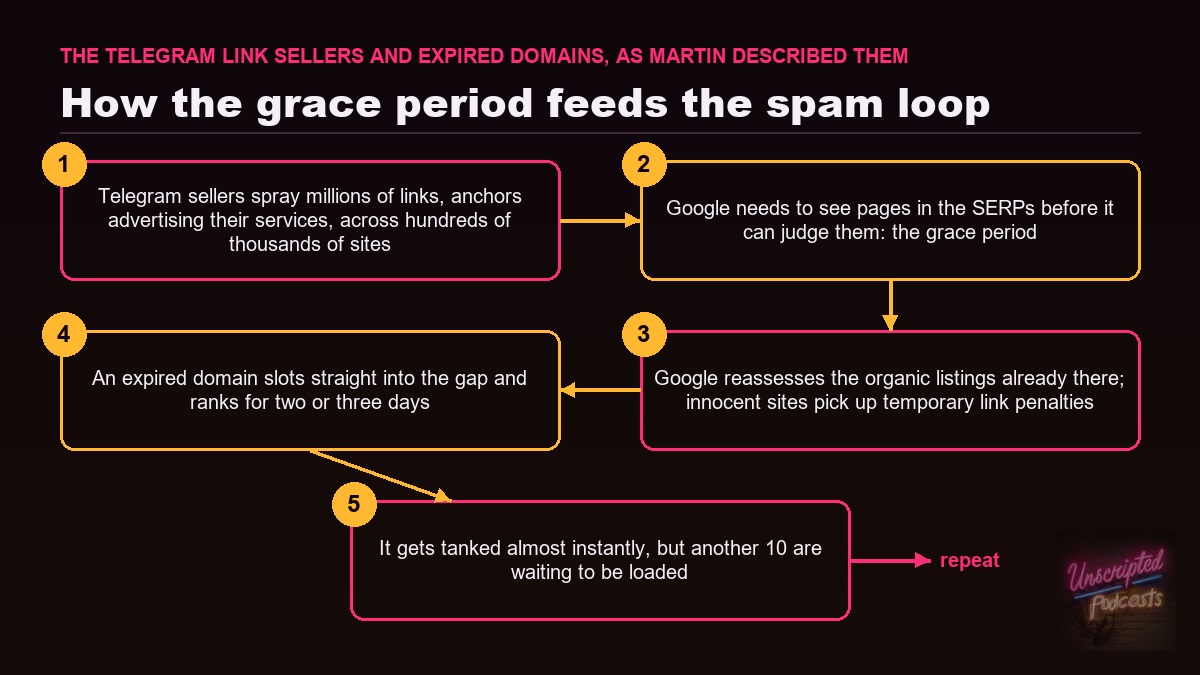
The loop runs like this:
- A spam page ranks for two or three days inside the grace period.
- It gets tanked almost instantly, but another ten are waiting to be loaded.
- The spam links make Google reassess the organic listings that were already there. Martin has seen sites disappear with no reason to disappear, dug into the details, and found Telegram sellers diluting anchor text and wrecking the link profile.
- “You’ve got 20 sites that are under a temporary link penalty; your expired domain just slots in instantly.”
Add the canonical redirect abuse Timothy Malmros walked me through, where operators buy old domains, stand them up and push the traffic to an end destination, and you have what Martin calls a perfect storm. In iGaming, his home niche, the deluge comes from “offshore illegal companies,” not from SEOs taking black hat risks. If a reputable pharmaceutical company had to compete with offshore illegal drug suppliers, that stuff would disappear straight away. iGaming, he says, has been left, handled algorithmically by a Google that doesn’t understand regulation country by country.
What a weekly disavow did for a door manufacturer
A weekly disavow brought a door manufacturer’s rankings back after a competitor sludged the whole top 10, and I was on the receiving end of that one. Somebody in the niche was buying about 20 domains a month, standing up the same CMS content library on different themes and spraying junk links and irrelevant anchor text (image hotlinks, direct links) at everybody in the top 10 except one site. I suspect, and can’t prove, that the one site paid for it. Their rankings rose because everybody else got pulled down.
The fix wasn’t clever — a hygiene program, meaning an aggressive disavow checked every week. They launched another ten sites, we disavowed them. Once we started doing that, the rankings that had tanked climbed back and the anchor text profile cleaned up.
Martin’s response to that story is the line I’d put on the wall:
“I just want balance back. I want to be able to pull levers and for them to work, not to pull levers and end up on page three.”
He isn’t asking for a clean SERP. A lot of what SEOs do contravenes Google’s guidelines and he wants it that way: “We do want levers that we can pull as SEOs.” What he can’t work with is a top 20 of churn-and-burn sites that a client with long-term prospects can’t compete against. “That would be gone tomorrow, and then there’s a different top 20.” We get one spam update a year that we know of. At the moment, he says, “it’s not balanced at all. It’s swamped.”
Your opinion is the one thing the model can’t fetch
Ask Martin what a company selling precast walls or sunrooms should do for AI search and he starts with a content gap, then lands on perspective. The companies he meets have either too much content (they went to scale) or too little (neglect), and almost nobody is looking at the traffic they already have and asking whether they’ve got enough unique, informational content for their own users rather than the wider searcher.
Then the line the whole episode turns on:
“You have a perspective on the product that you sell. And your opinion and your perspective is going to be your currency in the future.”
The facts (size, scale, colour, technical specs) can’t move, and AI digs them out straight away. Perspective is different. His example: everyone assumes a flip-flop is summer clothing, but “who buys a flip-flop for the rain?” People in tropical countries. “It’s not a unique selling point, but it’s a unique angle,” and you only find it by getting down into granular use cases and buying personas. “AI can’t reproduce perspective or opinion.”
That pairs with his top tip for anyone learning SEO right now:
- Open Visual Studio and hit the OpenAI or Gemini API from the terminal.
- Ask it a raw question. “What you get back is junk.”
- Work out what’s augmenting the chat results in the background. There’s RAG, and OpenAI, he notes, has been caught Googling.
Once you understand those extra requests, you know two things. “SEO is not dead, first of all, because these LLMs are having to go out and get extra information from somewhere,” and you know where your site has to be positioned for that fetch to find you.
His parting thought: if part of SEO goes server-side, the conversation moves to optimising the RSS feeds and APIs WordPress already exposes, rather than llms.txt. “Maybe I’m the first to go down that route. There’ll be a whole raft of courses on it by next week on LinkedIn.”
Turn this interview into action with the SEO SOP: Query the Raw LLM API to See What Retrieval Adds – seven steps to run Martin’s raw-API experiment on your own money queries, plus the one-page PDF free inside The Vault.
So, two questions for your own client list. Which of your clients is sitting under a temporary link penalty they didn’t earn and nobody has checked? And which of their pages says something about the product that only they could say?
Listen to the full episode: https://www.youtube.com/watch?v=X4s7o82vq3I · https://the-unscripted-seo-interview-podcast.castos.com/episodes/martin-mcgarry-on-black-hat-balance-wordpress-exploits-and-perspective-as-currency-in-ai-search
Find Martin: Search Assistance · LinkedIn · Bluesky. He’s also in the SEO Community Slack, “whining about black hat.”