
If your agency hands client work to AI and the output hurts the client, is that a liability problem? I put that question to Delina Yasmeh, a business and tax attorney and founder of DELINA.ESQ in Los Angeles, on Unscripted Small Business. She didn’t hedge. “I absolutely think it’s a major liability.”
Delina has done more than a thousand consultations with business owners, and she’s had to work AI use into consulting clients’ contracts with their own clients. She isn’t a marketer, and she didn’t talk about rankings or tactics. What she gave me is a view of AI-assisted client work from the side of the table where contracts get read, and that’s the side most agency owners skip.
This episode recap is for general education only. It is not specific legal or business advice, and reading it does not create an attorney-client or advisory relationship. Any genuine legal question should be handled through a retained professional.
Watch the full episode on YouTube or listen on Castos.
AI failures in client work are a contract question, not only a quality one
Here’s the scenario I gave her. Say I sold a client SEO, then turned the work over to an AI bot and told it to go do SEO. It pulls from months-old articles, draws the wrong conclusions and de-optimizes the site. The client could reasonably say: you sold us a service, you didn’t live up to the commitments, and it looks like you used AI to do it.
Delina called it “a perfect example” and said she’s had this exact conversation with clients, mainly in the consulting field. Her general view on where it belongs: “it needs to be built into your contracts that you are using AI and to have the transparency.” She also added the part about ownership: “you need to be responsible as a business owner.”
She practices it, too. Her own firm publishes an AI use disclosure. If your agency’s contracts say nothing about how AI touches the deliverables, that’s a gap worth raising with your own attorney, because Delina can’t tell you what your contract should say and neither can I.
Read the deliverable like the other side is counting on you not to
Delina told a story that every agency owner should hear. She uses AI to dictate her emails. She reads the contracts herself. During a back-and-forth with another attorney, five rounds in, he changed the terms of the contract entirely and wrote that he hadn’t changed anything. She thinks he assumed that since AI was writing her emails, she wasn’t reading the documents. “I caught it in two seconds.”
That’s the line she draws between using AI well and using it badly: the AI saves her the typing, and she does the reading as the lawyer. Her point to me about SEO was the same. “A, you have to be an expert yourself.” If you don’t know the work, “that is where you’re going to be more reliant on the AI and you may not catch the mistakes.”
For a marketing team, the equivalent is boring and it works. Someone who knows the work reads every AI-assisted deliverable before it goes to a client: the audit, the content brief, the report, the outreach email. Not a skim. Bookkeeper Maya Weinreb made the same case from her field when she told me AI output depends on the input, and on whether someone who knows the books checks it.
Shared SOPs decide whether your team’s AI output matches
I told Delina about a guest of mine who works with Oleno, which builds marketing context for Claude and ChatGPT. His point was that one person who knows what they’re doing can set up their own AI to do a specific task well. But if you don’t take the time to set up everyone else’s with the right prompts and “the right shared SOP,” then “you’ll get radically different results.”
I’ve lived that. I’ve built Claude Code workflows that chain prompts together to turn a podcast transcript into an article, and when I first started, “it invented parts of the conversation with the guests that didn’t exist.” The fix wasn’t a smarter model. It was a tighter process, written down so it runs the same way every time.
Delina’s firm went through the same thing. She has spent “a year and a half with my team working on the back end” to get her AI to give the answers, results and context her work needs, and even now the team is “constantly checking, rechecking, and making adjustments.” If a law firm with a dedicated team is still adjusting after eighteen months, your agency’s one-off prompt in a shared doc probably isn’t finished either. If you want a place to start, Barry Moline’s AI job description exercise is a good way to decide which tasks get an SOP first.
AI made the expert more necessary, not less
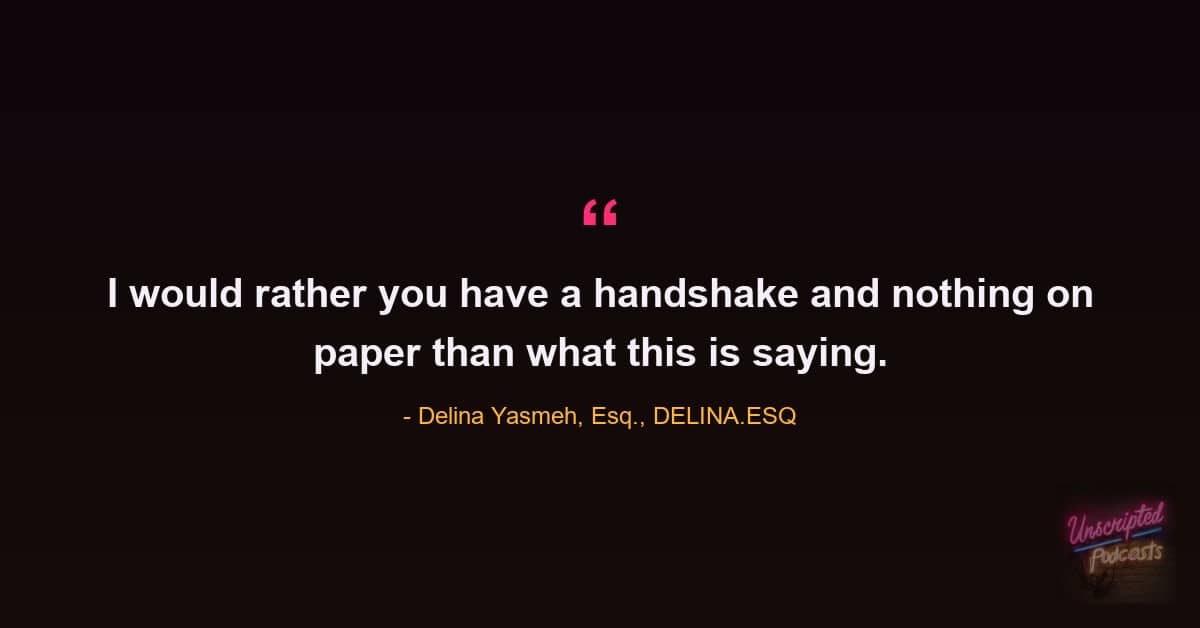
People keep asking Delina whether AI means clients don’t need lawyers. Her answer: “If anything, it’s made it so that I am more necessary.” Clients send her contracts they drafted with AI, and “I don’t think I’ve seen a single AI drafted contract that has been good.” Her line to those clients: “I would rather you have a handshake and nothing on paper than what this is saying.”
That’s a lawyer talking about contracts, not a marketer talking about content, so I won’t stretch it into a claim about your field. But the shape will feel familiar. When anybody can produce a first draft, the value moves to the person who can tell whether the draft is any good. Delina agreed with how I put it on the show, that AI is “artificial intelligence, not artificial wisdom.” In her words, “it is not an entity, it is not your coworker.”
What a lawyer can’t say online, and why marketers should notice
If you market law firms, this part of the conversation is a useful reality check. Delina described what she can’t do that other business owners can:
- She can’t pay a non-attorney a cut for bringing in a client, so a commissioned sales team is off the table. She said the only referral relationship she can have is with other attorneys.
- She can’t give specific legal advice online. “I do not want to ever unintentionally create an attorney-client relationship.”
- She can’t disclose client information, so every story gets generalized, with names, facts and circumstances changed.
- On her own posts, “we always have the disclaimer in there.”
What she does instead is answer recurring questions in general terms. “I have taken some of the recurring questions that I get and I’ve given general answers on our website,” she said, in her law library. Matthew Fornaro built his firm’s site around a similar idea, which we covered in a law firm website that answers questions first.
AI disclosure in agency contracts: questions to take to your attorney
None of this is legal advice, and Delina was clear that general information isn’t a substitute for talking to an attorney. These are the questions I’m taking from the episode to my own:
- Do my client contracts say how AI is used in the work, and is that disclosure clear enough to count as transparency?
- If an AI-assisted deliverable goes wrong, what do my contracts say about responsibility?
- What client data is going into AI tools, and do my agreements cover that? Delina’s first AI risk was “data and privacy.”
- Who on my team reads every AI-assisted deliverable before it ships, and do they know the work well enough to catch a mistake?
- Is the way my team uses AI written down as a shared SOP, or does every person run their own version?
The full episode recap is Delina Yasmeh on AI contracts, tax changes and preparing to scale on Unscripted Small Business, and my own take is on artificial intelligence, not artificial wisdom. You can find Delina on LinkedIn, on Instagram as Delina Esquire, and see her firm’s business contract practice.
This episode is supported by our sponsors: uSERP, a link building agency, and ClearLead Digital, which does property management seo for property managers, along with Oleno, mentioned above.
Sponsor disclosure: uSERP, Oleno and ClearLead Digital are paid sponsors of the Unscripted podcast network. Links to them are marked as sponsored.