
How do you market a product into a category with more than 4,000 competitors in one region, most of them backed by celebrities or big distributors? Pamela Maria De La Luz answered that on Unscripted Small Business, and she didn’t mention a single ad. She launched AgaveLuz Organic Tequila last year into a Southern California market she puts at “over four thousand brands of tequila,” and her growth so far runs on a rescue partnership, tastings she pours herself and pet owners who asked to make videos for free.
I offer some of my own clients a community cleanup service, where we co-brand a park cleanup with City Hall, a school or a church, and it has opened more doors for them than broadcasting “buy my stuff” ever did. So I was listening for the mechanics. Read more from Pamela on the AgaveLuz blog. You can watch the full episode here.
The cause has to exist before the campaign
If you’re tempted to bolt a charity onto a product launch, Pamela’s story is the reason not to. She was volunteering with the Humane Society’s Pets for Life program and caring for a feral cat colony in Los Angeles long before AgaveLuz existed. When she built the company, she tied a donation to local rescues to every bottle sold.
“So that’s something that wasn’t planned as a strategy, but I wanted to put together my two passions in life.”
People told her it was a smart strategy. She said no. And she’s skeptical of the brands that announce a donation and stop there:
“The same the words is very easy. But to actually prove it and actually doing it, that’s different.”
That’s the test your audience runs too. A cause the founder has worked on for fifteen years has proof behind it: photos, partners, people who’ve seen them show up. A cause picked in a planning meeting has a press release.
One partner in one city can open doors in other states
The clearest result Pamela described came from Las Vegas.
“So we are with the biggest rescue in Las Vegas. That has been our key to open so many big doors. We are in the menu of big places there.”
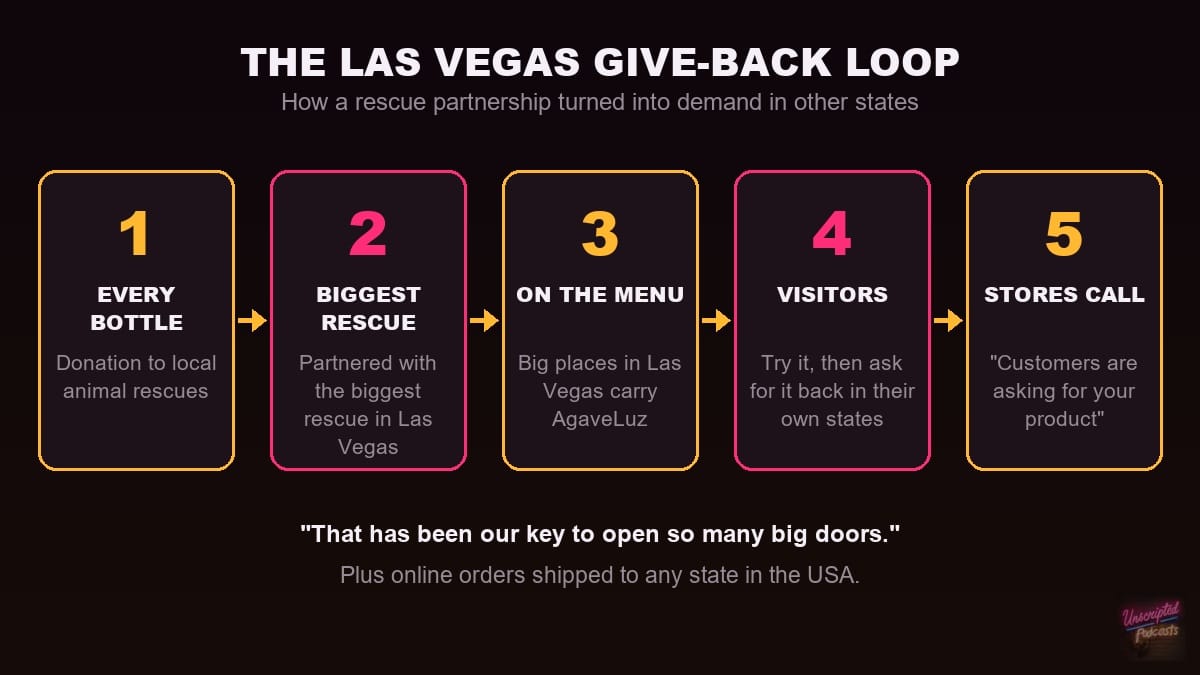
Then the loop closes on its own. Visitors try AgaveLuz on a Las Vegas menu, go home, and look for it in their own states. Stores in those states contact AgaveLuz because customers are asking for the product. Notice what that is: demand showing up at retailers who never saw a campaign.
If you do local SEO, you already know the link side of this. Josh Shankowsky’s SOP for building local links by sponsoring nonprofits covers how a nonprofit partner earns you durable local mentions. Pamela’s version adds the step most link builders skip: pick the biggest partner in one market and go deep there before you spread out.
In-person tastings are proof you can’t fake
Pamela still works events and in-store demos herself, standing in the chain stores that carry AgaveLuz “like a regular demo person.” The moment she likes best is when shoppers find out the person pouring is the founder.
“And they when they find out I’m the founder but I’m introducing my product and and talking about the story and why this is and why is the difference in this. That’s a very, very nice experience.”
For your marketing, every one of those demos is a primary source. It’s a story only her brand can tell, with real people in it. That’s the raw material for a content library no competitor can copy, and you can’t generate it from a prompt.
Seed creators who already care about the cause
AgaveLuz runs its marketing in-house, and its influencer filter is simple. “Specifically influencers that we look as influencers that have a pet,” Pamela said. Some creators reached out first and offered to make a video for free. AgaveLuz sent a bottle and a doggy toy.
“Because people reach out to us for just they they just wanna be part of that.”
Here’s how you could run the same play for a client:
- Filter creators by the cause, not by follower count. Pet owners for a rescue partner, parents for a school program.
- Send the product with something tied to the cause. The doggy toy did more work than a discount code would.
- Track which videos send people to the store locator or the shop page, so you know which creators to send the next box to.
Why this beats publishing more pages
During the interview I said this beats opening a chatbot and publishing a hundred articles on how agave ferments. Pamela’s buyers are telling her the same thing. People told her younger generations are drinking less. She doesn’t buy it:
“I think new generations are making smarter decisions.”
Her one cautionary tale was a brand that spent over fifty million dollars to be everywhere. The money ran out. If your client’s whole strategy is paid reach, you’re in that position on a smaller budget: as soon as the money’s gone, so’s the publicity. The full conversation is on the Unscripted Small Business recap.
So what does your client already care about that has nothing to do with the product? Who’s the biggest partner for that in one city? And when did the founder last stand in a store and hand the product to a stranger?