
How much could an SEO campaign benefit your business? Here’s a specific exploration of potentially how much SEO revenue per month you could add to your bottom line with a successful SEO campaign. Here’s a step-by-step guide if you want to go more in-depth for yourself on predicting your SEO traffic potential.
Examining The SEO Potential for a Nashville Yoga Studio
Looking at the top 10 urls that rank for “Nashville Yoga Studio”, rankings co-occur for 356 overlapping relevant keywords/phrases with 81,210 monthly search volume.
(This is what we do at SEO arcade, get a free report when you sign up)
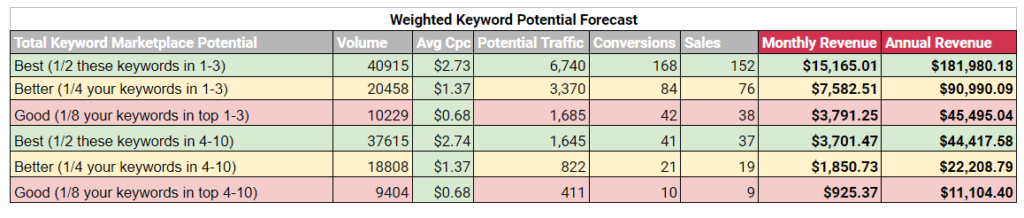
If you had a 2.5% conversion rate, and 80% of those leads signing up for $100 worth of classes, if you got just 1/2 of those keywords in the top 3 rankings you could add $15,165 of revenue to the books.
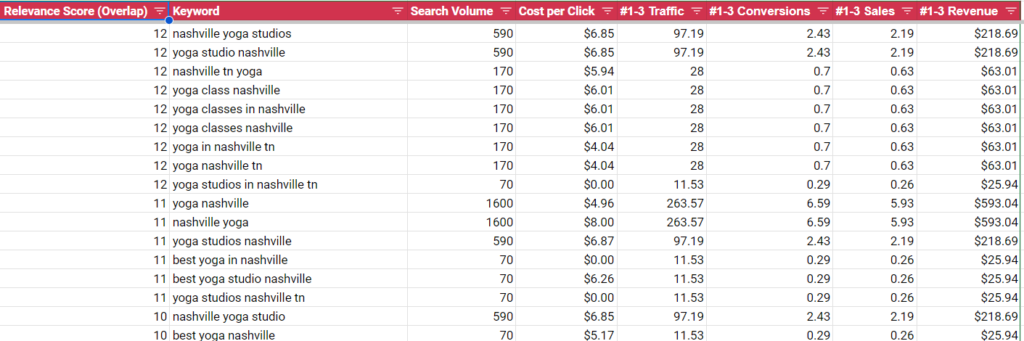
If you’re confident in offering SEO agency services that can get a yoga studio into the top 3 for around $5,000 a month, you could project a potential 300% ROI to that business owner based on just a single month’s income. Of course, SEO isn’t a turn-on/turn-off process, so if you were successful in your campaign to boost those rankings, then you could expect for the most part for that increase in monthly revenue to remain for a long time. The trade-off is that also it isn’t an instant process.
Filtering, Narrowing & Expanding Relevant Keywords
Note on case studies: A detailed review of the initial list of keywords that those top ranking URLs also ranked for include a number of brand phrases, irrelevant terms and non-sequitor results that should be filtered out in a more thorough keyword research process. You also can, with SEO arcade, start with up to 5 different “seed keywords” to capture all of the very different ways people might find your service, for example “Vinyasa yoga, stretching classes etc,”.
Jeremy’s 2026 Refresh: Local SEO ROI Now Lives Below the Traffic Line
When I built this Nashville yoga forecast back in 2023, the math started and ended at rankings: get the keywords into the top 3, multiply by a conversion rate, book the revenue. In 2026 that model still works, but it’s only the opening move. For a local business, the search results page itself has changed shape. AI Overviews now answer “best vinyasa studio near me” before a single blue link gets clicked, and a growing share of “where should I go” research happens inside ChatGPT and Google’s AI Mode. BrightLocal’s 2026 Local Consumer Review Survey found AI tools jumped to the third most-used source for local recommendations — from 6% to 45% in a single year. So the 81,210 monthly searches I sized here are no longer all destined for ten organic results; a chunk of that demand is being intercepted upstream. For a studio, that means your Google Business Profile, your review velocity, and the structured facts on your site (class types, schedule, neighborhood) are now load-bearing parts of the forecast, not afterthoughts.
The bigger correction I’d make to my younger self: stop selling the traffic number and start selling the conversion. A 300% ROI projection built on rankings is fragile if those rankings deliver clicks that never become booked classes. The forecast I’d present today leads with conversions — booked intro packages, filled class slots, lifetime value of a member — and treats rankings and AI citations as the inputs that feed them. That’s the same shift Drew Dorenfest and I dug into on his Unscripted SEO episode on SEO for small businesses: for a local owner, getting cited and getting chosen matter more than a raw position. If you’re sizing this opportunity in 2026, anchor it in revenue, lock down the profile and reviews that earn the AI mention, and treat the keyword volume as your ceiling — not your invoice.