
It’s pretty nifty when you can bring content from other sites and sources into your site, but it’s not just a free ticket! You’ve got some implications for your users and even your SEO to consider!
A Deep Dive into the Technical SEO Aspect of Embeded Content
- Media/Content players and widgets, how do they embed? Where, and the features within their share popups?
- Do you have embedded stores on Facebook, Twitter, Medium, Tumblr for Shopify?
- How do they appear in RSS feeds?
- On which RSS readers? What alt images/links?
- How are those shared directly from the embed?
- Do they provide link options? Embedded would include players/widgets, how they embed, where, and the features within their share popups. Maybe also the content of any feeds for ecommerce, podcasts, blog rss etc “syndicated links”
- You (or even an affiliate or customer) embed a video or dynamic store widget in a blog post using oembed, or pasting the code.
- What happens in the RSS feed?
- What appears in RSS when in a reader?
- What appears in email with RSS > email What happens with the same link on other sites?

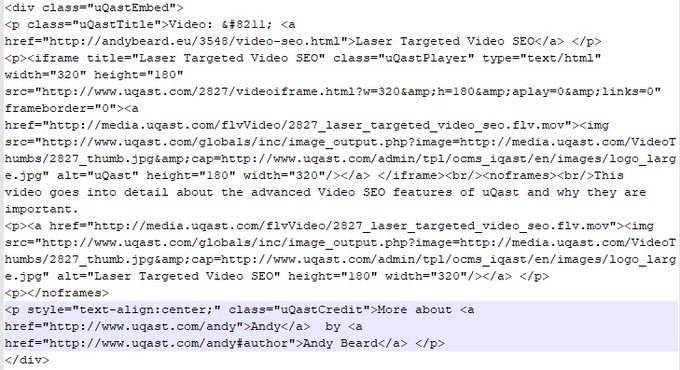
Example of Tricky Embed Code
This is old embed code Before HTML5 was universally supported Youtube had just switched to Iframe embeds Facebook only supported Flash embeds. Twitter cards didn’t exist yet, but the embed code could build links to any site:
Imagine 100 affiliates for a store posting a widget that allows for a transaction directly on their blog page using ShopPay in 1 click.
Do the same on Facebook, Twitter, Medium, Tumblr In RSS/Email there is guaranteed at least a thumb + link, even if iframe blocked.
How is this Technical SEO?
A shop owner might fill in 1 field for where a blog post or landing page announced the new product.
Everything else… code, widget interface, shop interface and affiliate system is all very technical. Systems that build links and sales
Jeremy’s 2026 Refresh: Can AI Crawlers Actually Read Your Embeds?
When I wrote this back in 2023, the worry was mostly about iframes, RSS thumbnails, and whether your embed code leaked a clean link. In 2026 the bigger question is rendering: Googlebot will spin up a headless Chromium instance to render JavaScript and iframes before it indexes a page, but most of the LLM and AI crawlers feeding ChatGPT, Perplexity, and Google’s AI answers do not render at all. They grab the raw HTML and move on. That means anything trapped inside an iframe, an oEmbed widget, or a JS-injected store block is effectively invisible to the models that increasingly decide whether your brand gets cited.
So my rule for 2026 is simple: never let your only copy of an important fact, price, or link live inside an embed. Mirror the substance in plain HTML around the iframe, give every embed a real title attribute and a fallback link, and keep heavy widgets lazy-loaded so they don’t wreck rendering or Core Web Vitals. I dug into exactly this tension between rendered pages and what machines can parse with Bradley Benner on the Unscripted SEO podcast, where we talked through relevance, entity associations, and the future of link building in an AI-first crawl world. Embeds can still build links and sales, but only if the crawler can actually see them.
When you’re embedding content onto your site, it’s not just set and forget!